You’ve spent years building expertise. Whether you’re a software engineer with innovations in AI safety, a biomedical researcher advancing cancer treatments, or an entrepreneur creating American jobs; you’ve earned the right to build your future in the United States on your own terms.
But here’s the frustration: Most employment-based green cards chain you to an employer who controls your immigration destiny. The EB-2 National Interest Waiver (NIW) breaks those chains.
After guiding hundreds of professionals through this process, from Fortune 500 engineers to startup founders; I can tell you that NIW approval isn’t about being “famous” or having a PhD. It’s about understanding how USCIS actually evaluates “national interest” in 2026, and positioning your unique contributions within that framework.
This guide walks you through exactly who qualifies, why some exceptional candidates get denied, and how to build a petition that convinces immigration officers your work truly matters for America.
What Makes the EB-2 NIW Different (And Why It Matters)
Most employment-based immigration requires a job offer and labor certification, a months-long process proving no American worker can do your job. The NIW waives both requirements because your work benefits the United States so significantly that the usual protections for American workers become unnecessary.
The game-changer: You self-petition. No employer sponsorship. No PERM labor certification delays. No risk of losing your green card process if you change jobs.
But this freedom comes with strict qualification standards. USCIS uses the three-prong framework established in Matter of Dhanasar (2016) to determine who gets the waiver.
The Three-Prong Test: Breaking Down EB-2 NIW Requirements
To qualify, you must satisfy all three prongs simultaneously. Missing one means denial, regardless of how impressive your other credentials are.
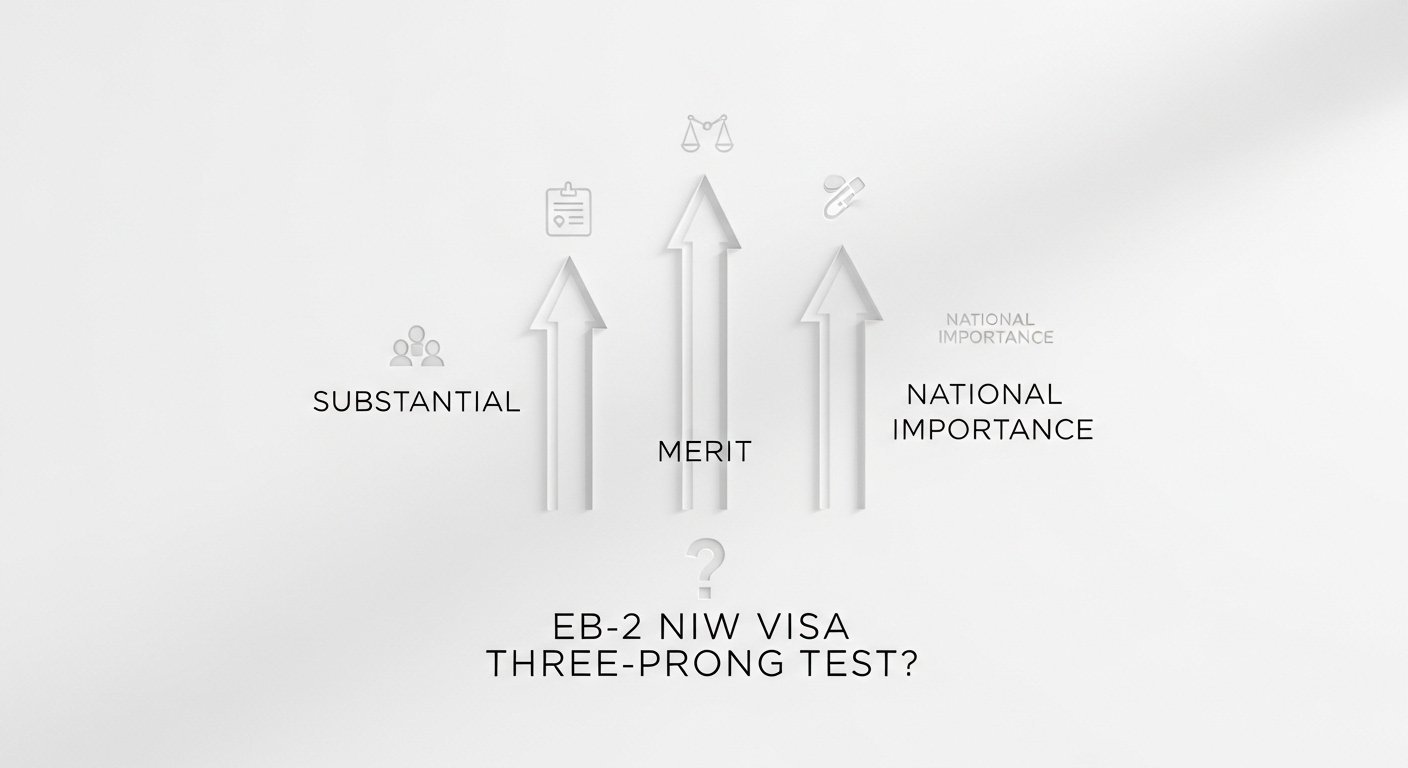
Prong 1: Your Endeavor Has “Substantial Merit and National Importance”
This isn’t about your personal success, it’s about your work’s impact on the United States.
What USCIS actually looks for:
- Field of endeavor: STEM fields, healthcare, education, technology, economic development, and cultural contributions typically qualify, but any field serving national interest works
- Merit vs. Importance: Your work can have substantial merit (valuable) without national importance (broad impact). You need both.
- Geographic scope: “National” doesn’t mean coast-to-coast. Regional impact with national implications counts.
Real-world examples that work:
- The AI Safety Researcher: Developing algorithms that prevent bias in healthcare AI affects patient outcomes nationwide, even if working at a single university.
- The Green Energy Entrepreneur: Creating solar installation methods that reduce costs by 30% impacts national energy independence and climate goals.
- The Rural Healthcare Specialist: Implementing telemedicine protocols that serve underserved agricultural communities addresses the national physician shortage.
Common mistake: Candidates focus on their impressive job title rather than the national problem they solve. A senior software engineer at Google isn’t inherently NIW-worthy; an engineer solving critical infrastructure cybersecurity vulnerabilities is.
Expert tip: Frame your work around U.S. government priorities. Current administration focuses include AI safety, supply chain resilience, pandemic preparedness, clean energy, and semiconductor manufacturing. Aligning your contributions with these areas strengthens Prong 1 significantly.
Prong 2: You’re Well-Positioned to Advance the Endeavor
USCIS must believe you specifically, not just someone like you, will succeed in this work.
Evidence that convinces officers:
- Education and skills: Advanced degrees, specialized certifications, rare technical expertise
- Record of success: Past achievements predicting future impact (publications, patents, implemented projects)
- Progress toward goals: Concrete steps already taken, not just future plans
- External validation: Letters from government agencies, industry leaders, or academic experts confirming your unique positioning
The “well-positioned” nuance: You don’t need to prove you’ll definitely succeed—just that you’re more likely than not to advance the endeavor. Early-career researchers can qualify if they show momentum (strong publication trajectory, prestigious grants, innovative methodologies).
Case study: Dr. Sarah Chen, a postdoctoral researcher in battery technology, had only 8 citations but possessed proprietary electrolyte formulations licensed by a major manufacturer. Her NIW was approved because she demonstrated implementation capability, not just academic interest.
Red flag: Generic recommendation letters stating “Dr. X is brilliant.” Instead, you need specific testimony: “Dr. X’s methodology for X solves Problem Y that our industry has faced for Z years, and her continued work is essential because…”
Prong 3: The Balance Test—Waiving the Job Offer Benefits the U.S.
This is where most self-filed petitions fail. You must prove that the flexibility of not requiring a job offer outweighs the protection of the labor certification process.
Winning arguments:
- Urgency: Your work addresses time-sensitive national needs (e.g., pandemic response, cybersecurity threats)
- Flexibility requirements: Your work requires moving between academia and industry, or collaborating across multiple institutions
- Entrepreneurial necessity: You’re creating a startup that doesn’t exist yet, making a traditional job offer impossible
- Unique constraints: Your research requires specific resources or collaborations that no single employer can provide
Critical distinction: This isn’t about whether you benefit from the waiver. It’s whether the United States benefits from not restricting you to one employer.
Example: A climate scientist developing carbon capture technology needs freedom to partner with various energy companies, government labs, and international consortiums. Restricting her to one employer actually hinders national interest.
Do You Need a PhD? Debunking EB-2 NIW Myths

Myth 1: You need a doctorate.
Reality: While advanced degrees strengthen petitions, exceptional ability candidates (those without degrees but with 5+ years of progressive experience) qualify regularly. We’ve approved NIWs for senior software architects with bachelor’s degrees and serial entrepreneurs without formal education.
Myth 2: You need hundreds of citations.
Reality: Quality over quantity. 20 citations from influential researchers in your field outweigh 200 from irrelevant sources. For non-academic candidates, patents, commercial applications, or media recognition substitute for citations.
Myth 3: You must be famous or win awards.
Reality: Most approved NIW beneficiaries are “working experts” mid-career professionals solving practical problems. Prestigious prizes help but aren’t required. Consistent, documented impact matters more than recognition.
Myth 4: You need a job offer first.
Reality: This misunderstands the “Waiver” concept entirely. The NIW exists precisely to bypass job offers. However, having contracts, letters of intent, or consulting agreements demonstrates Prong 2 (well-positioned status).
The “Advanced Degree” vs. “Exceptional Ability” Pathways
You can qualify under either category, but the evidence differs:

Advanced Degree Professionals
- Master’s degree or higher (or Bachelor’s + 5 years progressive experience)
- Evidence focuses on academic preparation and specialized knowledge
- Strong for: Researchers, engineers, healthcare professionals, educators
Exceptional Ability Candidates
- Degree not required, but must meet 3 of 6 criteria:
- Academic records in field of endeavor
- 10+ years of full-time experience
- Professional license or certification
- Commanding salary demonstrating exceptional ability
- Professional association membership
- Recognition for achievements by peers, government, or professional organizations
Strategic choice: If you have both, file under Advanced Degree but include exceptional ability evidence. This dual approach strengthens Prong 2 by showing both theoretical foundation and practical impact.
Real Approval Profiles: Who Actually Gets Approved?
Profile A: The Tech Innovator
- Background: MS Computer Science, 7 years experience
- Work: Machine learning models for agricultural yield prediction
- Evidence: 2 patents, pilot program with USDA, $2M in VC funding for ag-tech startup
- Key to success: Demonstrated economic impact on American farming sector and food security
Profile B: The Medical Researcher
- Background: PhD Biomedical Engineering, postdoc at NIH-funded lab
- Work: Portable diagnostic devices for rural healthcare
- Evidence: 12 publications, NIH grant, collaboration with HHS, implementation in 3 states
- Key to success: Addressed specific HHS priority (rural health disparities) with tangible deployment
Profile C: The Business Strategist
- Background: MBA, 12 years supply chain management
- Work: Reshoring manufacturing operations for critical medical supplies
- Evidence: Created 150+ American jobs, contracts with Defense Department, media coverage in industry publications
- Key to success: Direct connection to national security (supply chain resilience) and job creation
Profile D: The Creative Professional
- Background: MFA, 8 years documentary filmmaking
- Work: Films addressing veterans’ mental health and suicide prevention
- Evidence: Distribution through PBS, partnership with VA hospitals, congressional screening
- Key to success: Cultural contribution with measurable social impact on veteran populations
Common Denial Reasons (And How to Avoid Them)
1. Vague “National Importance” Claims Mistake: Stating your work is “important to the economy.” Fix: Quantify impact. “My optimization algorithms reduce shipping costs by 15%, directly addressing the $150B U.S. logistics inefficiency cited in the DOT Strategic Plan.”
2. Passive Voice Petitions Mistake: “Research was conducted on…” Fix: Active ownership. “I developed…” USCIS needs to see your specific contribution, not your team’s.
3. Future-Tense Only Descriptions Mistake: “I will develop…” Fix: Show current progress. “I have developed… and am now implementing…” Past success predicts future achievement.
4. Ignoring the “Waiver” Prong Mistake: Focusing entirely on your qualifications without explaining why the job offer requirement should be waived. Fix: Explicitly state: “Restricting Dr. X to a single employer would impede [specific national goal] because…”
5. Weak Recommendation Letters Mistake: Letters from colleagues who describe your personality. Fix: Letters from independent experts (those who haven’t worked directly with you) who can objectively assess your national impact. Government officials and high-level industry leaders carry disproportionate weight.
The EB-2 NIW Application Process: Step-by-Step
Phase 1: Pre-Filing Strategy (2-3 months)
- Credential evaluation: Confirm your degree qualifies or gather exceptional ability evidence
- Impact mapping: Identify the specific U.S. national interest your work serves
- Evidence collection: Gather documentation for all three prongs
- Expert outreach: Secure 4-6 independent recommendation letters
Phase 2: Petition Preparation (1-2 months)
- Form I-140: Immigrant Petition for Alien Worker
- Supporting memorandum: 15-25 page legal argument tying your evidence to the Dhanasar framework
- Exhibit organization: Indexed, tabbed evidence supporting each claim
- Fee payment: $715 filing fee
Phase 3: Processing
- Regular processing: 6-12 months (varies by service center)
- Premium processing: $2,805 additional, 45-day guarantee (now available for NIW as of 2023)
Phase 4: Green Card Application
- Concurrent filing: If your priority date is current (typically for ROW – Rest of World), file I-485 Adjustment of Status simultaneously with I-140
- Consular processing: If outside the U.S., interview at U.S. consulate after I-140 approval
FAQ: EB-2 NIW Qualification Questions
Q: Can I apply for EB-2 NIW while on H-1B or L-1?
Yes. The NIW is a “future job” petition—you don’t need current authorization for the specific work you’ll do. However, maintain your nonimmigrant status carefully; NIW approval doesn’t grant status, just the immigrant visa petition.
Q: How does the “national interest” standard differ from EB-1A “extraordinary ability”?
EB-1A requires proving you’re at the top of your field nationally or internationally. EB-2 NIW requires proving your work benefits the United States significantly. You can be mid-level in your field but still qualify for NIW if your specific project serves national priorities.
Q: Can entrepreneurs qualify for NIW?
Absolutely. In fact, entrepreneurs often have stronger Prong 3 arguments (the waiver benefits the U.S.) because they can’t get traditional job offers for businesses that don’t exist yet. Show your business plan creates American jobs or solves national problems.
Q: What if I’m working for a foreign company remotely?
You can still qualify if your work benefits the U.S. substantially. However, you’ll need to demonstrate intent to continue the work in the United States and how your physical presence serves national interest.
Q: How many publications do I need?
There’s no magic number. Zero publications with strong alternative evidence (patents, commercial applications, government adoption) can succeed. Conversely, 50 publications with no demonstration of impact can fail.
Q: Can I include my family?
Your spouse and unmarried children under 21 receive green cards as derivative beneficiaries when your I-140 is approved and visas are available.
Q: What if my priority date isn’t current?
If you’re from India or China, you may face waiting periods due to per-country caps. Your NIW I-140 can be approved, but you can’t file I-485 until your priority date becomes current. File I-140 early to lock in your priority date.