
Introduction
Germany’s Opportunity Card, also known as the Chancenkarte, is one of the most important pathways for skilled non-EU professionals who want to move to Germany without having a job offer in advance. It was introduced to help Germany attract qualified international talent and make the immigration process more flexible for applicants who have the skills, qualifications, and potential to contribute to the German labour market. The Opportunity Card allows eligible applicants to enter Germany, search for work, attend interviews, and even take up limited part-time work while looking for a long-term role.
What Is the Germany Opportunity Card?
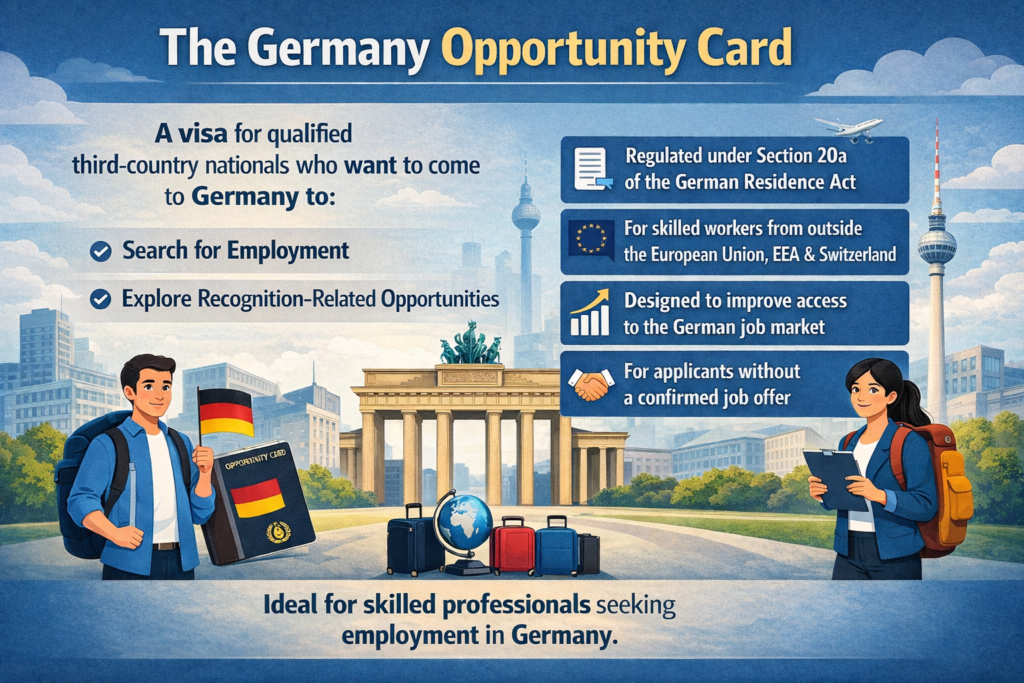
TheGermany Opportunity Card is a one year long Visa for qualified third-country nationals who want to come to Germany to search for employment or explore recognition-related opportunities. It is regulated under Section 20a of the German Residence Act and is designed to improve access to the German job market for skilled workers from outside the European Union, the European Economic Area, and Switzerland. It is particularly useful for applicants who do not yet have a confirmed job offer but have a strong professional profile and want to secure employment after arriving in Germany.
When Did the Opportunity Card Come Into Effect?
The Germany Opportunity Card is not a future proposal or a developing concept anymore. It became part of the final phase of Germany’s updated Skilled Immigration Act, and the relevant Opportunity Card rules came into force on 1 June 2024. That means any article saying the program is not yet available, still under development, or only expected to launch is outdated.
Who Can Apply for the Germany Opportunity Card?
There are two main routes to qualify for the Germany Opportunity Card.
1. Opportunity Card for recognised skilled workers
You may qualify directly if you have a foreign university degree or vocational qualification that is fully recognised in Germany, or if you completed your academic studies or vocational training in Germany. Applicants in this category are treated as recognised skilled workers and do not need to use the points system to qualify.
2. Opportunity Card through the points system
If your qualification is not fully recognised in Germany, you may still qualify through the points-based route. In that case, you must meet the basic eligibility requirements and score at least six points. The basic requirements include having a recognised qualification in the country where it was obtained, meeting the minimum vocational training duration if applicable, having German language skills of at least A1 or English language skills of at least B2, and proving that you can financially support yourself during your stay in Germany.
Germany Opportunity Card Points System Explained
The points system applies only to applicants using the second route. To receive the card through this route, you must score a minimum of six points. Points are awarded on the basis of education, professional experience, language skills, age, prior residence in Germany, and, in some cases, the eligibility of a spouse or life partner.
You can earn points as follows:
- 4 points if your foreign qualification has been found to be partially equivalent in Germany
- 1 point if your qualification is in a shortage occupation
- 2 points if you have at least two years of professional experience within the last five years
- 3 points if you have at least five years of professional experience within the last seven years
- 1 point for German language skills at A2
- 2 points for German language skills at B1
- 3 points for German language skills at B2 or above
- 1 additional point for English at C1 or above, or if you are a native speaker
- 2 points if you are up to the age of 35
- 1 point if you are between 35 and 40
- 1 point if you have legally stayed in Germany for at least six continuous months within the last five years
- 1 point if your spouse or life partner also qualifies for an Opportunity Card
This is why it is inaccurate to say applicants simply need to meet “three out of four conditions.” The actual system is more detailed and must be assessed under the official points criteria.
Financial Requirements for the Opportunity Card
Applicants must show that they can cover their living expenses in Germany during the job-search period. This is usually done through a blocked account or a declaration of commitment. According to current official guidance, the relevant amount for 2026 is €1,091 net per month. In some cases, a part-time employment contract may also be considered when verifying financial means, depending on the salary.
How Long Is the Opportunity Card Valid?
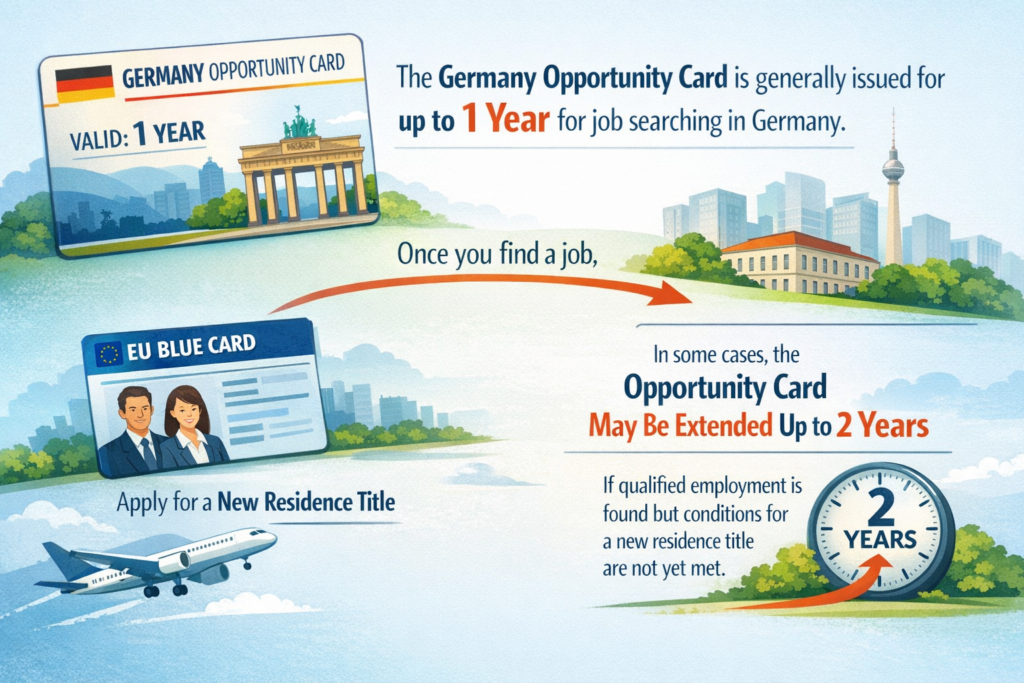
The Germany Opportunity Card is generally issued for a maximum of one year for the purpose of searching for work in Germany. Once you find a suitable job, you can apply for another residence title that matches your employment situation, such as an EU Blue Card or a residence permit for qualified professionals. In certain individual cases, the Opportunity Card may be extended for up to two years if the job is qualified employment but the conditions for another residence title are not yet fully met.
What Can You Do in Germany on an Opportunity Card?
One of the biggest advantages of the Opportunity Card is that it offers more flexibility than older job-search routes. While in Germany, Opportunity Card holders may:
- search for qualified employment,
- work in one or more part-time jobs for up to 20 hours per week in total,
- complete job trials for up to two weeks per employer, and
- switch to another appropriate residence title from within Germany after securing eligible employment.
This makes the Opportunity Card especially attractive for people who want to explore the market directly, attend interviews in person, and build stronger connections with employers in Germany.
How to Apply for the Germany Opportunity Card
If you meet the legal requirements, you can usually apply through the Consular Services Portal of the Federal Foreign Office. If online processing is not available in your country, you should follow the instructions of the responsible German embassy or consulate. The exact document checklist can vary by case, but most applicants should expect to provide:
- a valid passport,
- educational or vocational qualification documents,
- proof of recognition or comparability where required,
- language certificates where required,
- proof of financial means,
- health insurance documentation, and
- completed visa application forms.
Because document rules can vary by location and case type, applicants should always review country-specific instructions before submitting their file.
Opportunity Card vs EU Blue Card vs Work Visa
The Germany Opportunity Card is different from a standard employment visa or EU Blue Card because it is designed for people who do not yet have a job offer. An EU Blue Card is generally for applicants who already have a qualifying job offer that meets salary and legal conditions. A work visa for qualified professionals also usually requires confirmed employment before the application is submitted. In short, the Opportunity Card is a job-search pathway, while the Blue Card and most work visas are employment-based residence routes.
Benefits of the Germany Opportunity Card
The Opportunity Card has several important advantages for skilled applicants:
- It allows you to move to Germany without a prior full-time job offer.
- It gives you time to search for work from inside Germany.
- It allows limited part-time work while you are looking for a permanent role.
- It supports direct contact with employers, interviews, and job trials.
- It creates a practical pathway to long-term employment and residence in Germany.
Limitations of the Germany Opportunity Card
Although the Opportunity Card is highly beneficial, it is not a guaranteed route to settlement by itself. Applicants must still prove eligibility, finances, and qualifications properly. If you do not secure eligible employment, the card does not automatically become a long-term work permit. In addition, spouses generally cannot join the main applicant unless they qualify independently for their own residence title, although children may join under certain conditions if sufficient financial support is available.
FAQs
Is a job offer required for the Germany Opportunity Card?
No. The Opportunity Card is specifically designed for applicants who want to come to Germany without a prior job offer and search for work after arrival.
How many points do I need for the Germany Opportunity Card?
You need at least six points if you are applying through the points-based route. Recognised skilled workers do not need to use the points system.
Can I work in Germany while holding an Opportunity Card?
Yes. You can work in one or more part-time jobs for up to 20 hours per week and may also do trial work for up to two weeks per employer.
What is the financial requirement for the Opportunity Card in 2026?
The current official amount referenced for 2026 is €1,091 net per month, usually shown through a blocked account, qualifying part-time income, or a declaration of commitment.
How long is the Germany Opportunity Card valid?
It is generally issued for up to one year, with possible extension in certain individual cases where conditions are met.