
EB2 NIW, or Employment-Based Second Preference National Interest Waiver, is a strong immigration pathway for professionals, researchers, entrepreneurs, physicians, and other highly skilled applicants who want to obtain permanent residence in the United States. The greatest advantage of this category is that if the applicant can prove that their work is in the national interest of the United States, they may request a waiver of the job offer and labor certification requirement. In this process, Form I-140 plays a central role because it is the petition used to ask USCIS to approve eligibility under the EB-2 NIW category.
According to current USCIS guidance, the agency first determines whether the applicant qualifies for the underlying EB-2 category, and only after that does it evaluate the NIW standard.
Many people think that an NIW petition is simply a matter of gathering documents and mailing them in, but in reality, a successful Form I-140 petition depends on two things: legal strength and clear presentation. A long list of achievements alone is not enough. You must logically show that you qualify under the EB-2 category, that your proposed endeavor is important, that you are in a strong position to advance it, and that waiving the labor certification requirement would be beneficial to the United States. The USCIS Policy Manual applies this same three-part NIW framework.
First, Confirm That You Qualify for the EB-2 Category
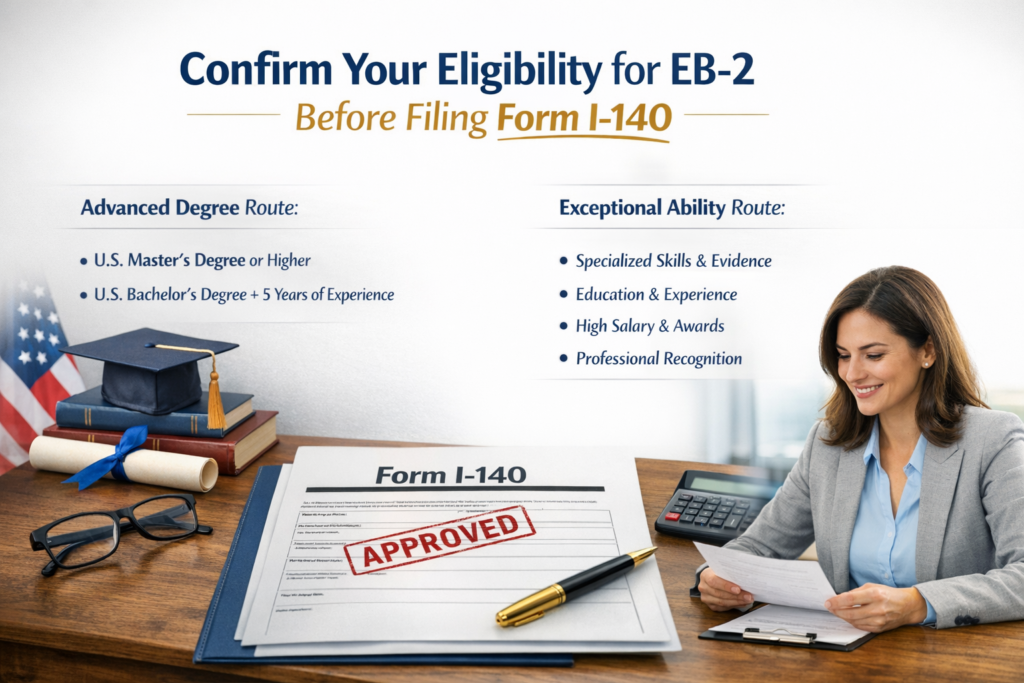
Before starting an NIW petition, the most important step is to confirm that you qualify for the EB-2 classification, since Form I-140 is filed under this category. This classification is generally based on two main routes: as an advanced degree professional or as a person of exceptional ability. According to USCIS, under the advanced degree route, the applicant must have a U.S. master’s degree or higher, or a U.S. bachelor’s degree along with at least five years of progressive post-degree experience. USCIS also makes it clear that if the applicant does not have at least a U.S. bachelor’s degree or its foreign equivalent, they are not eligible for this classification.
If you are filing Form I-140 under the exceptional ability route, generalized claims are not enough. USCIS looks at specific evidentiary criteria, such as education, experience, a license, high salary, professional memberships, or recognition in the field. However, in the final analysis, simply checking boxes is not enough; officers also evaluate the quality of the evidence. That is why a professional Form I-140 petition always clearly establishes EB-2 threshold eligibility first and only then builds the NIW arguments.
Understand the Standard USCIS Uses to Evaluate an NIW Case
The core legal test in an EB2 NIW case, as explained in a Form I-140 petition, is based on three main points. First, your proposed endeavor must have substantial merit and national importance. Second, you must be well positioned to advance that endeavor. Third, on balance, it must be beneficial to the United States to waive the job offer and labor certification requirement. This structure is a central part of the USCIS policy framework, and recommendation letters, publications, projects, business plans, impact evidence, and media coverage included with Form I-140 should all be organized accordingly.
That is why a strong NIW article or Form I-140 petition never simply says that the applicant is talented. It shows that the applicant’s work can have a meaningful impact on the U.S. economy, healthcare, technology, national security, education, public health, or another significant area. The purpose of professional writing is to help the reader understand not just the documents, but also a coherent legal story.
Download the Current Forms and Double-Check the Filing Rules
Before filing Form I-140, always download the latest edition from the official USCIS website. The USCIS Form I-140 page includes filing guidance and online filing information, and fees and instructions may change over time. That is why relying on an old blog post or forum discussion can be risky.
According to current USCIS guidance, an EB-2 NIW self-petitioner should complete the fee-related boxes in Part 1 of Form I-140 correctly to indicate eligibility for the reduced $300 Asylum Program Fee, allowing USCIS to calculate the proper total filing amount of $1,015, which includes the $715 Form I-140 filing fee. USCIS has specifically warned that if the correct fee is not submitted or the relevant fee information is not properly completed, the filing may be rejected. That is why the article should clearly advise readers to verify the official fee page before filing.
If you want to request premium processing, USCIS requires Form I-907. USCIS has also stated that a premium processing request submitted on or after March 1, 2026, with the wrong fee may be rejected (the current fee is $2,965). That is why it is very important to verify the updated fee and current instructions whenever premium processing is mentioned.
Understand the Required Form Set for an EB2 NIW Petition
Although the labor certification requirement is waived in the NIW category, current USCIS guidance states that National Interest Waiver petitions filed through Form I-140 must be accompanied by a completed Form ETA-9089, Appendix A, and a signed Form ETA-9089, Final Determination. USCIS policy guidance also explains that, in NIW requests, petitioners submit the uncertified Final Determination directly to USCIS together with Form I-140. Therefore, it is not correct to present older or outdated form references as if they were the current NIW rule.
This point is very important because many self-prepared applicants and content writers make factual mistakes here. No matter how polished your Form I-140 article looks, if the required form information is wrong, the credibility of the content will suffer.
Do Not Treat the Petition Letter or Cover Letter as a Mere Formality
In a professional EB2 NIW filing, the cover letter should not be just a short introduction. It is better to prepare a substantive petition letter or legal brief that clearly explains the entire case theory to the officer reviewing your Form I-140 petition. This letter should describe the applicant’s background, the proposed endeavor, EB-2 eligibility, the NIW legal standard, and the logical role of each exhibit.
A strong Form I-140 petition letter generally covers the following:
the basis on which the applicant qualifies for EB-2;
what the proposed endeavor exactly is;
why the endeavor has substantial merit and national importance;
what evidence shows that the applicant is well positioned; and
why it is appropriate in the U.S. interest to waive the labor certification requirement.
This is where the difference between a professional writer and an average writer becomes clear. Strong evidence only becomes truly persuasive when it is placed within the right Form I-140 narrative.
Organize Supporting Documents According to Their Legal Relevance
Attaching documents randomly in a Form I-140 petition is a common mistake. Every exhibit should serve a legal purpose. Degrees, transcripts, credential evaluations, and experience letters help establish EB-2 eligibility. Publications, citations, patents, grants, media reports, contracts, project evidence, awards, implementation records, business plans, expert letters, and real-world impact materials may support the core NIW prongs.
If you are relying on the advanced degree route, your degree and record of progressive experience should be completely clear. If you are filing Form I-140 under the exceptional ability route, your evidence should be mapped to the USCIS regulatory criteria. The strongest petitions do not merely list the applicant’s achievements; they show that the applicant’s background is directly connected to the proposed endeavor and its impact in the United States.
Recommended Document Checklist for EB2 NIW I-140 Filing
Below is a professional-level checklist that also adds practical value to the article:
Form I-140, properly completed and signed
Correct filing fee and applicable Asylum Program Fee
Form ETA-9089 Appendix A
Signed Form ETA-9089 Final Determination
Petition letter or legal brief
Table of contents
Exhibit list
Degree certificates and transcripts
Credential evaluation, if the degree is foreign
Experience letters
CV or resume
Recommendation letters
Publications, citations, patents, or research evidence
Awards, memberships, media coverage, or press mentions
Evidence of current work, projects, contracts, grants, or implementation
Proof showing national importance and future impact
Optional Form I-907, if premium processing is requested
This checklist is helpful for self-filers, but it should not be followed blindly. Every case must be customized according to its own facts.
Assemble the Petition in a Logical Order
The purpose of good Form I-140 assembly is not “fancy packaging,” but easy review. The best approach is to arrange the documents in the same logical order in which the officer is likely to review the case. For example:
Suggested Assembly Order
Filing fee and payment documents
Form I-140
ETA-9089 Appendix A
Signed ETA-9089 Final Determination
Petition letter
Table of contents
EB-2 eligibility evidence
NIW prong 1 evidence
NIW prong 2 evidence
NIW prong 3 evidence
Recommendation letters
Additional supporting exhibits
This type of Form I-140 structure makes it easier for the officer to understand the case. Simple divider pages may be used for each major section, but they should not be presented as though they are official requirements. USCIS’s real focus is on correct forms, correct fees, correct filing location, and proper evidence.
Keep the Physical Presentation Neat, but Do Not Overdo It
Clear organization, section markers, and readable formatting are useful. However, a professional Form I-140 article should make it clear that plastic cover sheets, fancy folders, or aggressive tabbing are not official USCIS requirements. They are only optional presentation tools that may improve readability. It is better to keep the Form I-140 petition clean, readable, and properly labeled.
Another important practical point is that original documents are usually unnecessary. USCIS filing guidance and checklists generally emphasize that original documents should only be sent when they are specifically required. Including this advice in a Form I-140 article is both professional and responsible.
Verify the Filing Address on the Official USCIS Page Before Mailing
This is a very important section. The filing address for Form I-140 is not fixed. USCIS’s direct filing address page explains that the filing location may depend on whether the Form I-140 petition is submitted by itself, with Form I-485, or in the context of premium processing. That is why including a static address in the article can be risky. The best practice is to clearly instruct the reader to check the official USCIS direct filing address page immediately before mailing.
Sending a Form I-140 filing to the wrong address may increase the risk of delay or rejection. That is why this section should be strongly emphasized in every professional article.
What to Do After Mailing the Petition
After finalizing the Form I-140 petition, it is very important to keep a complete copy for your records. Use a shipping service that provides tracking and delivery confirmation. Once USCIS receives and accepts the Form I-140 petition, USCIS will typically issue a receipt notice. The applicant can then use that receipt to track case progress. USCIS filing guidance and Form I-140 resources also suggest carefully following filing procedures in order to avoid intake-related problems.
Common Mistakes You Should Avoid
The most common mistakes include:
simply listing achievements without legal analysis;
failing to clearly prove EB-2 eligibility;
keeping the proposed endeavor vague;
making recommendation letters repetitive;
using outdated form information;
submitting the wrong fee;
failing to verify the filing address; and
attaching evidence in a random order.
A strong NIW petition is always clear, focused, evidence-based, and legally structured.
Conclusion
EB2 NIW I-140 filing is a serious legal process, not just a document assembly exercise. For a successful petition, you must first establish EB-2 eligibility and then logically build your case under the NIW standard. According to current USCIS guidance, forms, fees, ETA-9089 requirements, and filing address details must all be carefully verified. When you combine strong evidence with a clear petition letter and a professional structure, your case appears more credible, readable, and persuasive.
If you are filing a self-petition, your goal should not simply be to send documents to USCIS. Your goal should be to make sure the officer truly understands your case — from the first page to the last — in a professional, organized, and legally convincing format.
FAQs
What is EB2 NIW?
EB2 NIW is an employment-based immigrant category in which the applicant requests a waiver of the job offer and labor certification requirement on the basis of national interest. According to current USCIS policy, the applicant must first qualify under the EB-2 category and then satisfy the NIW standard.
Can I self-file Form I-140 for EB2 NIW?
Yes, self-petitioning is possible in the NIW category. That is one of the main reasons why this route is considered highly attractive for researchers, founders, physicians, and independent professionals.
Do I need ETA-9089 for EB2 NIW?
According to current USCIS guidance, NIW petitions must include a completed ETA-9089 Appendix A and a signed ETA-9089 Final Determination.
What is the filing fee for Form I-140?
According to current USCIS guidance, the filing fee for Form I-140 is $715, and an Asylum Program Fee may also apply depending on the filer category. The official USCIS fee page should always be verified before filing.
Where should I mail my EB2 NIW I-140 petition? The filing address for Form I-140 depends on the type of case, such as a standalone filing, concurrent filing with Form I-485, or premium processing. That is why you should always check the official USCIS direct filing address page before mailing the petition