This article focuses on: once a student understands that Lithuania allows graduates to remain for a year after finishing their studies, the next and more important question usually follows immediately: can that route actually lead to permanent residence? In Lithuania, the answer is YES, and this is where the country becomes especially interesting from an immigration strategy perspective.
Permanent Residency In Lithuania: How Post-Study Work Leads to Long-Term Settlement
Many countries let international students stay for a short period after graduation, but far fewer make it genuinely realistic for those students to convert that experience into long-term settlement. Lithuania’s system is notable because it does more than offer a short post-study bridge; it also gives graduates a meaningful advantage when they later pursue permanent residence.
Basic long-term Residence Rules
The basic long-term rule is straightforward. Lithuanian law provides that a foreigner may become eligible for permanent residence after five years of uninterrupted lawful residence in Lithuania, provided the other legal conditions are met. This five-year standard is the foundation of the permanent residence pathway and corresponds to Lithuania’s implementation of long-term residence principles under its immigration framework. On paper, that may sound similar to many other European countries, because “five years” is a common threshold across the region. The real difference lies in how those years are counted and what Lithuania does with the time a person spent in the country as a student.
Read More About REPUBLIC OF LITHUANIA’s LAW
How Student Residence Years Are Counted Toward Permanent Residency In Lithuania
This is the point where Lithuania offers one of its most important advantages. Under the law, residence in Lithuania on a student temporary residence permit is normally counted only at half rate for long-term residence purposes. That would mean, in a standard case, that two years spent as a student might count as only one year toward permanent residence. However, the same legal framework also creates a highly favourable exception: the half-counting rule does not apply to a foreigner who completed studies in Lithuania and obtained a higher education qualification. In practical terms, this means that if the student actually graduates, the student years may count in full rather than being discounted.
That single legal nuance changes the entire settlement picture. In many countries, student years either count partially or do not really help much at all in the race toward permanent settlement. Lithuania, by contrast, effectively rewards successful completion of studies.
A person who comes to Lithuania, studies seriously, earns the degree, and remains in lawful residence can progress toward permanent residence far more quickly than in systems that treat student residence as mostly temporary and disposable. This is one of the strongest reasons why Lithuania deserves attention from students looking not just for education, but for a realistic long-term European future.
Practical Example: How the Timeline Works
Consider the practical effect. A student might spend two years studying in Lithuania, then remain for one year on the post-study residence permit, and then continue for two more years on a work-based residence permit. If the degree was successfully completed, those study years may count fully, which means the person could reach the five-year threshold much sooner than in countries where student residence is discounted. That is not merely a technical legal detail; it is a major settlement advantage. It can literally shorten the road to permanent residence by years.
Other Key Requirements for Permanent Residency In Lithuania
Of course, the five-year residence period is not the only requirement. A person applying for permanent residence in Lithuania must also show that the residence was lawful and continuous. Long absences can disrupt that continuity, which means applicants should be careful about extended periods abroad. The general logic of long-term residence is that Lithuania wants evidence of real and stable integration into the country. That is why lawful and uninterrupted residence matters so much.
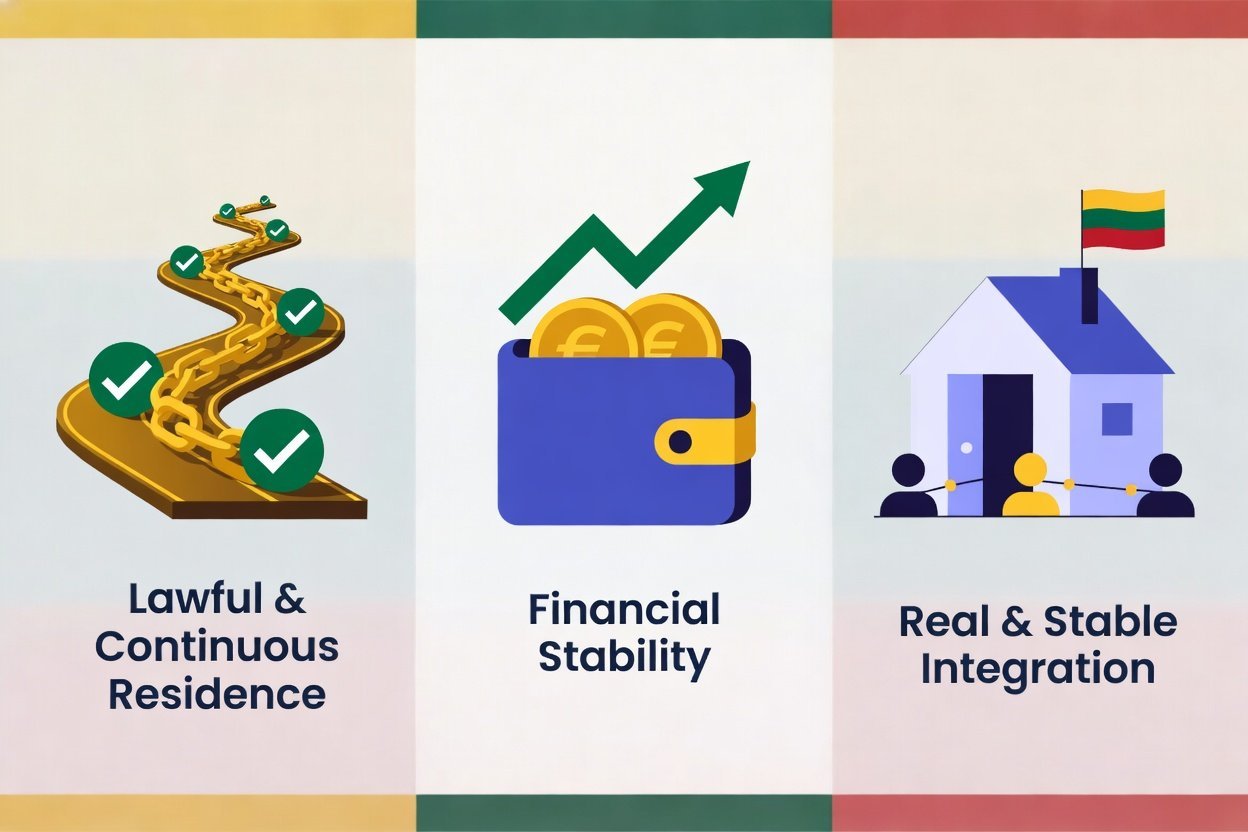
Another important requirement is financial stability. While Lithuania is not known for imposing an especially harsh or inflexible salary threshold for permanent residence in the way some countries do, applicants must still demonstrate sufficient means of subsistence and a stable basis of living in the country.
In practice, a graduate who has followed the normal route into employment will usually be in a much stronger position here, because current employment or another lawful source of support helps show that the person is economically settled rather than dependent on temporary or uncertain arrangements.
There is also an integration requirement, and this is one that applicants should prepare for early rather than late. Lithuanian law requires most permanent residence applicants to pass an examination in the state languageand an examination on the fundamentals of the Constitution of the Republic of Lithuania. In practice, this is commonly discussed as a relatively basic Lithuanian language requirement, often described at around A2 level, together with a civics or constitutional knowledge component.
Compared with the more demanding language thresholds found in some other European countries, this is a comparatively moderate requirement, but it is still important and should not be treated casually. A student who already knows during university that permanent residence may be the long-term goal is wise to begin learning Lithuanian early rather than postponing it until year five.
There are also the standard administrative conditions that appear throughout residence law: the applicant should hold a valid travel document, have the necessary residence documentation, maintain a declared place of residence, and avoid disqualifying immigration or security issues. These are routine in the sense that most long-term residents already satisfy them, but they remain part of the formal process when the permanent residence application is filed through the Migration Department system.
The Complete Settlement Pathway After Graduation
Seen as a whole, the Lithuanian settlement path works best when understood as a gradual progression. The student first resides lawfully in Lithuania for the purpose of studies. After graduation, the graduate uses the one-year post-study residence permit to remain in the country, seek work, and start working if the opportunity arises. Once the graduate has secured stable employment or another valid long-term basis, the person transitions to a work-based temporary residence permit. If lawful residence continues and the integration conditions are eventually met, permanent residence becomes the next major milestone. Each stage builds on the previous one, which is why Lithuania’s approach feels more coherent than systems where each immigration category exists in isolation.
How Lithuania Compares with Other European Countries
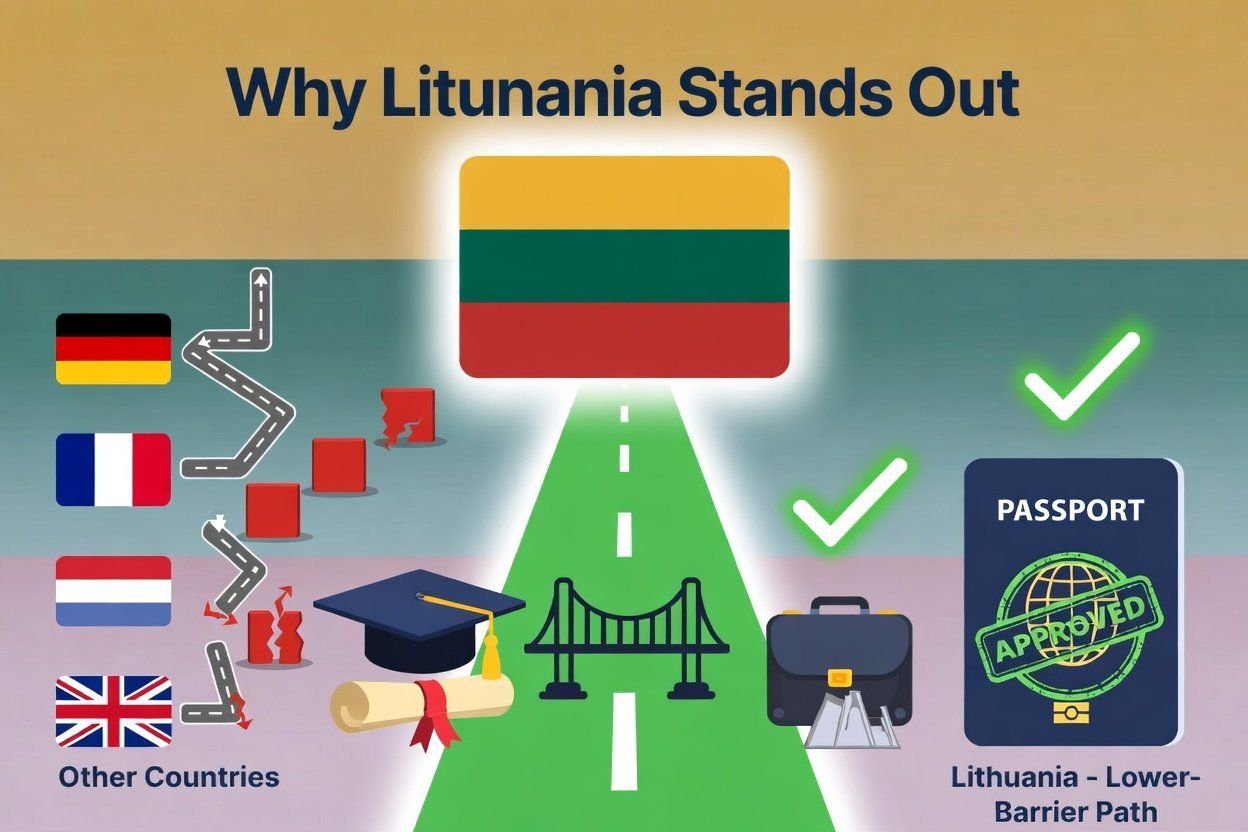
This is also the point where comparison with other countries becomes useful.
Germany
Germany, for example, is often seen as very attractive for international graduates because it offers an 18-month job-seeking period after graduation. That is longer than Lithuania’s one-year post-study permit. However, Germany generally counts student residence only at half rate toward permanent settlement, and its permanent residence route often involves stronger language demands and a contribution-based employment history. In simple terms, Germany may offer a longer initial post-study window, but Lithuania can be easier when the actual goal is to reach permanent residence faster and with less weight placed on higher-level language integration.
Austria
Austria presents a similar pattern. It allows graduates to remain and transition into work, but the settlement framework is less forgiving when it comes to counting student years, and language and integration requirements are generally more demanding.
Netherlands
The Netherlands is more competitive in this respect because it also has a well-known graduate orientation year, but Lithuania still compares well due to its favourable treatment of completed study years and its comparatively flexible work rules during study.
France
France offers opportunities too, especially for graduates at higher qualification levels, but the route from student status to long-term residence can be more bureaucratic and less transparent in practice.
United Kingdom
The United Kingdom is perhaps the clearest contrast. On the surface, the UK looks generous because it offers a two-year Graduate visa after completion of a bachelor’s or master’s degree. But the critical drawback is that the Graduate visa does not count toward the ordinary settlement route. A graduate generally must switch into a qualifying work visa and then begin a fresh five-year clock for indefinite leave to remain. Lithuania’s post-study period is shorter, but it is more strategically useful because it fits into a broader settlement structure in which the earlier residence history can matter. If the end goal is long-term residence rather than just a temporary extension after university, Lithuania may actually be the more settlement-friendly system.
Conclusion of Comparison
That is why Lithuania stands out despite being a smaller and less globally marketed destination than Germany, France, the Netherlands, or the UK. It offers a more coherent story for the international graduate who wants to stay. Students can work under relatively favourable conditions, remain in the country after graduation, move into employment with reduced bureaucracy, and then count their years in a way that genuinely supports permanent residence. Lithuania is not necessarily the biggest labour market, but in pure immigration-structure terms, it often offers a lower-barrier path from classroom to long-term settlement than more famous destinations do.
Final Thoughts: Can International Students Get Permanent Residency In Lithuania After Studies?
So, can international students get permanent residency in Lithuania after study? Yes, they can and the reason the answer is stronger in Lithuania than in many competitor countries is because Lithuania does not waste the student years of someone who actually completes a Lithuanian degree. That is the key legal advantage. For a serious student thinking about staying in Europe after graduation, this makes Lithuania not only an education destination, but also a realistic long-term residence destination.
Full Guide Of Study In Lithuania
FAQs About Permanent Residency In Lithuania After Study
Can international students get Permanent Residency In Lithuania after studies?
Yes. Lithuania allows graduates to stay for 1 year after graduation, and this period can lead to Permanent Residency In Lithuania if you meet the 5-year lawful residence requirement.
How many years do I need to live in Lithuania for Permanent Residency?
You need 5 years of uninterrupted lawful residence. The big advantage is that if you complete your studies in Lithuania, your student years count in full (not at half rate).
What is the post-study work permit in Lithuania?
After graduation, you can get a 1-year temporary residence permit to look for work and settle in Lithuania. This permit is part of the pathway to Permanent Residency In Lithuania.
What are the main requirements for Permanent Residency In Lithuania?
• 5 years of continuous lawful residence
• Lawful and uninterrupted stay
• Sufficient financial means
• Basic Lithuanian language (A2 level) + Constitution exam
• No security or immigration issues
Is Permanent Residency In Lithuania easier than in Germany or the UK?
Yes, in many ways. Lithuania counts completed study years in full, has simpler language requirements, and offers a more straightforward path from student → post-study → work → PR compared to Germany (half-counting), UK (fresh 5-year clock), or other countries.