Introduction
Germany work visa continues to be one of the most attractive destinations in Europe for skilled foreign professionals. With strong demand in sectors such as IT, engineering, healthcare, research and technical trades, the country offers several legal pathways for qualified non-EU workers to build a long-term future there. These pathways include the work visa for qualified professionals, the EU Blue Card, the visa for professionally experienced workers and the Opportunity Card.
For many applicants, the biggest mistake is assuming that a job offer alone is enough. In reality, visa success depends on choosing the correct immigration route, proving the right qualifications, meeting salary or recognition requirements where applicable, and submitting a complete application. Germany’s system is opportunity-rich, but it is also document-sensitive.
What is a Germany work visa?
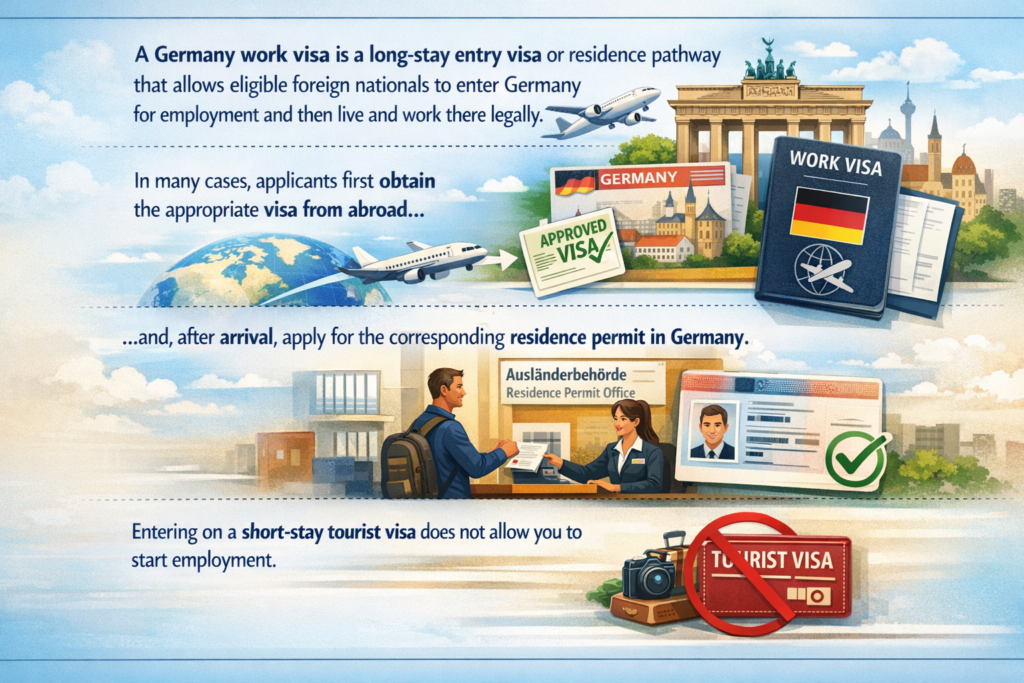
A Germany work visa is a long-stay entry visa or residence pathway that allows eligible foreign nationals to enter Germany for employment and then live and work there legally. In many cases, applicants first obtain the appropriate visa from abroad and, after arrival, apply for the corresponding residence permit in Germany. Entering on a short-stay tourist visa does not allow you to start employment.
Who needs a Germany work visa?
Most non-EU nationals need a visa or residence permit to work in Germany. Citizens of the EU, EEA and Switzerland do not need a work visa. Some countries such as the United States, the United Kingdom, Canada, Australia, Israel, Japan, New Zealand and South Korea benefit from more flexible entry rules and can often apply for the appropriate residence permit after arrival, but this does not apply to most applicants worldwide.
Main types of Germany work visa in 2026
Germany work visa does not operate a single one-size-fits-all work visa. Instead, it offers multiple routes depending on your qualification level, job offer, salary and professional background.
1. Work visa for qualified professionals
This is the standard route for applicants who have a recognised academic degree or recognised vocational qualification and a specific job offer in Germany. The job must be a qualified position. For regulated professions, such as many healthcare roles, a licence to practise may also be required. As a rule, the Federal Employment Agency checks whether the salary and working conditions are comparable to those of domestic workers.
If you are over 45 and coming to Germany for employment for the first time, the position must generally offer a gross annual salary of at least €55,770 in 2026, unless you can prove adequate pension provision. Residence permits under this route are issued for up to four years, or for the duration of the contract plus three months if the contract is shorter. Under certain conditions, settlement may become possible after three years of employment-based residence.
2. EU Blue Card Germany
The EU Blue Card is one of the most attractive options for highly qualified professionals because it offers strong career mobility and a faster route to permanent residence. In 2026, the regular minimum salary threshold is €50,700 gross annually. For shortage occupations, the lower threshold is €45,934.20, subject to approval where required.
The official shortage list includes a broader range of professions such as ICT managers, STEM professionals, doctors, dentists, pharmacists, nursing professionals, teachers and educators. In addition, new entrants to the labour market and some IT specialists without a formal degree may qualify under the lower threshold if they meet the official conditions.
The Blue Card also offers a faster path to permanent residence: holders may obtain a settlement permit after 27 months with A1 German or after 21 months with B1 German.
3. Visa for professionally experienced workers
This route is useful for applicants who have solid practical experience and want to work in Germany work visa even if full formal recognition is not available in the same way as under the classic skilled worker route. It is especially relevant for non-regulated professions and certain professional profiles where practical competence carries strong weight. Germany’s official skilled immigration framework has expanded options for experienced workers in recent years.
4. Opportunity Card Germany
The Opportunity Card is designed for skilled foreign nationals who want to come to Germany work visa to search for qualified employment. It is not the same as a full long-term employment permit from day one. There are two routes to qualify: either you already have a qualification fully recognised in Germany, or you qualify through the points system. Under the points route, you must score at least six points and also meet language and financial requirements.
For 2026, applicants generally need to prove sufficient financial means, such as a blocked account showing at least €1,091 net per month. Under the points route, you need at least German A1 or English B2. The points system takes into account qualifications, professional experience, language skills, age and previous stays in Germany.
5. Research and specialised employment routes
Germany also offers dedicated pathways for researchers and other specialist categories. These can be suitable for scientists, academics and applicants working with recognised institutions. The right route depends on the exact purpose of stay, host institution and contract structure.
Germany work visa requirements
The Germany work visa exact requirements vary by visa category, but most applicants will need the following:
Valid job offer
For standard skilled worker and Blue Card routes, you usually need a specific job offer from a German employer. The job should be qualified and, in many cases, consistent with the purpose of the residence title.
Recognised qualifications
Your academic or vocational qualification may need to be recognised in Germany or considered comparable to a German qualification. In regulated professions, recognition alone may not be enough; you may also need a licence to practise.
Salary threshold
Some pathways, especially the EU Blue Card, depend on meeting specific salary thresholds. These thresholds are updated periodically, so applicants should always verify the current figure before applying. In 2026, the key Blue Card salary benchmarks are €50,700 and €45,934.20 depending on the occupation and applicant category.
Language skills
German language ability is not mandatory for every visa route, but it can be decisive for certain professions and highly useful in practice. For the Opportunity Card points route, at least A1 German or B2 English is required. For naturalisation later on, B1 German is part of the standard eligibility criteria.
Financial means and documentation
Applicants may need to prove that they can support themselves, especially in routes such as the Opportunity Card. A complete application also usually includes a valid passport, visa forms, photographs, employer documents, qualification evidence, proof of accommodation or address planning, and health insurance depending on the stage of the process.
How to apply for a Germany work visa
The Germany work visa application process usually follows these steps:
Step 1: Choose the correct visa route
Before preparing documents, confirm whether you are applying under the skilled worker route, EU Blue Card, Opportunity Card or another category. Applying under the wrong route is one of the most common reasons for delay.
Step 2: Check qualification recognition
If your route requires recognised qualifications, complete that step early. For regulated professions, check whether you also need a licence to practise.
Step 3: Secure your job offer
For employment-based routes, obtain a written job offer or signed employment contract from a German employer.
Step 4: Prepare documents
Gather all supporting documents carefully. Missing or inconsistent records often cause avoidable delays.
Step 5: Submit your visa application
Germany offers online application options for some visa categories via the official Consular Services Portal, while many applicants still apply through the German embassy or consulate responsible for their region.
Step 6: Travel to Germany and apply for residence permit if required
Once you arrive, you must use the visa for its correct purpose and apply to the local foreigners authority in time if you need to convert it into a residence permit.
Can employers fast-track the process?
Yes. Germany provides a fast-track procedure for skilled workers in certain cases. This allows employers to work in coordination with the competent authorities to streamline parts of the process before the visa stage. It does not guarantee approval, but it can help reduce delays when handled properly.
Permanent residence in Germany
One of the biggest advantages of working in Germany legally is the possibility of long-term settlement. Under the standard work visa for qualified professionals, settlement may become possible after three years under certain conditions. For EU Blue Card holders, the route is faster at 27 months with A1 German or 21 months with B1 German.
German citizenship after a work visa
For many skilled workers, the long-term goal is not only employment but permanent integration. According to BAMF, naturalisation is generally possible after five years of habitual and lawful residence, and after three years in cases of special integration achievement. Standard conditions include financial self-sufficiency, a residence status capable of leading to permanent residence, B1 German, and knowledge of German legal and social life.
Common mistakes applicants should avoid
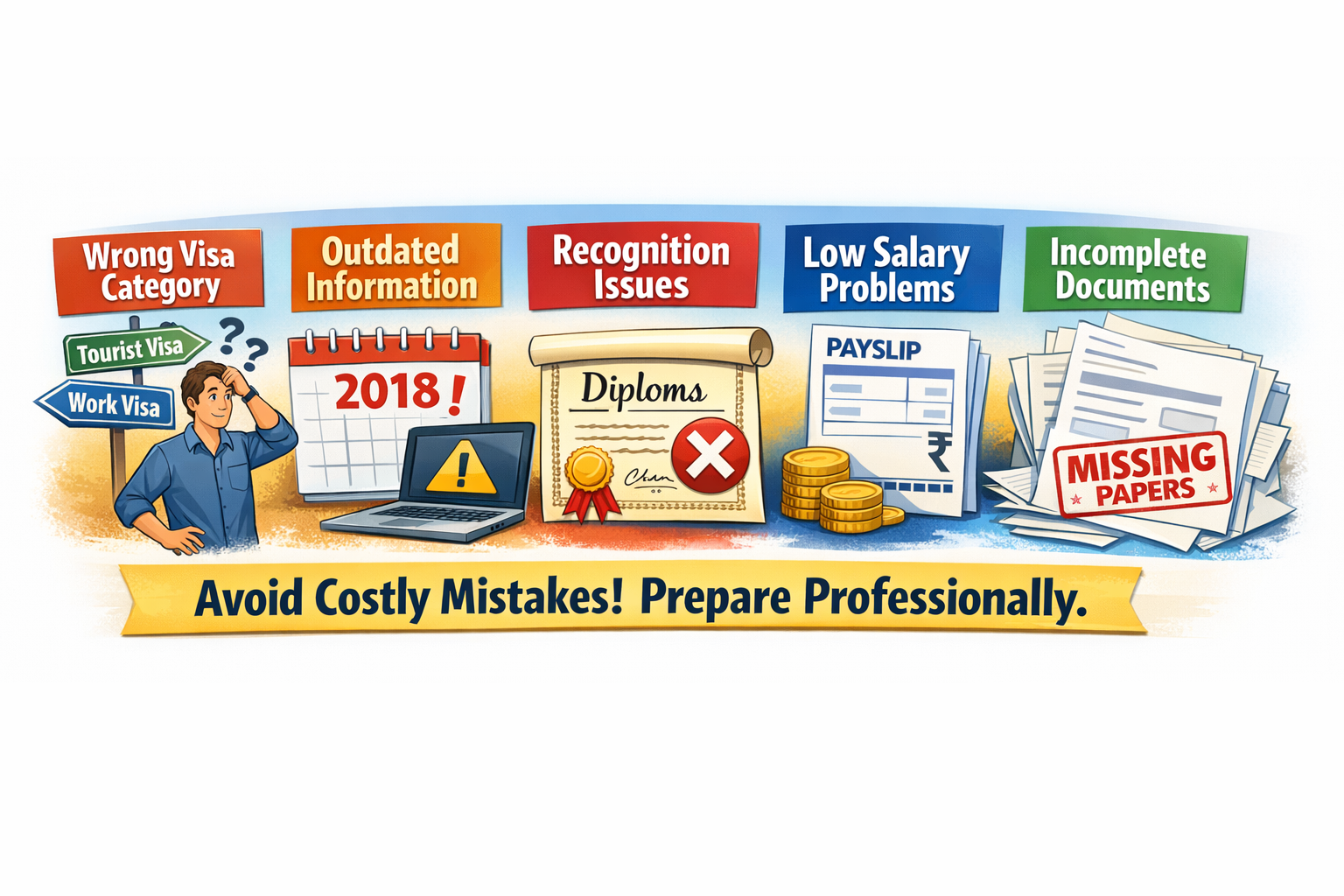
Many otherwise strong applicants face delays because they make avoidable mistakes. The most common problems include choosing the wrong visa category, relying on outdated information, misunderstanding recognition requirements, ignoring salary thresholds, and submitting incomplete documents. Professional preparation can significantly improve both speed and approval confidence. This is one of the main weaknesses in your original draft, which repeated visa ideas but did not separate the legal routes sharply enough for a serious reader.
Final verdict
Germany remains one of the strongest destinations for skilled migration in 2026, but success depends on choosing the correct legal pathway. A qualified engineer, IT professional, healthcare worker, researcher or technician may all be eligible to work in Germany, but not necessarily under the same route. The strongest strategy is to match your qualifications, salary profile and long-term goals to the most suitable visa category from the start.
If you want to work in Germany successfully, focus on four things first: the right visa route, recognised qualifications, complete documentation and a realistic long-term immigration plan. Done correctly, a Germany work visa can become the first step toward permanent residence and citizenship.
Is it easy to get a Germany work visa?
It depends on your qualifications, job offer, visa category and documentation. Applicants with recognised qualifications and a proper employment offer usually have stronger chances than applicants with incomplete or mismatched applications.
What is the minimum salary for the EU Blue Card in Germany in 2026?
In 2026, the regular minimum salary threshold is €50,700 and the lower threshold for shortage occupations is €45,934.20, subject to the official conditions.
Can I move to Germany without a job offer?
Yes, in some cases. The Opportunity Card allows eligible applicants to come to Germany to search for qualified employment, subject to the official points, language and financial requirements.
How long does it take to get permanent residence in Germany?
It depends on your route. For many qualified workers, settlement may be possible after three years, while EU Blue Card holders may qualify after 27 months with A1 German or 21 months with B1 German.
Can I get German citizenship after working in Germany?
Yes. BAMF states that naturalisation is generally possible after five years of lawful habitual residence, or after three years in special integration cases, provided all legal conditions are met.