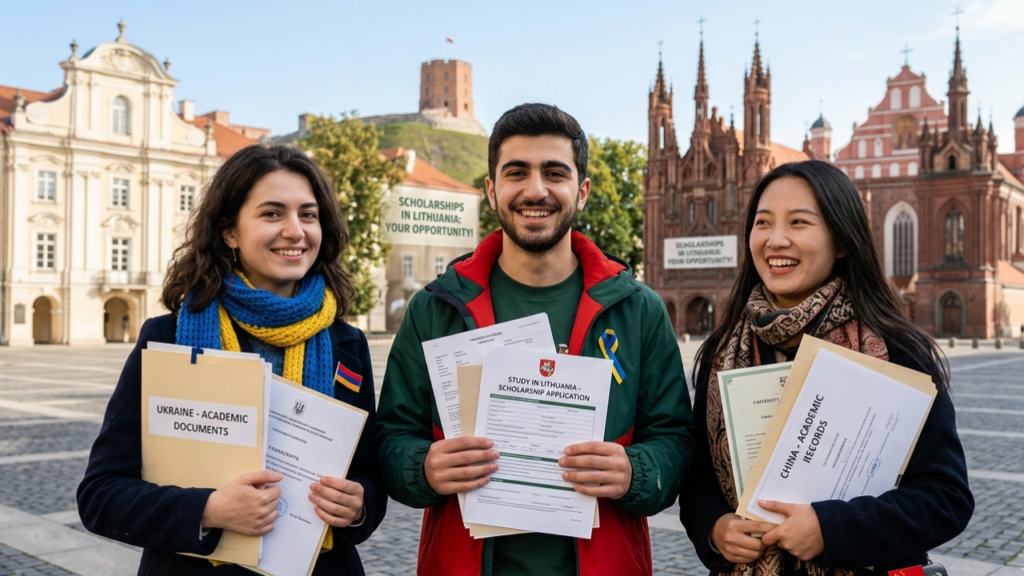
Studying in Lithuania can be made more affordable through various government-funded scholarships aimed at attracting international talent. Unlike university-specific scholarships or EU’s Erasmus+ exchanges, here we focus on national scholarship programs funded by the Lithuanian government or related agencies.

If you are a non-EU student looking for an opportunity to study in Lithuania, the Lithuanian State Scholarship could be the perfect fit. Offered at the Master’s and PhD levels, this prestigious scholarship provides a monthly stipend of €592 and covers tuition fees, allowing you to focus on your studies without financial worries.
These scholarships are primarily targeted at non-EU students and researchers, and many are available in specific fields, as determined by national education priorities. Below is an expert overview of the main Lithuanian State scholarship opportunities, including eligibility by country, benefits (stipend, tuition coverage), and how to apply.
A Comprehensive Guide About Study In Lithuania
Lithuanian State Scholarships for Full-Time Master’s Studies
One flagship initiative is the Lithuanian State Scholarships for full-time Master’s degree studies. Each year (subject to budget approval), the Education Exchanges Support Foundation announces a call for a set number of scholarships for international students enrolling in Lithuanian universities for Master’s or integrated (long-cycle) studies. These Lithuanian state scholarships are only available to citizens of selected countries.
As of the 2025-2026 call, eligible countries included a mix of Eastern Europe, Asia, and the Americas, for example: Armenia, Azerbaijan, Georgia, Ukraine, Moldova, China (PRC and Taiwan), Japan, Israel, South Korea, Indonesia, Vietnam, Uzbekistan, Kazakhstan, the United States, New Zealand, and a few others. In addition, a small quota is reserved for foreigners of Lithuanian origin (the diaspora) from non-EU countries. Students from EU/EEA are generally not eligible for this particular scheme, since other support exists for them.
For the 2026 academic year, Lithuania offered 70 such grants in total, divided among the countries (with up to 10 awards per country, although notably 20 were allocated specifically to Ukrainian citizens given special support, and 5 set aside for diaspora applicants). This gives a sense of scale – it’s competitive, but not impossible if you are from one of the eligible countries.
What the scholarship covers: If you are awarded this scholarship, you receive two main benefits: –
- Monthly Stipend: “A monthly scholarship is set to 8 Basic Social Amounts (BSA)”, which in 2026 equals €592 per month. (The Basic Social Amount is a Lithuanian benchmark that was €74, and 8× that is €592.) This stipend is meant to cover living expenses. It is paid to you (usually through the host university or foundation) throughout the academic year.
- Tuition Fee Grant: The Lithuanian State scholarship also includes a tuition coverage grant. It will pay for your tuition up to the standard study cost set by the Ministry of Education. Each study program in Lithuania has a nominal “standard cost” (which is often similar to the base tuition fee for Lithuanian students).
The scholarship will cover tuition up to that amount. In practice, for many programs this means full tuition is covered. If you choose a program with an unusually high tuition (above the standard), you might have to cover the difference, but most often the grant suffices to waive your whole tuition fee. The tuition money doesn’t go to you; it is transferred directly to the university on your behalf.
Note: There is no separate travel allowance or family allowance; it’s mainly the stipend and tuition. Also, the stipend and tuition can’t be combined with other scholarships or exchange program funding – you cannot “double dip” funding sources for the same costs.
Duration: These Lithuanian State scholarships typically cover the full duration of a Master’s program (usually 1.5 to 2 years, depending on the course) or the last two years of an integrated study program (for fields like medicine or law that combine bachelor+master). You must maintain good academic standing to continue receiving the stipend each month. Continuation may also require periodic progress reports.
How to apply: Calls are usually announced in the first quarter of the year (for studies starting in the fall semester). For example, the 2026 call was opened in late February 2026. The application process is done online through a dedicated system or the Study in LT portal. You will need to submit:
- Proof of eligibility (e.g., passport to show your nationality).
- Academic transcripts and diplomas from your previous studies.
- An admission letter or proof that you have applied to a Lithuanian university Master’s program. (Some calls require you to already have an acceptance letter; others allow you to apply for the scholarship while you’re applying to universities, and then you confirm enrollment later. Check the specific call guidelines.)
- A motivation letter, CV, and possibly recommendation letters.
Note: You do not apply through the university; instead, you apply to the Foundation or Ministry via the official online form (often on studyin.lt or apply.scholarships.lt). The deadline is typically around April or May of each year for studies beginning in September. (For instance, a previous call had a deadline of April 5 for short-term grants, and Masters Calls tend to be in spring as well.)
After the deadline, applications are evaluated based on academic merit, motivation, and alignment with any priority fields. Results are usually announced by early summer, giving you time to arrange visas and travel.
Example: A student from Indonesia who gets admission to Vilnius University’s Master’s program in Informatics could apply for this Lithuanian state scholarship. If selected, they would receive €592/month and tuition coverage (say the program costs €5,000/year, the scholarship would pay that). This substantially reduces the financial burden and is a prestigious award to list on your CV as well. According to the 2026 call, Indonesia is indeed one of the eligible countries.
Scholarships for Short-Term Studies and Exchanges
In addition to full-degree scholarships, Lithuania also offers short-term study scholarships for non-EU students who want to spend 1 or 2 semesters in Lithuania. These are often used for exchange students, visiting scholars, or those taking Lithuanian language and culture courses. The program’s aim is to promote academic exchange and Lithuanian higher education globally.

Eligible countries: The spectrum of countries for short-term scholarships is very broad, covering several regional groups:
- Eastern Partnership countries: Armenia, Azerbaijan, Belarus, Georgia, Moldova, and Ukraine.
- ASEM countries (Asia-Europe Meeting partners): This includes much of Asia and some Pacific nations, for example Australia, Bangladesh, China, India, Indonesia, Japan, South Korea, Kazakhstan, Thailand, Vietnam, and many others, as well as Russia. Essentially, a large list of Asian countries plus Australia/New Zealand.
- Lithuania’s priority export markets (for internationalization): This category includes many EU and Western countries like Germany, France, Sweden, Norway, Finland, UK, USA, Canada, and neighboring Latvia, Estonia, Poland, etc.
In summary, for short-term studies, almost all regions are covered – Europe, Asia, North America, etc. For example, a student from Canada or Australia could get a one-semester scholarship, even though those countries wouldn’t be eligible for the full Master’s scholarships. These reflect diplomatic and educational exchange priorities.
What’s included: The short-term scholarship provides:
A monthly scholarship stipend, which differs by student level:
- Approx. €390 per month for undergraduate (Bachelor) or graduate (Master’s) level students.
- Up to €468 per month for doctoral (PhD) level students or medical residents on exchange.
These amounts are approximate and can vary slightly depending on the exact number of days in the month, since the calculation is daily (so February’s payout is a bit less than a 31-day month). The stipend is intended to cover living expenses during your stay.
- Tuition waiver for the study period: The Lithuanian state covers your tuition fees at the host institution for the agreed period. This is paid directly to the university. There is a cap defined by the normative cost, but since this is a short exchange, it usually covers the agreed courses or program module fee fully.
- Not covered: Travel costs, accommodation, and other ancillary fees. You have to pay your own airfare to Lithuania and find housing (some universities offer dormitories which you’d pay from your stipend). Also, things like student union fees or library fees are on you. The stipend is meant to help with living costs, but you may need some savings especially initially.
- No additional family allowance (these short-term grants are generally for the individual student only, and family members, if any, would not be funded).
How to apply: These scholarships are usually applied for through an online system (previously apply.scholarships.lt). Key requirements:
- You must be currently enrolled in a higher education institution in your home country (or another eligible country) and get a preliminary acceptance or invitation from a Lithuanian university for the short-term study program. Commonly, you’ll fill a “Conditional Agreement for Studies” form that is signed by you, your home university, and the Lithuanian host university. This form outlines what courses or research you will do during the exchange.
- Language proficiency (typically English at B2 level or higher, unless you’re going to study in Lithuanian). You might need to show proof of English proficiency unless the exchange is in Lithuanian and you speak it.
- Submit the online application with your personal info, the study agreement form, transcripts, CV, and motivation letter. For example, the deadline has historically been around early April for studies starting in the fall semester. The process is competitive but not as intense as full-degree scholarships; around 30 scholarships might be offered per semester.
- A selection committee reviews and winners are announced maybe a month or two after the deadline, giving time to arrange visas.
This short-term scheme is great if you want a taste of Lithuanian education or to do a semester of research. For instance, a Master’s student from India could come to Kaunas University of Technology for one semester under this program and receive up to €390/month and free tuition for that semester.
Scholarships for Doctoral (PhD) Students and Researchers
For PhD students, the landscape is a bit different. There isn’t a specific state stipend program that you apply to in the same way as the Master’s scholarships – instead, funding for PhD students is often built into the doctoral admissions. Many doctoral positions at Lithuanian universities for both Lithuanian and international students are state-funded positions. If you secure such a position, you are entitled to a monthly doctoral scholarship from the state for the duration of your studies.
As of recent data, all full-time doctoral students in state-funded slots receive:
- €760 per month in the first year of PhD (which is equivalent to 19 Basic Social Benefits).
- €880 per month in years 2-4 of PhD (22 Basic Social Benefits).
These amounts (approximately €760/€880) are paid by the university or research council to the doctoral candidate as a living stipend. They are intended to cover living expenses so PhD students can focus on research. Note that to get this, you must be admitted as a funded PhD candidate (if you are admitted on a “tuition-paying” basis, you wouldn’t receive this stipend and would pay fees instead).
Many universities in Lithuania do not charge tuition for PhDs at all; instead, they provide this stipend to every accepted PhD student, including foreigners, as long as funding lines are available. The key is that admission is competitive.
Additional opportunities for PhDs and researchers:
- Lithuania, through the Research Council or other bodies, occasionally offers post-doctoral fellowships or grants that foreign researchers can compete for, often within specific fields or EU-funded programs (like Horizon Europe Marie Skłodowska-Curie Actions, which some Lithuanian institutions host).

- There are Lithuanian Foundation scholarships and other private/endowment funds (particularly for those of Lithuanian descent abroad), but those are outside government and often targeted to diaspora.
- For PhD mobility, the earlier mentioned short-term scholarship (€468/month) can support an exchange or research visit for a PhD student from abroad to Lithuania for a few months. Conversely, Lithuanian institutions may host foreign PhDs on joint projects with funding from Erasmus+ or bilateral programs (though the question specifically steers away from Erasmus, it’s worth noting these exist too).
In summary, if you aim to do a full PhD in Lithuania, your main “scholarship” route is to gain admission into a funded PhD position, which then grants you a monthly stipend by default. If you are already a PhD student elsewhere and want to come to Lithuania temporarily, the short-term scholarship or bilateral exchange grants are the way.
Other Notable Scholarship Programs
A couple of other scholarship options to be aware of:
- Lithuanian Language and Culture Courses: The government provides scholarships for summer Lithuanian language courses for foreigners interested in learning the language. These are often short (2-4 weeks) and cover the course fee and sometimes accommodation. Eligible countries lists are similar (many abroad), and they are often targeted at students, teachers, or researchers in Lithuanian studies abroad.
- Scholarships for Lithuanian Diaspora: If you have Lithuanian State Scholarships heritage (and are a non-EU citizen), there are specific scholarship opportunities. For example, in the state Master’s scholarships mentioned, a quota was reserved for foreign citizens of Lithuanian origin. Additionally, organizations like the Lithuanian Foundation (USA-based) give scholarships to students of Lithuanian descent studying anywhere, including Lithuania.
- Development Cooperation Scholarships: Occasionally, Lithuania provides scholarships as part of development aid or cooperation with certain countries (for instance, there have been special scholarships for Afghan or Belarusian students in recent years, given political situations). These are usually announced separately by the Ministry of Foreign Affairs or Education.
- University and other Scholarships: While not government-funded, note that many Lithuanian universities offer their own scholarships or tuition discounts for top international students (such as Vilnius University’s Talent Scholarships, or Vytautas Magnus University scholarships for non-EU students). These are worth exploring on each university’s site, even though they are outside our scope here. They can often be combined with or serve as alternatives if you don’t get a state scholarship.
Application Tips and Useful Links
When pursuing these scholarships, keep in mind:
- Start early. Application deadlines for fall intake scholarships are usually in spring (February to April). The calls for applications are published on Studyin.lt (the official Study in Lithuania portal) and the websites of the Education Exchanges Support Foundation or Ministry. For example, the 2026 Master’s scholarship call details can be found on studyin.lt with all conditions. Reading the official call document is crucial.
- Eligible fields: Generally all fields are open, but sometimes there are priority areas like engineering, IT, life sciences, etc., which might receive favorable consideration. Humanities applicants (except those in Lithuanian language studies) should ensure they make a strong case in their motivation.
- Quality of application: These scholarships are competitive. A well-written motivation letter explaining why you chose Lithuania, how the scholarship will help your career, and how you meet the criteria is very important. Also, strong academic records improve your chances.
- Official contacts: If you have questions, you can reach out to the Study in Lithuania organization or the International Office of the Lithuanian university you’re applying to. They often assist or at least guide students about these scholarships.
- Combine where possible: Lithuanian State Scholarships you can apply for multiple funding sources. For example, apply for the state scholarship and also a university scholarship; if you win both, usually you would have to decline one (cannot double-fund tuition), but it increases your chances of getting at least something. Be sure to check conditions to avoid any conflict of interest.
Finally, always refer to the official sources for the most up-to-date information. The Lithuanian government updates scholarship amounts (they tend to increase stipends as living costs rise – e.g., the stipend was €490 in earlier years and became €592 by 2026 due to BSA changes).
The lists of eligible countries can also change based on international agreements. The best starting point is the Study in Lithuania Scholarships page, as well as announcements on Lithuanian university websites (many universities like VU, KTU, LSMU publish news when Lithuanian state scholarship calls open, to prompt students to apply).
Frequently Asked Questions (FAQs)
Who is eligible for Lithuanian State Scholarships for Master’s Studies?
The scholarships are available to citizens from specific countries such as Armenia, Azerbaijan, China, Israel, Japan, South Korea, the United States, and more. A detailed list is published annually, so it’s important to check the specific eligibility for each year.
How do I apply for the Lithuanian State Scholarship?
The application is done online through official portals like Study in LT. You will need to provide proof of eligibility, academic transcripts, a motivation letter, and possibly an admission letter from a Lithuanian university. The application process opens early in the year, and deadlines are typically in April.
Can I combine the Lithuanian State Scholarship with other funding sources?
No, the state scholarship cannot be combined with other scholarships or exchange program funding for the same costs. You can only apply for one source of funding for your tuition and living expenses.
What are the benefits of the scholarship for doctoral (PhD) students?
Doctoral students receive a monthly stipend of €760 in their first year and €880 for years two through four, provided they are enrolled in state-funded doctoral positions.
How competitive is the scholarship process?
The scholarship process is competitive, particularly for full-time Master’s scholarships. Applications are evaluated based on academic merit, motivation, and the alignment of the applicant’s field with Lithuanian national priorities.