Introduction
Matter of Dhanasar is one of the most important precedent decisions in modern U.S. immigration law. Decided by the Administrative Appeals Office (AAO) on December 27, 2016, the case reshaped how U.S. Citizenship and Immigration Services (USCIS) evaluates National Interest Waiver petitions under the EB-2 category. By replacing the older Matter of New York State Department of Transportation (NYSDOT) framework, Dhanasar introduced a more practical and flexible legal standard for foreign nationals seeking permanent residence without a permanent job offer or labor certification. For international professionals and researchers navigating complex global mobility paths, understanding this framework is critical to unlocking U.S. permanent residency opportunities.
What Is an EB-2 National Interest Waiver?
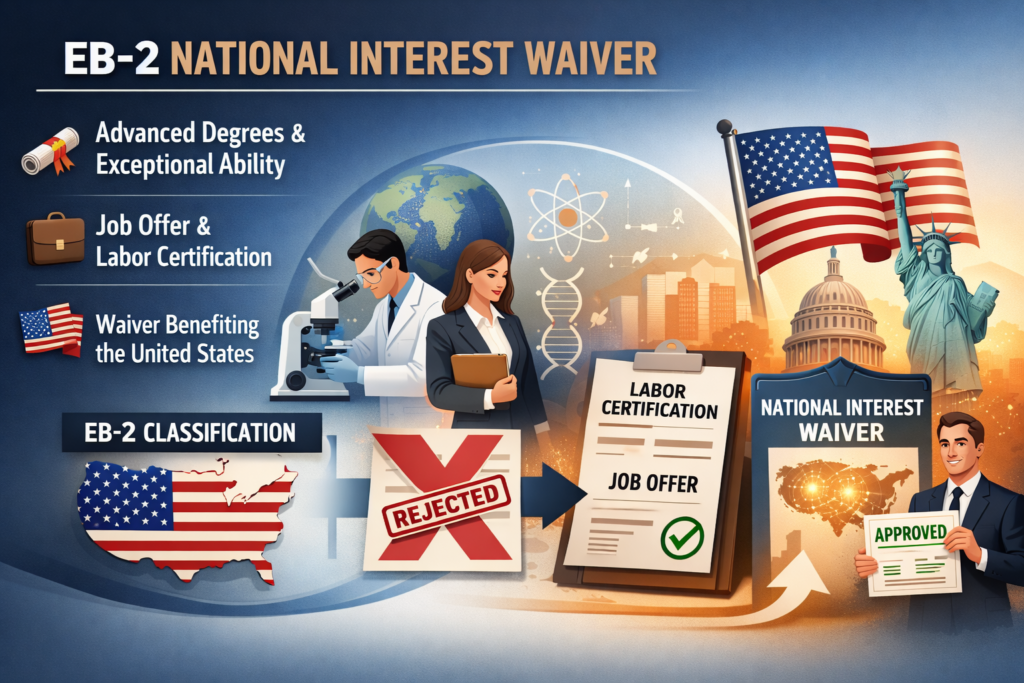
The EB-2 immigrant visa category generally covers professionals with advanced degrees and individuals of exceptional ability. In many employment-based immigration cases, the petition requires a permanent job offer and a labor certification. A National Interest Waiver, however, allows USCIS to waive those requirements when the petitioner shows that granting the waiver would benefit the United States. USCIS guidance also makes clear that a petitioner must first qualify for the underlying EB-2 classification before establishing eligibility for a National Interest Waiver.
The Legal Background Before Matter of Dhanasar
Before Matter of Dhanasar, USCIS generally relied on the framework established in Matter of New York State Department of Transportation (NYSDOT). That standard was often seen as restrictive and difficult to apply consistently, especially in cases involving researchers, entrepreneurs, and other highly skilled professionals whose work did not fit neatly into traditional employer-sponsored roles. In Dhanasar, the AAO expressly vacated the NYSDOT standard and adopted a new analytical approach for NIW adjudications. Under the old NYSDOT rule, applicants faced rigid requirements regarding “national scope” and proving that their work would directly impact the U.S. labor market in a way that precluded labor certification hurdles that often blocked innovative entrepreneurs and specialized scientists.
What Did Matter of Dhanasar Change?
The most significant contribution of Matter of Dhanasar was the introduction of a three-prong test for evaluating EB-2 NIW petitions. This framework gave USCIS a clearer and more flexible method for determining whether a National Interest Waiver should be granted. The decision also better reflected the realities of modern professional work, particularly in science, technology, entrepreneurship, education, health, and research.
The Three-Prong Test Under Matter of Dhanasar
1. The Proposed Endeavor Must Have Substantial Merit and National Importance
The first prong focuses on the value and importance of the foreign national’s proposed endeavor. According to the AAO, substantial merit may be shown in a wide range of fields, including business, entrepreneurialism, science, technology, culture, health, and education. National importance does not depend only on geographic scope; rather, USCIS examines the broader potential impact of the work on the United States. For instance, work that has significant implications for public health, economic revitalization, or critical technological advancements can satisfy national importance even if it is initially focused on a specific local region or startup venture.
2. The Foreign National Must Be Well Positioned to Advance the Proposed Endeavor
The second prong examines whether the applicant has the education, experience, skills, record of success, and supporting evidence necessary to move the proposed endeavor forward. USCIS may consider academic background, publications, patents, business plans, funding, industry recognition, letters of support, and past achievements when determining whether the applicant is well positioned to succeed. Adjudicators look closely at the applicant’s track record, checking whether their past accomplishments serve as a reliable indicator of future success in the U.S.
3. On Balance, It Must Be Beneficial to the United States to Waive the Job Offer and Labor Certification Requirements
The third prong is a balancing test. USCIS considers whether the national benefit of the foreign national’s work is strong enough to justify waiving the usual requirement of a permanent job offer and labor certification. If the petitioner satisfies all three elements by a preponderance of the evidence, USCIS may approve the National Interest Waiver as a matter of discretion. Factors weighed here include whether urgent or critical fields (such as critical technologies or healthcare advancements) make the standard labor certification process impractical or contrary to the national interest.
Subsequent USCIS Policy Guidance on STEM and Entrepreneurs
In recent years, USCIS has expanded and clarified how the Dhanasar framework applies to specific groups:
- STEM Professionals and Researchers: Policy manuals now explicitly recognize that proposals directed toward critical and emerging technologies (such as artificial intelligence, advanced computing, semiconductor engineering, and biotechnology) carry strong national importance, making it easier for advanced degree STEM professionals to demonstrate eligibility.
- Entrepreneurs and Startup Founders: USCIS clarified that business owners and startup founders do not necessarily need to create hundreds of jobs immediately to meet the standard. Showing that a startup will generate economic activity, innovate within a key industry, or create specialized employment opportunities can satisfy the requirements under Dhanasar’s first and third prongs.
Why Matter of Dhanasar Is So Important
Matter of Dhanasar remains a cornerstone of EB-2 NIW adjudication because it brought much needed clarity to a complex area of immigration law. The decision provided a more realistic and applicant-focused framework, particularly for professionals whose work may deliver broad public, scientific, economic, medical, or technological benefits. USCIS has also issued later guidance clarifying how NIW eligibility is assessed in areas such as entrepreneurship and STEM-related endeavors, showing the continuing relevance of the Dhanasar framework.
Who Can Benefit From the Dhanasar Framework?
The Dhanasar standard can be especially important for researchers, scientists, physicians, engineers, startup founders, entrepreneurs, and other highly skilled professionals whose work has measurable national value. It does not guarantee approval, but it allows applicants to present a stronger case when they can show that their work has substantial merit, national importance, and that they are well positioned to advance it. USCIS also notes that broad and unsupported claims about economic benefit or job creation alone are not enough; each case is decided on its own merits.
Practical Evidence Commonly Used in an EB-2 NIW Case
In practice, successful NIW petitions often rely on a combination of strong documentary evidence. This may include degrees, experience letters, publications, citations, patents, expert recommendation letters, grants, contracts, media coverage, business plans, proof of innovation, and evidence showing how the proposed work benefits the United States. The weight of the evidence depends on the specific field and the nature of the endeavor, but the goal is always the same: to show that the petitioner and the proposed work satisfy the Dhanasar standard. Strong independent advisory letters from recognized experts in the field who can attest to the significance of the applicant’s past work play a crucial persuasive role.
Conclusion
Matter of Dhanasar fundamentally changed the way EB-2 National Interest Waiver petitions are evaluated. By replacing the outdated NYSDOT framework with a clearer three-prong test, the AAO made NIW adjudication more structured, more flexible, and better suited to modern professional and entrepreneurial realities. For qualified foreign nationals whose work offers real national value, Matter of Dhanasar remains one of the most significant decisions in the National Interest Waiver landscape. Proper legal presentation and meticulous documentation remain essential to turning the flexibility of the Dhanasar standard into an approved green card petition.
FAQs
What is Matter of Dhanasar?
Matter of Dhanasar is a 2016 AAO precedent decision that established the current three-prong test used by USCIS to evaluate EB-2 National Interest Waiver petitions.
What did Matter of Dhanasar replace?
It replaced the older Matter of New York State Department of Transportation (NYSDOT) framework, which the AAO vacated in the decision.
What are the three prongs of Dhanasar?
The three prongs are:
Substantial merit and national importance.
The applicant is well positioned to advance the endeavor.
On balance, waiving the job offer and labor certification requirements benefits the United States.
Does Matter of Dhanasar guarantee NIW approval?
No. It provides the legal framework for adjudication, but USCIS still decides each case on its individual facts and supporting evidence.
How has USCIS guidance evolved for STEM and entrepreneurs under Dhanasar?
USCIS has issued targeted policy manual updates emphasizing that advanced degree professionals in critical STEM fields and startup founders meeting specific criteria can more readily establish national importance and benefit under the Dhanasar framework.
Do I need a permanent job offer or employer sponsor to apply for an EB-2 NIW?
No. One of the primary benefits of a National Interest Waiver is that it allows you to self-petition, meaning you do not need a permanent job offer from a U.S. employer or an approved PERM labor certification.
What kind of supporting documents are most critical under Prong 2 (Well Positioned)?
Crucial documents typically include an advanced degree certificate, detailed letters of experience, peer-reviewed publications, citation records, expert recommendation letters from independent industry authorities, and evidence of funding, grants, or commercial success.