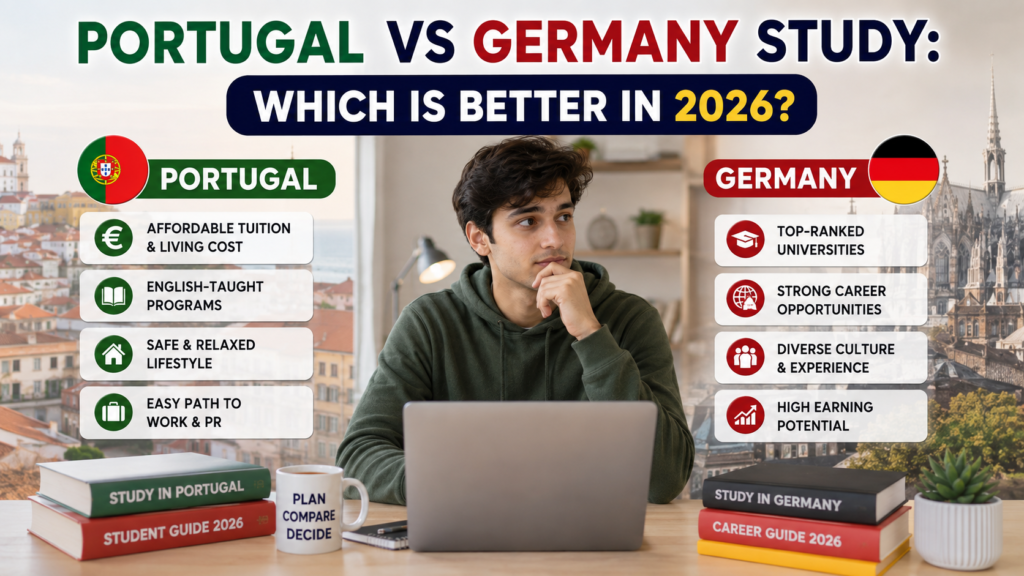
If you are comparing Portugal vs Germany study which is better in 2026, the better choice depends on your real goal: low entry pressure, a comfortable English speaking transition, stronger post study employment, lower tuition, or long-term EU residence planning. Germany usually offers stronger graduate employment and lower public university tuition, but it can be more demanding on documentation, language planning, and financial proof. Portugal can feel more accessible and lifestyle friendly, but students must plan carefully around AIMA residence permit steps, Portuguese job market salaries, housing, and long-term immigration changes.
This article is written for non-EU international students who are deciding between Portugal and Germany before choosing a university, paying deposits, or applying for a visa. It does not claim that one country is universally better. Instead, it explains which country may fit which applicant profile.
Quick Answer: Should You Study in Portugal or Germany?
| Choose Germany if… | Choose Portugal if… |
| You want stronger graduate job prospects in engineering, IT, manufacturing, healthcare, research, or regulated technical sectors. | You want a smaller, warmer, lifestyle oriented EU destination with growing English taught options and a potentially smoother cultural transition. |
| You are comfortable preparing stronger documents, financial proof, language evidence, APS/recognition checks where applicable, and German style visa logic. | You prefer a less crowded alternative to Germany and are prepared to manage the Portuguese national visa plus AIMA residence permit stage. |
| You want public-university tuition advantages and a structured post-study job search residence permit of up to 18 months after German graduation. | You are open to lower average salaries but value Portugal’s climate, English friendly urban areas, and academic options in Lisbon, Porto, Braga, Coimbra, Aveiro, or other cities. |
| You can realistically learn at least some German to improve jobs, internships, housing, and integration. | You can study in English but are willing to learn Portuguese for work, services, and long-term integration. |
Germany vs Portugal Student Visa Comparison
A direct visa comparison must separate the visa stage from what happens after arrival. Germany’s system is often more predictable on paper for students, but it can be strict about proof of funds, qualification logic, language proof, APS where applicable, and study intent. Portugal may appear simpler at the visa stage, but students must also manage the AIMA residence permit process after arrival.
| Factor | Germany | Portugal | Practical Meaning |
| Entry document | Usually a national visa for study, followed by a residence permit in Germany. | Residence visa for stays over one year; generally valid for four months and two entries, followed by AIMA residence permit application. | Do not compare only visa approval. Compare the full visa-to-residence pathway. |
| Financial proof | Commonly EUR 11,904 for one year, or EUR 992 per month, for student financing proof. | Means of subsistence are based on Portugal’s minimum monthly salary benchmark, EUR 920 in 2026, with family unit additions where relevant. | Germany is more specific and often uses blocked account logic. Portugal depends on official subsistence criteria and consular documentation. |
| Language | Depends on programme. English-taught programmes may not require German for admission, but German helps strongly for life and jobs. | Depends on programme. English-taught programmes exist, but Portuguese improves work, housing, administration, and long-term integration. | English may be enough to study in both countries, but not enough for every job or long-term plan. |
| Work during study | Third-country students may generally work 140 full days or 280 half-days, or use the 20-hour weekly lecture-period framework. | Higher education student residence permit holders may work in subordinate or independent professional activity if it remains complementary to the study purpose. | Germany gives clearer numerical limits. Portugal uses a broader complementary-work concept. |
| Post-study route | Up to 18 months after graduation to seek qualified employment, with work allowed during that period; not renewable for the same purpose. | Portugal has study-to-work mechanisms, including post-study residence possibilities under Portuguese law, but AIMA procedures and eligibility should be checked carefully. | Germany is usually stronger for graduates seeking a clearly structured job-search period. |
Portugal Germany International Student Comparison: The Real Decision Factors
1. Academic Fit
Germany is often stronger for students targeting engineering, computer science, manufacturing, automotive, applied sciences, medical technology, logistics, research, and public university pathways. Its university and university of applied sciences system is highly structured, and many public programmes charge no regular tuition, although semester contributions and exceptions apply.
Portugal can be attractive for business, tourism, hospitality, digital media, international relations, marine sciences, renewable energy, architecture, social sciences, and selected technology programmes. Lisbon, Porto, Coimbra, Braga, Aveiro, and other university cities can offer a more compact and culturally accessible study environment.
2. Visa and Residence Practicality
Germany can be strict, but the student pathway is well documented. If the applicant has admission, proof of financing, health insurance, language proof where required, APS where applicable, and a credible study plan, the structure is relatively clear.
Portugal is not automatically easier. A non-EU student usually has to think in two stages: the national residence visa before travel and the AIMA residence permit after arrival. The first stage allows entry. The second stage makes long-term residence practical. Applicants who ignore the AIMA stage may be surprised by appointment, documentation, or processing complications.
3. Cost Reality
Germany may look more expensive because the blocked account figure is high, but many public universities charge no regular tuition. Portugal may have lower proof-of-means expectations in some cases, but tuition, rent, private accommodation, and lower earning potential can change the calculation. Lisbon and Porto are not automatically cheap for students.
4. Employment Outlook
Germany generally has the stronger industrial labor market, especially for technical and regulated professions. However, German language, recognition, and degree job matching can matter. Portugal can offer English-speaking jobs in shared services, tourism, customer support, technology, and digital roles, but salaries are usually lower and Portuguese can become important outside international companies.
Tuition Fees Portugal vs Germany
| Cost Area | Germany | Portugal | Recommendation |
| Public university tuition | Many public programmes charge no regular tuition, but students pay semester contributions. Exceptions exist by state, institution, and programme. | Public universities usually charge tuition; non-EU fees vary by institution and programme. | Compare the exact programme page, not general country claims. |
| Private universities | Can be expensive and must be assessed for recognition and visa credibility. | Can be expensive and may require careful visa-purpose and financial planning. | Do not choose a private university only because admission is easier. |
| Financial proof | Usually EUR 11,904 for one year for student financing proof. | Based on Portuguese means-of-subsistence rules using the 2026 minimum monthly salary of EUR 920 as the benchmark. | Calculate visa funds and real monthly costs separately. |
| Hidden costs | Semester contribution, health insurance, rent deposit, local transport, recognition/APS where relevant. | Tuition, rent deposit, health insurance, AIMA steps, NIF/NISS, translations/legalisation where required. | Build a 12-month cash-flow plan before choosing. |
Cost of Living Lisbon vs Berlin: Be Careful With Simple Comparisons
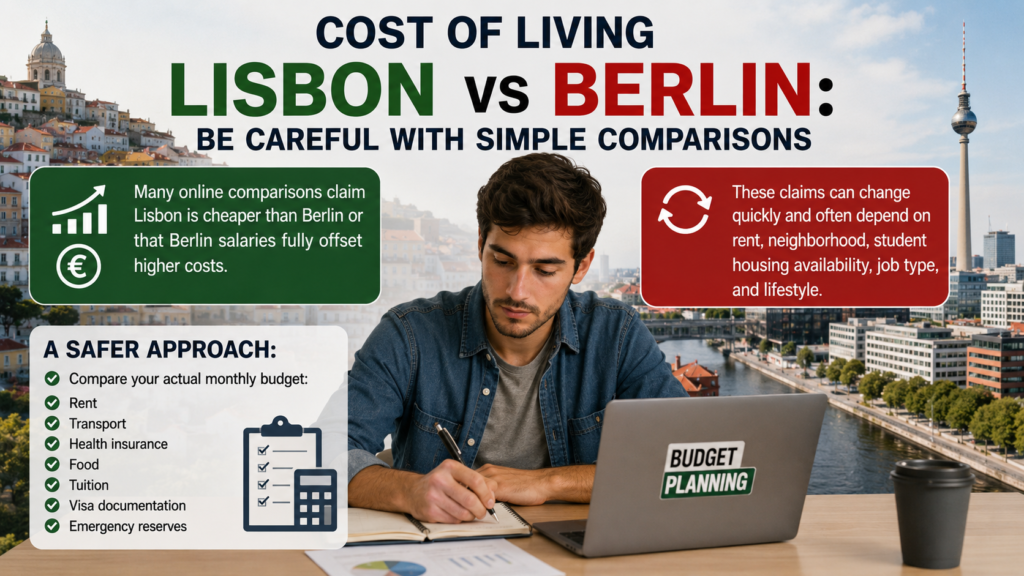
Many online comparisons claim Lisbon is cheaper than Berlin or that Berlin salaries fully offset higher costs. These claims can change quickly and often depend on rent, neighborhood, student housing availability, job type, and lifestyle. A safer approach is to compare your actual monthly budget: rent, transport, health insurance, food, tuition, visa documentation, and emergency reserves.
| Budget Category | Germany Planning Note | Portugal Planning Note |
| Rent | Berlin, Munich, Hamburg, Frankfurt, and Cologne can be difficult and expensive. Student housing waiting lists can be long. | Lisbon and Porto have serious housing pressure. Smaller cities such as Braga, Coimbra, Aveiro, Evora, or Covilha may be more manageable. |
| Food and transport | Student transport benefits may exist through semester contributions, depending on the institution/state. | Transport costs vary by city. Lisbon and Porto are more expensive than smaller cities. |
| Health insurance | Students usually need qualifying health insurance for visa and enrollment/residence purposes. | Students need health coverage, and residence-permit requirements should be checked for the exact category. |
| Part-time income | Hourly wages are often higher, but language and job-market competition matter. | Hourly earnings may be lower; English jobs exist but are not guaranteed. Portuguese helps. |
| Overall risk | High documentation expectations but stronger job-market upside. | Potentially smoother lifestyle entry but AIMA-stage and lower salary risks. |
Language Requirement Portugal vs Germany
The language question is not simply whether you can study in English. Both countries have English-taught programmes, especially at Master’s level. The deeper question is whether you can live, work, build a network, and move from student status to employment.
| Question | Germany | Portugal |
| Can I study in English? | Yes, if admitted to an English-taught programme and you meet the university’s language proof requirements. | Yes, if admitted to an English-taught programme and you meet the institution’s requirements. |
| Do I need the local language for the visa? | Depends on the programme and mission. German proof is usually needed for German-taught study; English-taught study may rely on English proof. | Depends on programme and visa file. Portuguese may not be mandatory for every English-taught programme, but it helps with daily life and work. |
| Does local language affect jobs? | Strongly. German improves internships, Werkstudent roles, regulated professions, and long-term employment. | Strongly outside international employers. Portuguese improves local employment, bureaucracy, housing, and integration. |
| Strategic advice | Even for English programmes, learn German early. | Even for English programmes, learn Portuguese early. |
Best EU Country to Study 2026: Which Country Wins by Goal?
| Student Goal | Better Fit | Why |
| Lowest tuition at public universities | Germany | Many public programmes remain tuition-free, though exceptions and semester contributions apply. |
| Warmer climate and lifestyle transition | Portugal | Portugal may feel easier culturally and socially for some students. |
| Stronger technical job market after graduation | Germany | Germany has a larger industrial and skilled-labor economy. |
| English-friendly urban transition | Portugal | Lisbon and Porto can be accessible for English speakers, especially in international environments. |
| Clearer numeric student work rules | Germany | The 140/280-day framework is more specific than Portugal’s complementary-work concept. |
| More relaxed small-country environment | Portugal | Portugal may suit students who prefer smaller cities and lifestyle balance. |
| Faster structured graduate job-search residence period | Germany | Germany provides up to 18 months after graduation to seek qualified employment. |
Post-Study Work Visa Portugal Germany: What Happens After Graduation?
Germany After Graduation
For many non-EU graduates, Germany offers one of the clearer post-study frameworks in Europe. After completing studies in Germany, a graduate may obtain a residence permit for up to 18 months to look for qualified employment. During that period, work is allowed, and the permit is not renewable for the same purpose. Once the graduate finds suitable qualified employment, they may move to a skilled worker residence permit or an EU Blue Card where salary, degree match, and other requirements are met.
For 2026, the EU Blue Card salary thresholds are EUR 50,700 for standard cases and EUR 45,934.20 for shortage occupations or eligible recent graduates/new entrants where conditions are met. These thresholds should be checked each year because they are updated.
Portugal After Graduation
Portugal can also provide post-study options, but students should not assume that studying in Portugal automatically creates an easy permanent route. A graduate may explore Portuguese mechanisms for remaining after studies, including pathways tied to employment, qualified activity, or post-study transition provisions. However, the student must track AIMA procedures, appointment availability, residence-permit validity, employment documentation, tax and social-security requirements, and any current legal changes.
The practical distinction is important: Germany is often stronger for students whose main goal is qualified employment after graduation. Portugal may be attractive for students who value lifestyle, specific academic programmes, and EU residence experience, but the graduate-employment plan should be realistic.
Study Europe Germany Portugal Pros Cons
| Country | Main Pros | Main Cons |
| Germany | Strong labor market; many public tuition-free options; structured post-study job-search permit; clear student work rules; strong technical reputation. | More documentation pressure; German language can be important; housing difficult in major cities; APS/recognition issues for some applicants; regulated professions require planning. |
| Portugal | Attractive lifestyle; English-friendly urban areas; growing international education sector; smaller cities may be manageable; good option for some business, tourism, digital, and social-science profiles. | Lower salaries; AIMA-stage uncertainty; housing pressure in Lisbon/Porto; Portuguese needed for many local jobs; long-term immigration rules should be checked carefully. |
Applicant Scenarios: Which Country Fits Your Profile?
| Applicant Type | Likely Better Fit | Reason | Mistake to Avoid |
| Engineering or IT student seeking strong employment after graduation | Germany | Larger technical labor market and clearer graduate job-search route. | Ignoring German language because the degree is in English. |
| Student seeking warmer lifestyle and English-friendly city environment | Portugal | Lisbon, Porto, and other university cities may feel more accessible. | Assuming Portugal is cheap without checking rent and tuition. |
| Budget-sensitive student targeting public universities | Germany | Public tuition advantage may be strong if the student avoids fee-charging exceptions. | Forgetting semester contribution, blocked account, insurance, and housing. |
| Business, tourism, hospitality, or international services student | Portugal | Portugal can match these sectors and international service environments. | Assuming English-only jobs are guaranteed. |
| Student planning long-term EU career and PR | Germany | Stronger link between degree, skilled employment, EU Blue Card, and settlement planning. | Choosing a weak programme with poor employment outcomes. |
| Student who wants a smaller EU country and slower transition | Portugal | Portugal can suit students who value lifestyle and manageable city size. | Ignoring AIMA residence-permit timing after entry. |
Portugal vs Germany Study Decision Checklist
- Check whether your target programme is recognized and credible, not only whether admission is easy.
- Calculate total first-year costs, including visa proof, tuition, insurance, rent deposit, translations, and emergency savings.
- Compare expected post-study employment in your field, not general country rankings.
- Assess your language plan honestly: German for Germany, Portuguese for Portugal.
- Check visa-stage and residence-permit-stage requirements separately.
- Review housing availability before accepting admission in Lisbon, Porto, Berlin, Munich, Hamburg, or Frankfurt.
- Do not choose Portugal based on old citizenship timelines or outdated “easy PR” claims.
- Do not choose Germany only because tuition may be free; the visa and settlement plan still need strong documentation.
- Compare student work rights, but do not rely on part-time work as your only financial plan.
- Seek professional review if your case involves family, prior refusal, weak finances, academic gap, private institution, or a country-specific document issue.
When Portugal May Be the Better Choice
Portugal may be the better choice if your programme is strong, the institution is credible, you can document your finances and accommodation, and your long-term plan does not depend solely on a high-salary graduate job immediately after study. It can be especially attractive for students who value climate, lifestyle, smaller cities, business or tourism-related fields, and an English-friendly transition while learning Portuguese.
When Germany May Be the Better Choice
Germany may be the better choice if your main goal is a strong employment pathway after graduation, especially in engineering, IT, manufacturing, healthcare, research, or regulated technical fields. Germany may also be stronger if you can manage stricter documentation, financial proof, language preparation, and recognition issues. The country rewards careful planning.
The Honest Answer: Which One Should You Actually Choose?
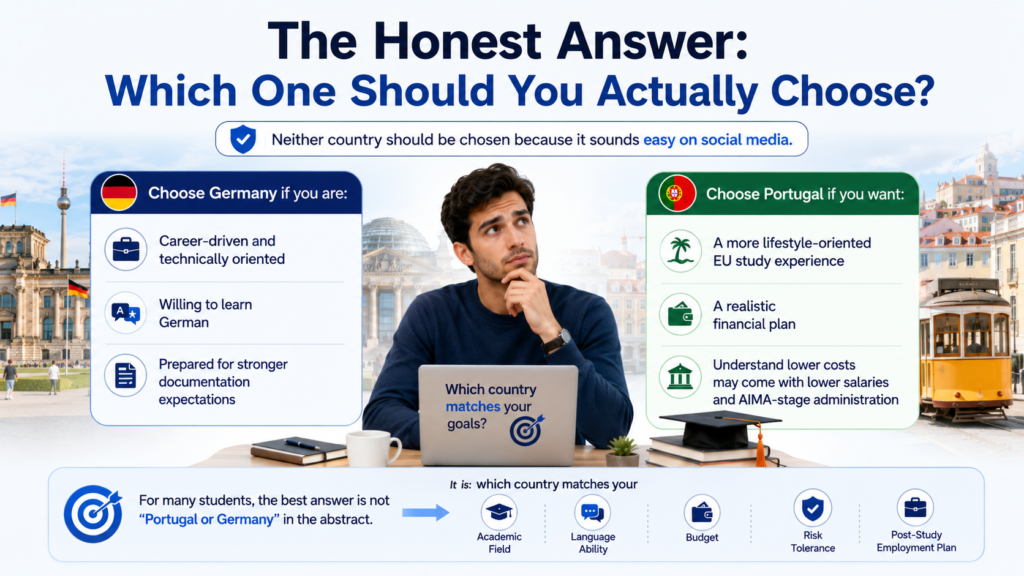
Choose Germany if you are career-driven, technically oriented, willing to learn German, and prepared for stronger documentation expectations. Choose Portugal if you want a more lifestyle oriented EU study experience, have a realistic financial plan, and understand that lower costs in some areas may come with lower salaries and AIMA-stage administration. Neither country should be chosen because it sounds easy on social media.
For many students, the best answer is not “Portugal or Germany” in the abstract. It is: which country matches your academic field, language ability, budget, risk tolerance, and post-study employment plan?
Professional Note
This article provides general information and should not be treated as personalized legal advice. Requirements can vary by nationality, university, course type, location, consulate, residence authority, and current law. Applicants should verify current requirements with official sources before applying.
FAQ Section
Should I study in Portugal or Germany?
Study in Germany if your priority is graduate employment, public-university value, and structured post-study work options. Study in Portugal if you prefer lifestyle, a smaller EU destination, and a programme that fits your field and budget.
Which is cheaper to study, Portugal or Germany?
Germany may be cheaper for tuition at many public universities, but financial proof and housing can be demanding. Portugal may have lower proof-of-means benchmarks, but tuition and rent in Lisbon or Porto can still be significant.
Is it easier to get a visa for Portugal or Germany?
Neither visa should be treated as easy. Portugal may feel less rigid in some cases, but the AIMA residence-permit stage matters. Germany can be strict but more structured if documents are complete and credible.
Which country has better job prospects after graduation?
Germany generally has stronger graduate job prospects in technical, engineering, IT, healthcare, manufacturing, and research fields. Portugal can offer opportunities in tourism, customer service, tech, business, and digital sectors, but average salaries are often lower.
Is English enough to study in Portugal or Germany?
English may be enough for an English-taught programme in either country. For jobs, housing, administration, internships, and long-term integration, German in Germany and Portuguese in Portugal are strongly useful.
Can I work while studying in Germany?
Yes. Third-country students in Germany may generally work 140 full days or 280 half-days per year, or use the 20-hour weekly lecture-period framework, subject to the residence title and applicable rules.
Can I work while studying in Portugal?
Higher education students in Portugal may engage in professional activity if it remains complementary to the study purpose. Students should check the residence permit wording and AIMA requirements before relying on work income.
Which country is better for PR or settlement?
Germany may offer clearer skilled-work-to-settlement planning for graduates who move into qualified employment. Portugal can also support long-term residence, but current nationality and residence rules should be checked carefully.
Is Portugal still a fast citizenship route?
Students should not choose Portugal based on outdated fast-citizenship claims. Portugal has changed or tightened nationality-law timelines, and applicants should verify the current rule before making long-term plans.
Which country is better for South Asian or African students?
It depends on the student’s field, finances, language readiness, document strength, and long-term plan. Germany may suit technical career goals; Portugal may suit lifestyle and specific academic pathways. A profile review is often useful.