
Study and work in Portugal student visa is an important topic for many non-EU students. Many non-EU students want to study and work in Portugal on a student visa because part-time income can make Lisbon, Porto, Coimbra, Braga or Aveiro more affordable. The answer is generally encouraging, but it is not as simple as “you can work 20 hours per week.” Portugal’s official rules focus on whether the student holds the right residence status and whether the work remains complementary to the study purpose. This article explains what is allowed, what is risky, and how to prepare before accepting a job, internship or freelance project.
Quick Answer: Can Non-EU Students Work While Studying in Portugal?
Yes, a non-EU higher education student in Portugal may generally work after obtaining the appropriate student residence permit, provided the work is compatible with the purpose of residence. Official AIMA-linked guidance states that higher education student residence permit holders may engage in subordinate or independent professional activity complementary to the activity that justified the visa. Students should still check their permit wording and local AIMA guidance before starting work.
| Question | Practical Answer |
| Can a higher education student work? | Generally yes, if the work is complementary to the study purpose and the student holds the right residence status. |
| Is there a universal 20-hour legal cap? | Do not rely on this as a universal official rule. It is a common practical benchmark, but official wording is more focused on complementarity with studies. |
| Can a student freelance? | Potentially, because independent professional activity may be allowed, but tax registration, invoicing, social security and permit wording must be checked first. |
| Can secondary students, unpaid trainees or volunteers work? | European Commission guidance says secondary education students, unremunerated trainees and volunteers are not allowed to work with their residence permit. |
| Can work replace visa-stage financial proof? | No. Student work may help after arrival, but it should not be treated as a substitute for required financial means at the visa or residence stage. |
Portugal Student Visa Work Rights 2026: The Rule Students Should Actually Understand
For 2026, the safest way to explain Portugal student visa work rights is this: the work right depends on the student’s residence status and must remain secondary to the study purpose. The Portuguese residence visa is usually the entry step. After arrival, the student must apply for a residence permit with AIMA. Work rights should be assessed at the residence-permit stage, not only from the visa sticker.
| Stage | What It Means for Work |
| Before visa approval | The student is outside Portugal and should not plan employment as proof of eligibility. |
| Residence visa entry stage | A residence visa normally allows entry for the purpose of applying for a residence permit. It is generally valid for four months and two entries. |
| AIMA residence-permit stage | This is the key stage for long-term stay and work compatibility. The permit wording and AIMA rules matter. |
| During studies | Higher education students may engage in work that remains complementary to the study purpose. |
| After studies | A separate residence basis may be needed to work as an employee, self-employed person or graduate job seeker. |
Work Hours Portugal Student Visa: Is There Really a 20-Hour Rule?
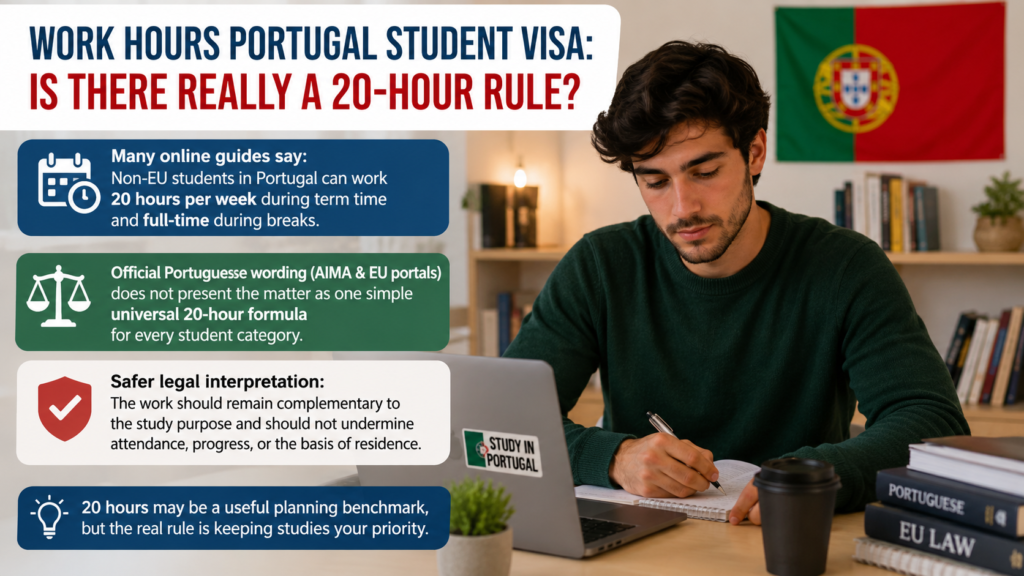
Many online guides say non-EU students in Portugal can work 20 hours per week during term time and full-time during breaks. That may be a useful planning benchmark, and some schools or employers may apply it as a practical rule. However, official Portuguese wording available through AIMA and EU portals does not present the matter as one simple universal 20-hour formula for every student category. The safer legal interpretation is that the work should remain complementary to the study purpose and should not undermine attendance, progress, or the basis of residence.
Part-Time Work Portugal International Student: Common Jobs and Realistic Earnings
Portugal can offer part-time work opportunities in tourism, hospitality, retail, call centers, tutoring, tech support, digital services and university linked roles. English-speaking work may be available in Lisbon and Porto, but Portuguese remains useful for everyday life, local employers, internships and long-term integration.
| Job Type | Possible Fit for Students | Key Caution |
| Hospitality and tourism | Useful in cities with tourism demand; some roles may use English. | Evening/weekend schedules can conflict with classes. |
| Retail and customer service | Common entry level route for students. | Portuguese may be expected for customer-facing roles. |
| Tutoring/language support | Good for students with strong English, STEM or language skills. | Freelance tutoring may require tax registration if invoiced independently. |
| IT, digital marketing, design or content work | Potentially suitable for skilled students. | Remote/freelance status must be handled carefully. |
| University assistantships or internships | Can align well with studies. | Check whether the activity is curricular, paid, unpaid, or separately regulated. |
Portugal Student Work Permit Rules: What You Need Before Starting a Job
Portugal does not usually require a separate “student work permit” in the way some countries do, but that does not mean a student can ignore administration. A student who works should usually be prepared to show a valid residence permit, NIF, Social Security number where applicable, contract or service arrangement, and tax compliance.
| Requirement | Why It Matters |
| Valid residence status | The right to work depends on the legal basis of stay and permit wording. |
| NIF tax number | Usually needed for tax, contracts, banking, rent and employment administration. |
| NISS / Social Security number | Often needed for employment and social security contributions. |
| Employment contract or service agreement | Shows the activity is lawful and documentable. |
| School enrollment and attendance | Your residence basis depends on genuine study. |
| Academic progress | Work should not weaken your renewal or residence credibility. |
NIF, NISS and Taxes: The Practical Setup for Student Workers
Students often focus only on the visa, but legal work in Portugal usually requires administrative readiness. A NIF is Portugal’s tax identification number. A NISS is connected to Social Security. If you are an employee, the employer will normally need your identification and social-security details. If you are self-employed, you may need to open activity with the Portuguese Tax Authority and issue invoices.
| Item | Student Meaning |
| NIF | Tax identification number often needed for employment, banking, rent and invoices. |
| NISS | Social Security number used for social contributions and employment registration. |
| IRS / income tax | Income may create filing obligations depending on amount and circumstances. |
| Social Security contributions | Employees and self-employed workers may have contribution obligations. |
| Minimum wage | Mainland Portugal’s 2026 guaranteed minimum monthly wage is EUR 920 gross. Part-time pay is typically proportionate. |
Portugal Minimum Wage 2026: What Student Workers Should Know
Portugal’s mainland minimum monthly wage for 2026 is EUR 920 gross. This does not mean every student working part-time receives EUR 920. Part-time salaries are generally proportionate to working time, and tax or social-security deductions may affect net income. Students should calculate budgets conservatively because part-time income may not cover rent, tuition, transport, food, insurance and emergency costs.
| Budget Issue | Practical Guidance |
| Gross vs. net income | Gross salary is before deductions. Net income is what reaches your account. |
| Part-time salary | Usually proportionate to hours worked and contract terms. |
| 14-month salary culture | Portuguese employment can include holiday and Christmas allowances, but arrangements depend on contract type. |
| Visa financial proof | Do not rely on future part-time work to satisfy initial means-of-subsistence requirements. |
Can You Freelance in Portugal on a Student Visa?
Freelancing requires extra caution. AIMA-linked guidance recognizes that higher education student residence permit holders may engage in independent professional activity if it remains complementary to the study purpose. However, freelance activity can trigger tax registration, invoicing, Social Security obligations, client contracts and income reporting. A student should not begin freelance work simply because an online article says it is allowed.
| Freelance Question | Safe Answer |
| Can I invoice clients? | Possibly, but you may need to open activity with Finanças and handle receipts/invoices correctly. |
| Can I work for foreign clients? | Potentially, but tax residency, invoicing and social-security treatment must be assessed. |
| Can freelance income become my main activity? | That can become risky if it appears that work, not study, is the real purpose of residence. |
| Should I inform AIMA? | If the permit wording or local guidance requires notification, comply before starting. |
Student Worker Status in Portugal: Useful Rights Many Students Miss
If a student is formally employed, Portuguese labour law may provide student-worker protections. These protections are not the same as immigration permission. They are labour rights tools that can help a student manage classes, exams and work schedules after employment begins.
| Right or Obligation | Practical Meaning |
| Proof to employer | The student worker must prove student status and show the class schedule. |
| Adjusted schedule | Working time should, where possible, allow attendance of classes and travel to the educational establishment. |
| Exam-related absences | Portuguese labour law provides justified absences for evaluation tests subject to legal limits and conditions. |
| Unpaid leave | Student-workers may be entitled to unpaid leave for academic reasons under the Labour Code. |
| Academic success | Maintaining the status depends on school achievement/progression under the law. |
Traineeships, Internships and Curricular Work: Do Not Treat Them All the Same
Portugal distinguishes between different study-related categories. A paid job, a curricular internship, an unremunerated traineeship, volunteering and self-employment may be treated differently. European Commission guidance states that secondary education students, unremunerated trainees and volunteers are not allowed to work with their residence permit. A higher education student should confirm whether an internship is curricular, paid, required by the programme, or a separate professional activity.
| Activity | Risk Level | What to Check |
| Curricular internship required by programme | Lower if properly documented | University letter, internship agreement and residence-permit wording. |
| Paid part-time job | Moderate | Contract, NIF/NISS, tax and study compatibility. |
| Unpaid volunteer role | Can be misunderstood | Whether the residence category permits it and whether it affects study purpose. |
| Independent/freelance work | Higher | Tax activity, invoices, social security and AIMA compatibility. |
Does Working in Portugal Affect Your Student Visa or Residence Permit?
Working can support your budget and improve local experience, but it can also hurt your case if it undermines your study purpose. The main immigration risk is not earning income; it is appearing to use student residence primarily as a work route. Keep enrollment active, attend classes, maintain academic progress, comply with tax rules, and keep records of contracts, payslips, invoices and Social Security documentation.
| Good Practice | Why It Helps |
| Keep proof of enrollment | Shows that study remains the main purpose. |
| Keep contracts and payslips | Shows work is lawful and transparent. |
| Avoid excessive hours during academic periods | Protects academic progress and renewal credibility. |
| Handle taxes and social security correctly | Prevents administrative problems later. |
| Check permit wording before freelancing | Reduces risk of unauthorized activity. |
Decision Framework: Should You Work While Studying in Portugal?
| Student Situation | Recommended Approach |
| You need small monthly support for rent or food | Consider a modest part-time job that does not affect attendance. |
| Your course is intensive or exam-heavy | Prioritize study first; work only if schedule allows. |
| You have freelance skills | Check tax and permit requirements before accepting clients. |
| You plan to stay after graduation | Choose work that builds a credible career pathway, not only short-term income. |
| You do not yet have a residence permit | Do not assume the entry visa alone gives full work flexibility. Confirm before starting. |
Portugal vs Germany: Student Work Rights Compared
| Issue | Portugal | Germany |
| Core rule style | Work should be complementary to the study purpose for higher education residence permit holders. | Students generally follow a defined 140 full days / 280 half days framework or weekly model. |
| Freelancing | Potentially possible but tax, social-security and permit compatibility must be checked. | Generally requires separate permission and is not automatically covered by standard student work rights. |
| Minimum wage reference | EUR 920 gross monthly mainland minimum wage in 2026. | Germany has a statutory hourly minimum wage. |
| Administrative focus | NIF, NISS, AIMA residence permit, tax/social-security compliance. | Tax ID, residence permit, student work limits, health-insurance status. |
| Best fit | Students who want an EU study base with flexible but carefully documented work options. | Students who want more clearly quantified student work limits. |
Applicant Scenarios: What Works and What Can Go Wrong
| Student Profile | Possible Work Plan | Main Risk | Better Strategy |
| Master’s student in Lisbon | Part-time customer support or campus job. | Workload affects class attendance. | Limit hours during exams and keep academic records. |
| Tech student with remote clients | Freelance design or programming. | Tax registration and self-employment rules ignored. | Check Finanças, NISS and permit wording before invoicing. |
| Hospitality job in Porto | Evening/weekend employment. | Schedule conflicts with lectures. | Request student-worker schedule protection where applicable. |
| Student still waiting for AIMA card | Starts work immediately after arrival. | Work rights not yet clear. | Confirm legal status and temporary documents before employment. |
| Student planning post-study work | Uses part-time job to build local experience. | Job unrelated to long-term career. | Seek internships or roles aligned with future permit strategy. |
When Professional Guidance May Help
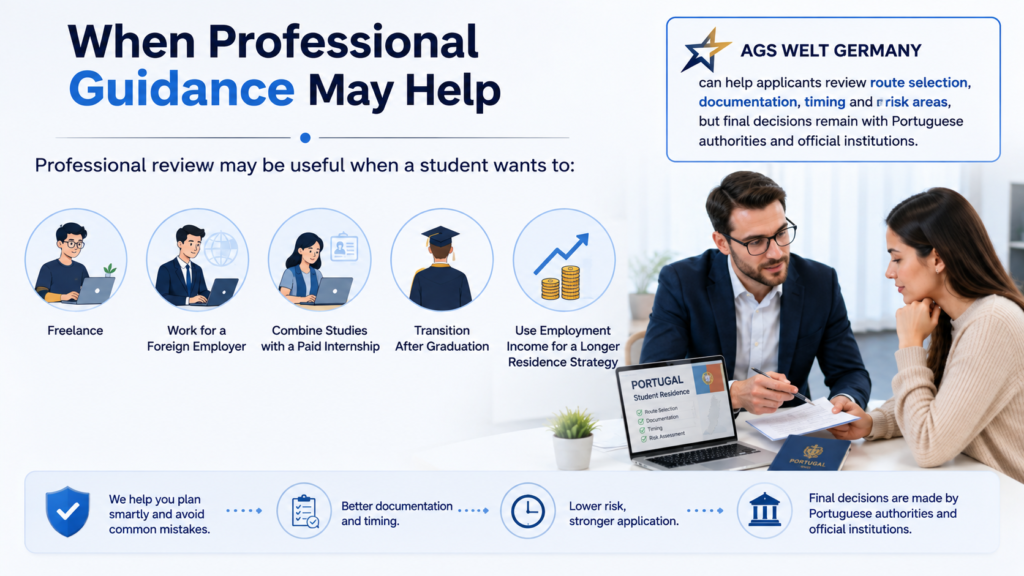
Professional review may be useful when a student wants to freelance, work for a foreign employer, combine studies with a paid internship, transition after graduation, or use employment income as part of a longer residence strategy. AGS Welt Germany can help applicants review route selection, documentation, timing and risk areas, but final decisions remain with Portuguese authorities and official institutions.
FAQs:
Can I work while studying in Portugal?
Yes, higher education students with the right residence permit may generally work if the activity remains complementary to the study purpose. Always check your permit wording and AIMA guidance before starting.
How many hours can I work on a Portugal student visa?
Do not rely on one universal hour limit. Many guides mention 20 hours per week, but official wording focuses on work being complementary to studies. Keep work modest and study-compatible.
Can I freelance in Portugal on a student visa?
Possibly, but only if your residence status allows independent activity and you complete tax and social-security steps. Freelancing should not become your main purpose of stay.
Does working in Portugal affect my student visa?
It can, if work interferes with study or creates compliance issues. Keep enrollment active, attend classes, maintain progress, and document lawful income.
What taxes do international students pay in Portugal?
Students who earn income may have tax and social-security obligations depending on work type and income level. Employees and freelancers are treated differently.
Do I need a NIF to work in Portugal?
Usually yes. The NIF is Portugal’s tax identification number and is commonly needed for employment, invoices, banking and tax administration.
Do I need a Social Security number in Portugal?
If you work as an employee or self-employed person, a Social Security number may be required. Your employer or adviser can help confirm the correct process.
Can I work before receiving my residence permit card?
Be careful. The residence visa is mainly an entry route to apply for a residence permit. Confirm your temporary status and written work authorization before starting.
Can student income replace financial proof for the visa?
No. Expected future work income should not replace required financial proof for the student visa or residence permit stage.
Can I work full-time during holidays in Portugal?
Some students may be able to work more during breaks, but you should confirm your permit conditions, academic obligations, and AIMA rules before doing so.