
If you search for the work while studying Germany 120-day rule, many results are now outdated. Germany expanded student work rights from the old 120 full days / 240 half days rule to a broader 140 full days / 280 half days framework. In 2026, international students must understand the updated rule before relying on part-time work, a Werkstudent role, a mini-job, a university assistant position, or an internship to support their stay.
This guide explains the current rule in practical terms: how days are counted, when the 20-hour weekly model matters, which activities may need extra permission, why freelancing is risky, and how students can avoid problems with the Auslaenderbehoerde, employers, tax registration, health insurance, and academic progress.
Quick Answer: Can International Students Work in Germany?
Yes. International students from non-EU countries may generally work while studying in Germany. Under the current framework, they can work up to 140 full days or 280 half days per calendar year without separate approval from the Federal Employment Agency. Alternatively, students may work up to 20 hours per week during the lecture period, while semester breaks allow more flexibility.
| Question | Practical Answer |
|---|---|
| Is the 120-day rule still correct? | No. It is now generally 140 full days or 280 half days for third-country students. |
| Can students work 20 hours per week? | Yes, during the lecture period this is generally permitted under the weekly model. |
| Can students work full-time during semester breaks? | Generally yes, but they should document the official lecture-free period and track the work. |
| Can students freelance? | Not automatically. Freelance or self-employed work usually needs permission from the Auslaenderbehoerde. |
| Can work replace financial proof for the visa? | No. A future job should not be treated as a substitute for required visa-stage proof of funds. |
Germany Student Work Permit Rules 2026: The Old 120-Day Rule Is Outdated
The phrase “120-day rule” remains common because it was used for many years. However, the current student work framework is more generous. Third-country students with a student residence status may generally work 140 full working days or 280 half working days per calendar year without prior approval from the Federal Employment Agency.
For clarity, this article still uses the phrase “120-day rule,” but students should plan according to the current 140/280-day rule unless their visa, residence permit, supplementary sheet, or local authority instruction states a different condition. Always read the employment wording on your own residence document.
| Old Wording Many Students Know | Current Practical Rule |
|---|---|
| 120 full days / 240 half days | Generally replaced by 140 full days / 280 half days. |
| Half day often misunderstood | A workday of up to four hours is generally counted as a half day. |
| Only university students could work in many older guides | Since the reforms, students in preparatory measures such as Studienkolleg or qualifying language preparation may also have work rights, subject to document wording. |
| Freelancing treated casually in online forums | Freelancing remains separate and usually needs immigration-office permission. |
How Many Hours Can I Work in Germany as a Student?
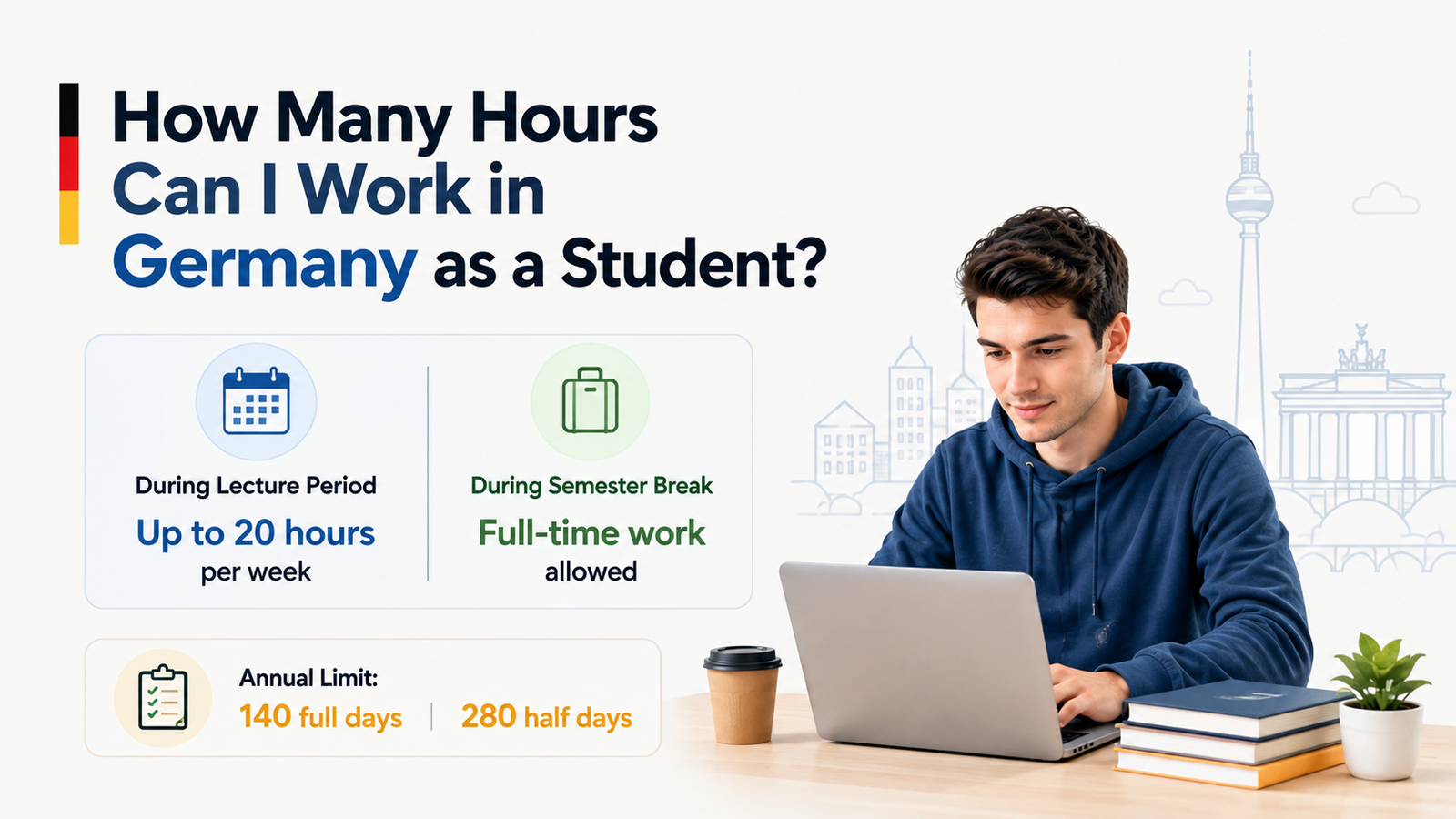
There are two practical ways to understand student work: the workday model and the weekly model. These are not the same as payroll categories such as mini-job or Werkstudent. They are immigration-related counting methods used to determine whether your student employment remains within the allowed framework.
1. The Workday Model
Under the workday model, each actual workday is counted. A day with up to four working hours is generally a half working day. A day with more than four hours is generally a full working day. Days on which no work is actually performed, such as public holidays, vacation days, or sick days, are generally not counted as worked days.
2. The Weekly Model
The weekly model focuses on weekly working time. During the lecture period, students may generally work up to 20 hours per week. Some official and student-service explanations describe this as a simplified weekly calculation, commonly equal to 2.5 working days for the week. During lecture-free periods, students may generally work more hours, but they should still document the period and keep records.
3. Which Model Should You Use?
Use the model that fits the week and avoids overcounting or accidental non-compliance. The safest approach is to record both the actual hours and the model used. Students with multiple employers should combine all jobs into one tracking record rather than treating each employer separately.
| Weekly Schedule Example | Likely Safer Counting Logic | Why It Matters |
|---|---|---|
| One 8-hour shift in a week | Workday model may count as one full day. | A flat weekly model may be less efficient for one long shift. |
| Four 5-hour shifts during lectures | Weekly model may be simpler if total is 20 hours. | Workday counting could treat each day as a full day. |
| Five 4-hour shifts during lectures | Either model may be similar. | Each day is a half day under workday counting. |
| Full-time week during semester break | Semester-break flexibility may apply. | Keep proof of the official lecture-free period. |
| Two jobs in the same week | Combine all hours and days. | Immigration limits apply to the student, not separately to each employer. |
Germany Student Visa Work Restrictions: What Counts and What Does Not
The right to work is attached to your residence status and the employment conditions printed on your visa, residence permit, or supplementary sheet. Employment, internships, academic assistant work, freelance activity, and self-employment are not treated the same way. Before starting work, check the exact wording on your document and keep written proof from the employer or university where relevant.
| Activity | Usually Counted? | Practical Caution |
|---|---|---|
| Regular part-time job | Yes | Track days and hours carefully. |
| Voluntary internship | Usually yes | It may count toward the annual allowance. |
| Compulsory internship required by study regulations | Often treated differently | Keep the module handbook or university confirmation. |
| HiWi or academic assistant role | May have special treatment | Do not assume every campus job is exempt; keep the job description and contract. |
| Freelance tutoring, online services, invoicing clients | Not automatically allowed | Usually needs permission from the Auslaenderbehoerde. |
| Unpaid trial work | Can still be relevant | Ask before doing repeated trial shifts, especially in commercial settings. |
Part-Time Work Germany International Student: Common Job Types
International students commonly work in cafes, restaurants, retail, delivery services, student-service offices, libraries, laboratories, university departments, tutoring, research projects, and company-based Werkstudent roles. The best job is not only the one that pays more. It is the job that fits your lecture schedule, residence conditions, insurance status, and academic progress.
For many students, a role connected to the field of study can be more valuable than unrelated work because it supports future employability. However, even a professionally useful job must still fit immigration and employment rules.
Mini-Job, Werkstudent and Tax ID: What Students Often Confuse
A mini-job, a Werkstudent role, and a student residence work allowance are different concepts. A mini-job is an earnings and social-security category. A Werkstudent role is an employment type designed for enrolled students. Your student residence conditions are immigration rules. One category does not automatically override the others.
After registering your address in Germany, you receive or can obtain a Steueridentifikationsnummer, commonly called a tax ID. Your employer needs this for payroll. Having a tax ID does not mean you can work without restriction; it only allows proper tax and payroll processing.
For 2026, the Minijob-Zentrale lists the mini-job earnings limit as EUR 603 per month. This is useful for payroll classification, but it does not replace the student work-day or 20-hour rules. Students who earn more may still be legally employed, but the payroll and social-security treatment can change.
Health Insurance and the 20-Hour Rule: Why It Still Matters
The immigration rules and health-insurance rules are related but not identical. A student may be permitted to work under residence rules, but excessive work during the lecture period can affect whether the person is still treated as a student for social-insurance purposes. The common practical benchmark is the 20-hour-per-week rule during lectures.
Students who work more during semester breaks should keep proof that the period was lecture-free. If your work pattern is heavy, continuous, or financially central to your stay, ask your health insurance provider and employer how the work affects your student status, contributions, and payroll classification. Do not rely only on immigration forums for this point.
Can You Work Full-Time During University Breaks in Germany?
Generally yes. During lecture-free periods, students can usually work more than 20 hours per week. The practical risk is not the idea of full-time work during semester break; the risk is poor documentation. Keep the university academic calendar, employment contract, payslips, and timesheets so that you can later show the work took place during an official break.
If you work for more than one employer, combine all hours in one record. If you are unsure whether a period is officially lecture-free, ask your university before relying on full-time work.
Working Days Account: How to Track Your Student Work Safely
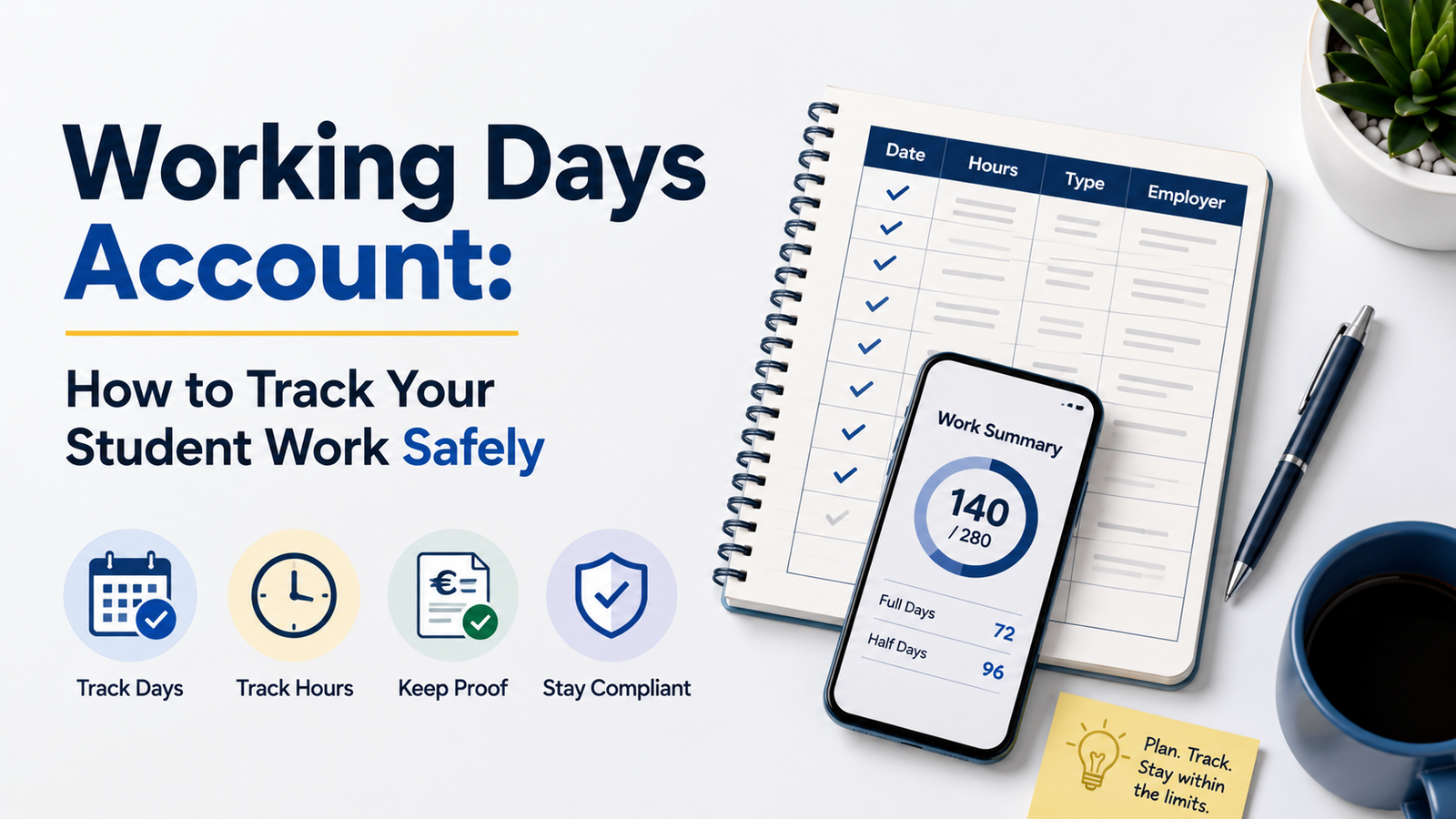
Students should maintain their own working days account, even if the employer also keeps payroll records. There is no need for a complicated government app. A clear spreadsheet is usually enough if it is accurate and supported by contracts, payslips, shift plans, and timesheets.
| Column to Track | Why It Helps |
|---|---|
| Date | Shows exactly when work occurred. |
| Employer | Useful if you have more than one job. |
| Hours worked | Needed for workday and weekly calculations. |
| Lecture period or semester break | Helps explain 20-hour and full-time work patterns. |
| Counting method used | Shows whether you used the workday or weekly logic. |
| Payslip or timesheet reference | Creates evidence if the Auslaenderbehoerde asks later. |
Update the record weekly. Waiting until residence renewal to reconstruct months of work creates unnecessary risk, especially if you worked irregular shifts or had more than one employer.
University Jobs, HiWi Roles and Academic Assistant Work
Student assistant roles at universities, academic research roles, tutoring, and certain roles at university-related institutions may be treated differently because they support the academic purpose of the student’s stay. However, students should not treat every campus or university-adjacent job as automatically exempt.
A research assistant role in your department is not the same as unrelated commercial work. Keep the contract, job description, university confirmation, and payslips. If the job is outside the university or only loosely connected to academic work, ask before assuming special treatment applies.
Internships: Compulsory vs. Voluntary Makes a Big Difference
Internships are one of the most common sources of confusion. A compulsory internship required by the study regulations is usually treated differently from a voluntary internship chosen for experience or income. If an internship is mandatory, keep the study regulations, module handbook, university confirmation, and internship agreement.
A voluntary internship is more likely to count toward the student work allowance. Before signing an internship contract, confirm whether it is compulsory or voluntary, paid or unpaid, full-time or part-time, and whether approval is needed.
Can Students in Language Courses or Studienkolleg Work?
The current framework is more generous than older guidance. Since the March 2024 reforms, students in certain study-preparatory measures, including preparatory language courses and Studienkolleg, may have work rights similar to students in degree programmes. However, this is exactly where students should be careful: older visa documents or specific conditions may still use restrictive wording.
If your visa or residence permit was issued before the reform, or if it refers narrowly to language preparation, ask the Auslaenderbehoerde whether an updated confirmation is needed before starting work.
Self-Employment Germany Student Visa: Freelancing Is Not Automatically Allowed
Freelancing is one of the highest-risk areas for international students. Do not assume you can invoice clients, operate a small business, provide paid online services, monetize content, or work as an independent contractor just because regular part-time employment is allowed.
DAAD guidance states that self-employed or freelance work is possible only if permitted by the Auslaenderbehoerde. This is especially important for students working through online platforms, remote clients, private tutoring arrangements, design work, software projects, consulting, content production, or gig-style paid services.
Does Working Affect Your Student Visa or Residence Permit?
Working within the permitted rules should not damage your student residence status. Problems arise when work becomes inconsistent with the primary purpose of stay, which is study. Excessive work, weak academic progress, unapproved self-employment, missing records, or unclear contracts can create questions during residence renewal.
A safe strategy is to treat student work as support for your studies, not as the main reason for being in Germany. If your study plan depends heavily on income from work, review your financial planning before arrival.
Income Limit Germany Student Visa: Can You Cover All Costs by Working?
Part-time work can help with living expenses, but it should not be treated as a substitute for required financial proof before arrival. A future job, expected wages, or possible Werkstudent role usually cannot replace the visa-stage requirement to prove sufficient funds.
Students should also remember that finding work takes time. Housing deposits, first rent, health insurance, transport, registration delays, and payroll timing can create expenses before the first salary arrives.
When Do You Need Approval from the Auslaenderbehoerde or Bundesagentur fuer Arbeit?
If you stay within the permitted student work framework, separate approval from the Federal Employment Agency is generally not required. Approval may become necessary if you want to exceed the permitted work allowance, take up freelance or self-employed activity, or start work that does not clearly fit your student residence conditions.
| Situation | Likely Action Before Starting |
|---|---|
| Regular part-time job within limits | Usually no separate approval, but track work carefully. |
| Work beyond 140 full days / 280 half days | Ask the Auslaenderbehoerde before exceeding the limit. |
| Freelancing or invoicing clients | Seek written permission before starting. |
| Voluntary full-time internship during lecture period | Check whether it counts and whether approval is needed. |
| Unclear residence-permit wording | Ask the Auslaenderbehoerde or a qualified adviser before relying on assumptions. |
Practical Applicant Scenarios
| Student Profile | Possible Work Setup | Key Issue | Mistake to Avoid |
|---|---|---|---|
| Master’s student with a Werkstudent offer | 20 hours per week during lectures | Weekly model and payroll classification | Assuming Werkstudent status removes immigration limits. |
| Bachelor’s student working cafe shifts | Irregular shifts under the workday model | Full-day vs half-day counting | Counting only income and not workdays. |
| Student with compulsory internship | Internship required by degree regulations | Proof that it is mandatory | Failing to keep university confirmation. |
| Studienkolleg student | Limited work under the current framework | Document wording and local confirmation | Relying on old online articles without checking the permit. |
| Student offering online freelance services | Potential self-employment | Auslaenderbehoerde permission | Invoicing clients before getting permission. |
Do Not Do This While Working as a Student in Germany
- Do not rely on old 120-day articles without checking the current 140/280-day rule.
- Do not start freelance, fee-based, or self-employed work without checking whether permission is needed.
- Do not assume a mini-job earnings limit replaces your immigration work limit.
- Do not work for multiple employers without combining all hours in one tracking record.
- Do not ignore the wording on your visa, residence permit, or supplementary sheet.
- Do not treat a voluntary internship as automatically exempt from the work allowance.
- Do not wait until residence renewal to reconstruct months of work history.
- Do not let work damage your academic progress, attendance, or exam performance.
- Do not assume full-time work is safe unless the period is truly lecture-free or separately permitted.
How AGS Welt Germany Can Help
If you are planning to study in Germany and want to understand your work rights, AGS Welt Germany can help review your student pathway, visa documentation, financial planning, and work-rights questions before you make avoidable mistakes. This may be especially useful if you are considering multiple jobs, a Werkstudent contract, a voluntary internship, preparatory study, or freelance activity.
AGS Welt Germany cannot guarantee approval by any German authority and cannot replace official decisions from the Auslaenderbehoerde, German mission, or Federal Employment Agency. However, a structured review can help you identify the right questions, prepare safer documentation, and avoid relying on outdated student-work rules.
Conclusion
The work while studying Germany 120-day rule is no longer the right way to plan student employment in 2026. The current framework generally allows 140 full days or 280 half days per calendar year, or an alternative 20-hour weekly approach during the lecture period. Semester breaks can offer more flexibility, while freelancing, internships, university jobs, and preparatory-course situations require careful classification.
Germany offers meaningful work opportunities for international students, but student employment should support your studies, not endanger your residence status. Read your permit, track your work, keep evidence, and ask before starting anything that looks like self-employment or exceeds normal student-work limits.
General Information Disclaimer
This article provides general information and should not be treated as personalized legal advice. Requirements and local practices can vary depending on nationality, residence document wording, university status, employment type, federal state, employer documentation, and the responsible authority. Students should verify current rules with official sources or seek professional guidance before making work-related decisions.
FAQs Section
International students may generally work 140 full days or 280 half days per calendar year. Alternatively, they may work up to 20 hours per week during the lecture period, with more flexibility during semester breaks.
The old 120 full days or 240 half days rule has changed. In 2026, the commonly applicable rule is 140 full days or 280 half days per calendar year for many third-country students.
Generally yes. Students can usually work more during lecture-free periods, but they should track hours and keep proof that the period was officially lecture-free.
Not automatically. Freelance, fee-based, or self-employed work usually requires permission from the Auslaenderbehoerde. Students should ask before invoicing clients or starting independent work.
Permitted work should not harm your status. Problems arise if you exceed limits, freelance without permission, miss academic progress, or cannot document your work history.
Usually yes, if it is regular employment. A mini-job is a payroll category, not an immigration exemption. Students should still track days and hours.
Some university or academic assistant jobs may be treated differently, but students should not assume every campus job is exempt. Keep the contract and ask if unsure.
Under the current framework, students in certain preparatory measures may have work rights. However, they should check the exact wording on their visa or residence permit.
Voluntary internships often count toward the work allowance. Compulsory internships required by study regulations may be treated differently if properly documented.
No. Expected future income should not be treated as a substitute for visa-stage financial proof. Work can support living costs after arrival, but financial proof is assessed separately.