A Germany student visa without IELTS 2026 is possible in some cases, but it is not automatic. The real question is not only whether a German university accepts you without IELTS. The visa office must also be satisfied that your language preparation matches your study plan, your admission conditions, and your ability to succeed in Germany. This article explains when IELTS is not required, which alternatives may work, when German language proof is needed instead, and where applicants often create unnecessary visa risk.
Quick Answer: Can You Get a Germany Student Visa Without IELTS in 2026?
Yes, you may be able to get a Germany student visa without IELTS in 2026 if your university admission clearly confirms that you meet the language requirements for your programme, or if you provide another accepted proof such as TOEFL, Cambridge English, PTE, TestDaF, DSH, Goethe, telc, or a valid German-language certificate. However, the final document expectation can vary by German mission, nationality, programme, and admission condition.
The safest approach is to treat language proof as a visa-readiness issue, not just an admission issue. A university may waive IELTS, but a visa officer may still ask whether your study plan is credible, whether your course is actually taught in English or German, and whether your documents clearly prove the required language level.
| Question | Practical Answer |
| Is IELTS mandatory for every Germany student visa? | No. Germany does not impose IELTS as a universal requirement for every student visa. The required language proof depends on the programme and the mission checklist. |
| Can TOEFL replace IELTS? | Often yes, if the university and visa checklist accept it for the chosen English-taught programme. |
| Can a Medium of Instruction letter replace IELTS? | Sometimes for university admission, but it is weaker for visa purposes unless the admission letter clearly confirms that language requirements are fully met. |
| Do German-taught programmes require IELTS? | No. They usually require German-language proof such as TestDaF, DSH, Goethe, telc Deutsch C1 Hochschule, or another accepted certificate. |
| Should English-programme students learn German? | It is usually not mandatory for English-taught study, but German skills are strongly useful for daily life, local authorities, housing, and long-term employment. |
Germany Student Visa Language Requirements: The Two-Level Test
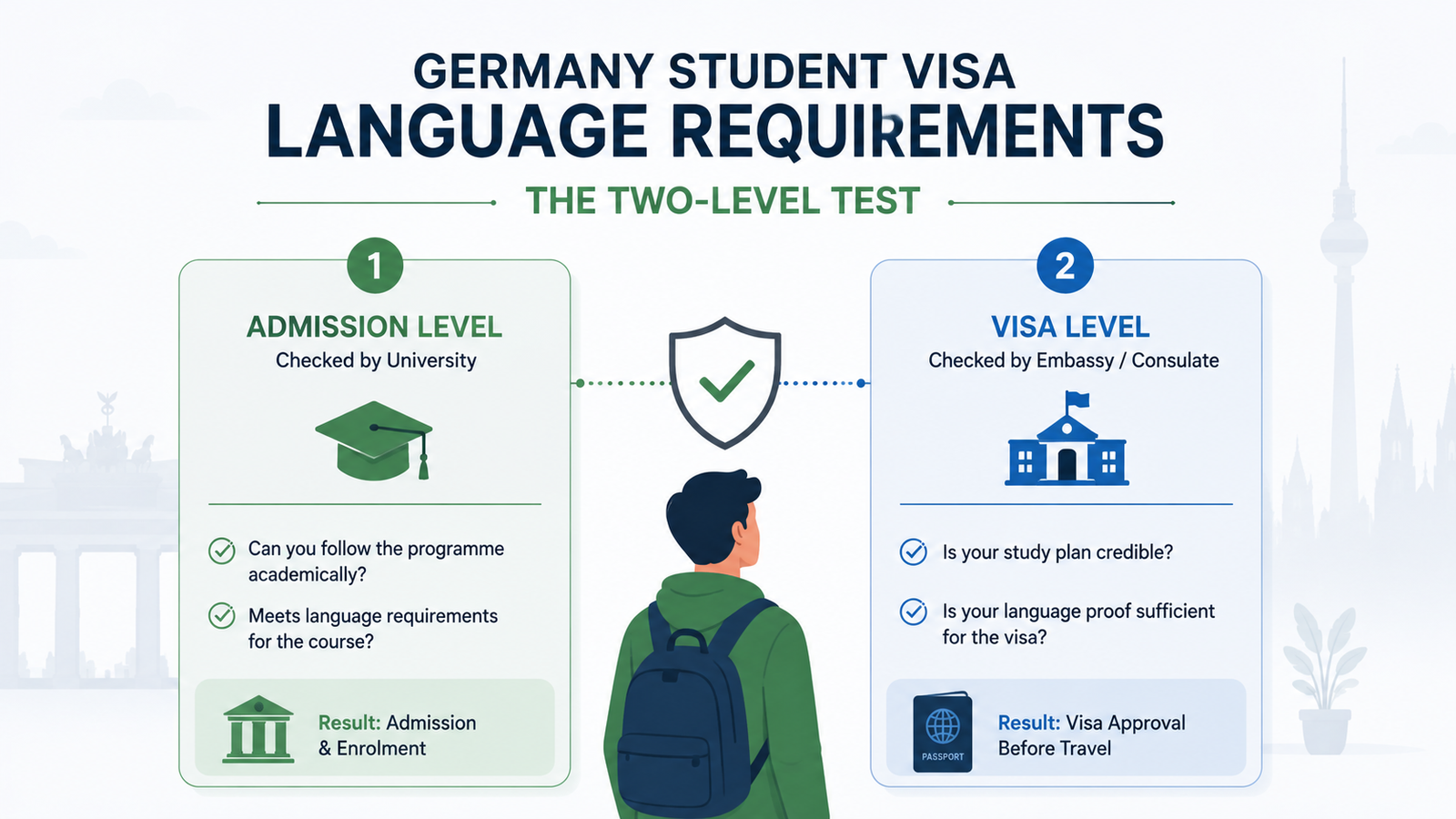
The most common mistake is treating university admission and visa approval as the same thing. They are connected, but they are not identical. The university checks whether you meet academic and language conditions for the programme. The embassy, consulate, or later the local foreigners authority checks whether you meet visa and residence requirements, including whether your study plan is plausible.
Make it in Germany states that students must meet the language requirements for the chosen study programme and may need to prove language skills to the German embassy or consulate. It also notes that some programmes require a certain language level, often B2 under the Common European Framework of Reference for Languages. This means the safest evidence depends on the language of instruction and the programme-specific admission rules.
| Authority | What It Usually Checks | Why It Matters |
| University | Whether you can follow the programme academically in English, German, or both. | This determines admission and enrolment conditions. |
| German embassy/consulate | Whether your visa file proves the study plan is credible and complete. | This affects visa issuance before travel. |
| Ausländerbehörde in Germany | Whether your residence permit conditions are met after arrival or status conversion. | This affects residence continuation and compliance. |
| Scholarship or admissions body | Whether language proof meets its programme or funding rules. | This can affect financial support and admission confirmation. |
What Official Sources Actually Say About Language Proof
Official guidance does not say that IELTS is the only acceptable route. DAAD explains that proof of language skills generally depends on the language of instruction: DSH or TestDaF for German-taught programmes and TOEFL or IELTS for English-taught programmes, with C1 often required depending on the programme. Make it in Germany also explains that German language proof is generally not needed for English-language study courses, although German skills are a major practical advantage.
Therefore, the best answer is balanced: IELTS is not universally mandatory, but language proof is still important. Students should not rely on social media lists of “universities without IELTS” unless the specific programme page, admission letter, and visa checklist all support the chosen proof.
Alternatives to IELTS Germany Visa: What Can Work?
If you do not have IELTS, your alternative depends on whether your programme is taught in English, German, or both. The strongest alternatives are standardized certificates accepted by the university and consistent with the visa checklist. The weakest alternative is an unclear or generic Medium of Instruction letter that the admission letter does not specifically validate.
| Alternative | Best Used For | Visa-Readiness Level | Practical Note |
| TOEFL iBT | English-taught programmes | Strong where accepted by the university and mission checklist. | DAAD commonly lists TOEFL or IELTS as examples for English-language proof. |
| Cambridge English | English-taught programmes | Strong where accepted by the programme. | Check exact accepted level and validity rules. |
| PTE Academic | English-taught programmes | Moderate to strong, programme-specific. | Do not assume every university or mission accepts it. |
| Duolingo English Test | Some English-taught programmes | Programme-specific and mission-sensitive. | Do not call it universally accepted. Verify the programme page and mission checklist. |
| MOI letter | Admission waiver cases | Potentially weak unless clearly accepted in the admission letter. | A vague MOI may not satisfy visa-stage credibility. |
| Internal university language assessment | Programme-specific waiver | Useful if the admission letter explicitly confirms language requirements are fulfilled. | Ask the university to state this clearly. |
| TestDaF / DSH | German-taught programmes | Strong for German-taught study. | Check the required score, often around B2/C1 or equivalent. |
| Goethe / telc / DSD II | German-taught or preparatory pathways | Strong where recognized for the programme. | telc Deutsch C1 Hochschule is widely relevant for university study. |
Why “Without IELTS” Does Not Always Mean “Without Language Proof”
Many students misunderstand the phrase “without IELTS.” In Germany, it usually means without that specific test, not without any proof of language ability. A student may avoid IELTS by using TOEFL, Cambridge English, PTE, a German-language certificate, a documented waiver, or an admission letter confirming that the university has already assessed language requirements.
This distinction matters because a visa officer may not be evaluating your English grammar only. The officer may be checking whether your study plan is coherent. For example, an English-taught data science master’s with a strong TOEFL score and a clear admission letter is different from an unclear private programme where the student has no test, no detailed waiver, and no explanation of how the university assessed language readiness.
Germany University Without English Test: When a Waiver May Be Acceptable
Some German universities may admit students to English-taught programmes without IELTS if the applicant previously studied in English, comes from an exempt background, passes an internal assessment, or provides another accepted certificate. This is a university-level decision. For visa purposes, the waiver is stronger when the admission letter clearly states that the applicant meets all language requirements for the programme.
A visa file becomes weaker when the student only attaches a generic MOI certificate and the admission letter is silent about language requirements. If the university truly waived IELTS, applicants should ask whether the admission letter or a separate official confirmation can state that the programme’s language requirement has been fulfilled.
A Practical Waiver Strength Test
| Language Evidence | How Strong Is It? | What to Improve Before Visa Filing |
| Admission letter says all language requirements are fulfilled | Strong | Still check local mission checklist for any separate certificate requirement. |
| TOEFL accepted by programme and listed in admission evidence | Strong | Attach score report and programme requirement page if helpful. |
| MOI certificate plus admission letter confirms waiver | Moderate to strong | Make sure wording is specific, not generic. |
| MOI certificate only, no admission-language confirmation | Weak | Request written confirmation from university or take a recognized test. |
| Conditional admission requiring language exam later | Case-specific | Explain the preparatory plan and include course/exam evidence. |
| German-taught admission but weak spoken German | High risk | Do not rely only on a certificate; prepare for interview consistency. |
German Language Visa Instead of IELTS: When German Proof Matters More
If your programme is taught in German, IELTS is usually irrelevant. You will normally need proof of German language ability accepted by the university. Make it in Germany lists DSH and TestDaF as common certificates for German-taught study and also identifies telc Deutsch C1 Hochschule, Deutsches Sprachdiplom II, and Goethe C2 among accepted pathways for German-language study admission.
For German-taught programmes, your certificate and your interview performance should match. If the programme requires German and you cannot answer basic study-related questions in German, the visa file may appear inconsistent even if a certificate is attached.
| German Certificate | Typical Use | Practical Comment |
| TestDaF | University entrance for German-taught programmes. | Requirements vary; many programmes expect high component scores. |
| DSH | University-administered German language exam. | Often DSH-2 is needed for full admission, but programme rules vary. |
| telc Deutsch C1 Hochschule | Academic German proof for higher education. | Recognized by German universities for academic language readiness. |
| Goethe-Zertifikat | General German proficiency evidence. | Accepted levels depend on programme and university rules. |
| DSD II | Often relevant for graduates of German schools abroad. | Check whether the institution accepts it for the specific programme. |
English-Taught Programmes Germany: Do You Need German at All?
For English-taught programmes, official guidance generally says German-language proof is not required for admission solely because the course is in Germany. Make it in Germany states that there is generally no need to provide proof of German language skills for English-language study courses. However, the same official guidance emphasizes that strong German skills are a big advantage for daily life, dealing with the foreigners authority, visiting doctors, social life, and career prospects.
For AGS Welt Germany’s advisory approach, this creates a practical distinction: basic German may not be a formal admission requirement, but it can improve your readiness and reduce avoidable questions during the visa process. It can also help after arrival when dealing with housing, registration, health insurance, and part-time work.
When Basic German Can Strengthen an English-Programme Case
- Your programme is in English, but your long-term career plan involves working in Germany after graduation.
- You will live in a city where housing, local administration, and everyday communication often require German.
- Your previous education and the new programme are not perfectly aligned, so you need to show serious preparation.
- You are applying for a preparatory pathway or language-related stage before full degree enrolment.
- Your admission letter is conditional and you need to show that you can realistically meet the condition.
Conditional Admission and Preparatory Language Courses
Some students receive conditional admission because they are academically suitable but must complete a language requirement before full enrolment. This can work, but the visa strategy must match the condition. The student should show the admission letter, the required language target, the preparatory course plan, payment or registration evidence where required, and a credible timeline.
For a German language acquisition visa, Make it in Germany states that the applicant must be admitted to an intensive German language course. It explains that courses with daily German lessons and at least 18 lessons per week are generally considered intensive, while evening and weekend courses are not sufficient. The Federal Foreign Office’s German Missions in India similarly state that the language course should cover at least 18 hours per week and that evening or weekend-only courses do not qualify.
Language Course Visa or Student Visa: Which One Fits?
| Situation | Possible Route | Risk to Check |
| You already have full university admission | Student visa / residence for study. | Make sure language proof matches admission conditions. |
| You have conditional admission requiring German before enrolment | Student-related preparatory route may be possible. | Course intensity, payment proof, and timeline must be clear. |
| You do not yet have admission and need to qualify first | Visa for seeking a place in higher education may be relevant. | Must meet school-leaving, financing, and language requirements. |
| You only want a standalone German course not connected to study | Language acquisition visa may fit. | Course must generally be intensive and finances must be proven. |
| You want online or weekend-only German lessons in Germany | Usually weak for visa purposes. | Intensive in-person requirements may not be met. |
Medium of Instruction Letter: Useful, But Not Always Enough
A Medium of Instruction letter can be useful when a German university accepts prior English-medium education as proof of English ability. However, for visa purposes it is safest when the university’s admission letter explicitly confirms that the applicant has fulfilled the language requirement. A generic MOI letter from a previous institution may not answer the visa officer’s real question: did the German university assess this applicant’s language readiness for this specific programme?
Applicants should avoid relying on broad internet claims such as “Germany accepts MOI instead of IELTS.” The better question is narrower: Does this particular university programme accept MOI, does the admission letter clearly confirm language compliance, and does the relevant German mission checklist require a standardized certificate anyway?
How to Make an MOI-Based Case Safer
- Check the official programme page for accepted language proofs.
- Ask the university whether MOI is accepted for your specific programme and intake.
- Request an admission letter or confirmation stating that all language requirements are fulfilled.
- Attach the MOI certificate only if it is official, signed, dated, and issued by the previous institution.
- Avoid vague explanations. Explain in the SOP how your previous English-medium study prepared you for the current programme.
- If the mission checklist is stricter, consider taking TOEFL, IELTS, PTE, Cambridge, or another accepted test instead of risking refusal.
Student Applicant Visa and Work Rights: Keep This Separate From IELTS
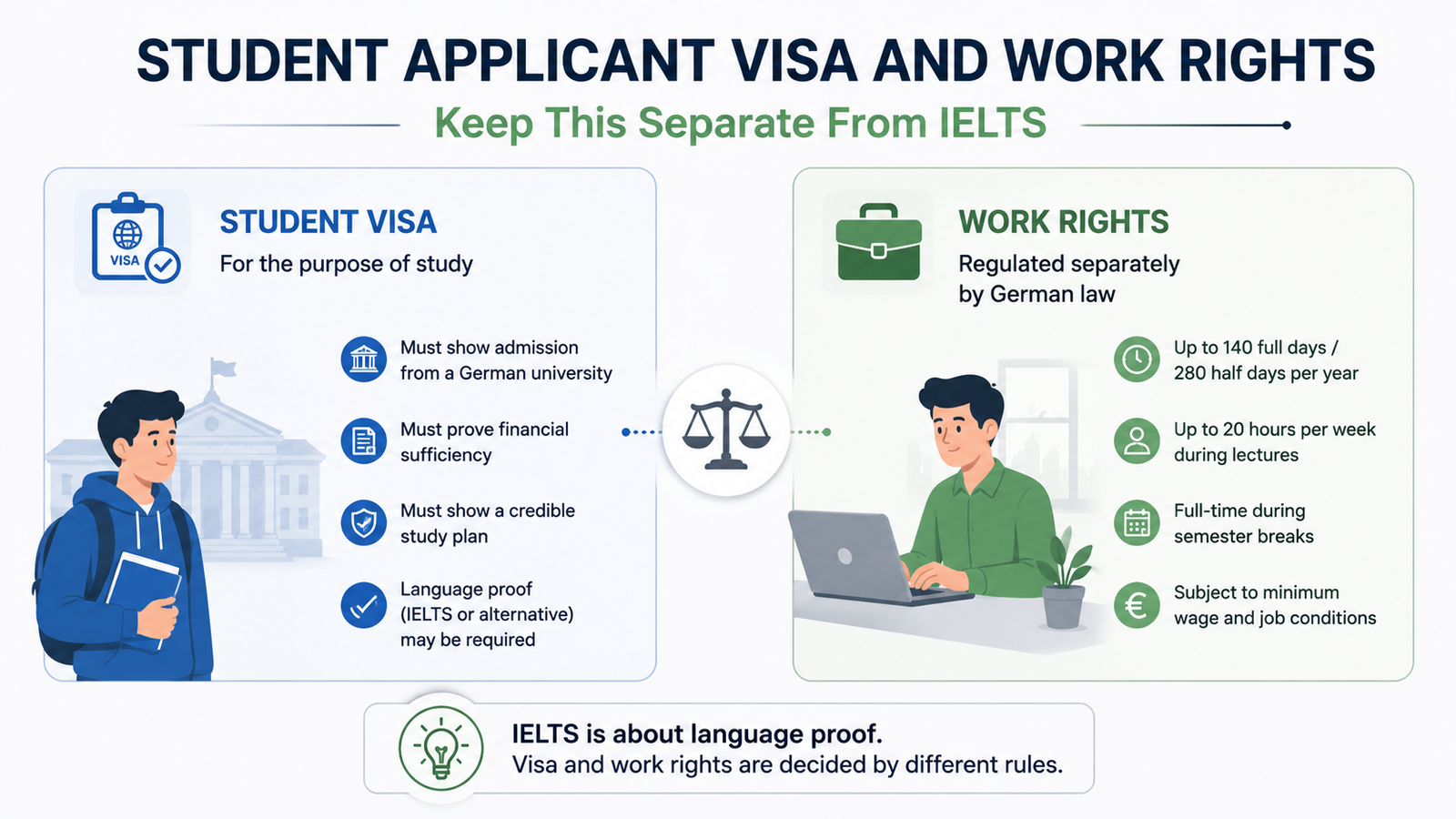
A visa for seeking a place in higher education can allow a stay of up to nine months, and Make it in Germany states that during this time students may work up to 20 hours per week and complete up to two weeks of trial work. This is different from a normal student residence permit after full admission.
This distinction matters because some applicants use “without IELTS” content to search for any easier entry route. A student applicant route is not a shortcut around language requirements. You still need to show that you meet the language requirements for the chosen study programme and can cover living costs.
Applicant Scenarios: What Actually Works in 2026?
| Applicant Type | Possible Language Strategy | Main Risk | Best Practical Step |
| Master’s applicant admitted to an English-taught programme with TOEFL | Use TOEFL and admission letter. | Certificate validity or mismatch with programme requirement. | Attach score report and programme language page. |
| Applicant admitted without IELTS using MOI | Use MOI only if admission confirms language requirements are fulfilled. | Visa office may find the waiver unclear. | Request stronger university confirmation or take a recognized test. |
| German-taught bachelor’s applicant with B1 only | Prepare recognized German proof at required level. | B1 may be below full admission requirement. | Check whether Studienkolleg, preparatory course, or DSH/TestDaF route is needed. |
| Conditional admission requiring DSH before enrolment | Use conditional admission plus intensive language course plan. | Course may not meet visa intensity or documentation standards. | Provide registration, payment proof, timeline, and motivation. |
| Student from English-speaking education background | Use exemption if programme rules allow. | Exemption may be assumed but not documented. | Get written confirmation from the university. |
| Applicant choosing Duolingo because it is cheaper | Use only if the exact programme and visa process accept it. | DET acceptance is not universal. | Verify before relying on it. |
Common Mistakes That Lead to Language-Related Refusal Risk
- Assuming IELTS is never needed because one university blog mentions MOI.
- Submitting a generic MOI letter without programme-specific language confirmation.
- Choosing a German-taught programme but being unable to explain the course in German.
- Using an expired or old certificate without checking university and mission rules.
- Applying with conditional admission but no serious language-course plan.
- Selecting a weekend or online-only language course when an intensive course is required.
- Writing a motivation letter that does not explain why the language pathway is realistic.
- Ignoring the embassy or consulate checklist for the country of residence.
Document Checklist for a Visa-Safe Language File
| Document | When Needed | Quality Standard |
| Admission letter | Always for admitted students. | Should clearly identify programme, intake, language of instruction, and conditions. |
| Programme language requirement page | Highly recommended. | Use the official university page, not an agent screenshot. |
| English test certificate | If IELTS, TOEFL, PTE, Cambridge, or DET is used. | Must match programme score and validity rules. |
| MOI certificate | Only if accepted by the programme. | Should be official, specific, dated, and consistent with admission. |
| German certificate | For German-taught or preparatory German routes. | Use accepted certificates such as TestDaF, DSH, Goethe, telc, or DSD as applicable. |
| Conditional admission letter | If language exam is pending. | Must state exact conditions and how they can be fulfilled. |
| Language course confirmation | For preparatory/language routes. | Should show intensity, start/end dates, level, payment proof, and provider details. |
| Motivation letter / SOP | Always important. | Should explain academic logic, language readiness, and realistic study plan. |
How AGS Welt Germany Can Help With Language-Requirement Risk
If you are unsure whether your Germany student visa without IELTS 2026 strategy is strong enough, AGS Welt Germany can review your admission letter, language proof, MOI certificate, programme requirements, and visa checklist before you apply. This is especially useful where a university waiver exists but the embassy may expect clearer proof of language readiness.
Professional support cannot guarantee a visa decision. However, a structured review can help identify avoidable weaknesses, such as unclear admission conditions, weak SOP language, missing certificate evidence, inconsistent study logic, or a preparatory course that may not satisfy visa expectations.
Conclusion
A Germany student visa without IELTS 2026 is possible, but the safest strategy is not to ask only whether IELTS is required. Ask whether your language evidence is strong enough for your exact programme, your nationality, your German mission, and your study plan. For English-taught programmes, TOEFL, Cambridge, PTE, accepted waivers, or clearly confirmed MOI may work. For German-taught programmes, German-language certificates such as TestDaF, DSH, Goethe, telc, or DSD are usually more relevant than IELTS.
Before filing, check the official university requirements and the German mission’s checklist. If your case depends on a language waiver, conditional admission, preparatory course, or MOI letter, a careful document review can prevent a weak application from turning into an avoidable refusal.