If you are searching for Netherlands student visa rejection reasons, you are probably worried that one weak document, an unclear financial file, or a poor study explanation could damage your admission plan. For non-EU students, the Dutch process is different from many other countries because the educational institution normally files the residence application with the Immigration and Naturalisation Service, known as the IND. That makes the university sponsor process, proof of funds, programme eligibility, and post-arrival compliance just as important as the visa sticker itself.
A Netherlands student application is not usually difficult when the admission, funds, documents, and sponsor process are clean. It becomes difficult when the file is incomplete, the educational institution is not an IND-recognised sponsor, the funds do not meet the official study norm, the student motivation is weak, or the applicant misunderstands post arrival obligations such as study progress and the TB test.
Quick Answer: Why Do Netherlands Student Visa Applications Get Rejected?
Netherlands student visa and residence applications are commonly at risk when the applicant does not meet the IND study requirements, cannot prove sufficient and reliable financial means, applies through a non-recognised institution, submits inconsistent documents, fails to satisfy admission or language conditions, or later fails to maintain required academic progress after arrival.
| Risk Area | Why It Matters | How to Reduce the Risk |
| Institution sponsorship | For higher education, the educational institution normally applies to the IND as the recognised sponsor. | Check that the institution is listed as an IND-recognised sponsor for study before relying on the admission. |
| Financial proof | The IND sets monthly study amounts that must be proven separately from tuition. | Use the 2026 IND study norm and your university’s exact financial document instructions. |
| Tuition payment | Living cost proof does not include tuition fees. | Budget tuition separately and follow the institution’s payment or deposit process. |
| Study motivation | A programme that does not match the applicant’s background may raise questions. | Explain academic progression, career purpose, and why this Dutch programme is necessary. |
| Document consistency | Different names, dates, addresses, or unexplained gaps weaken credibility. | Cross check passport, admission, financial documents, CV, SOP, and online profiles before submission. |
| Post arrival obligations | Approval is not the end of compliance. Study progress and TB obligations may affect residence status. | Understand the 50% credit rule, TB test requirement where applicable, BRP registration, and insurance obligations. |
Netherlands Student Visa Refusal Fix: Understand the Real Process First
The first mistake many applicants make is assuming that the Netherlands student visa process is identical to Germany, Portugal, or the UK. For most non-EU students entering Dutch higher education, the process is not simply a personal embassy application. The Dutch educational institution usually acts as the recognised sponsor and submits the application to the IND for a residence permit for study. The student may need an MVV entry visa depending on nationality, but the core immigration file is closely linked to the institution’s sponsorship role.
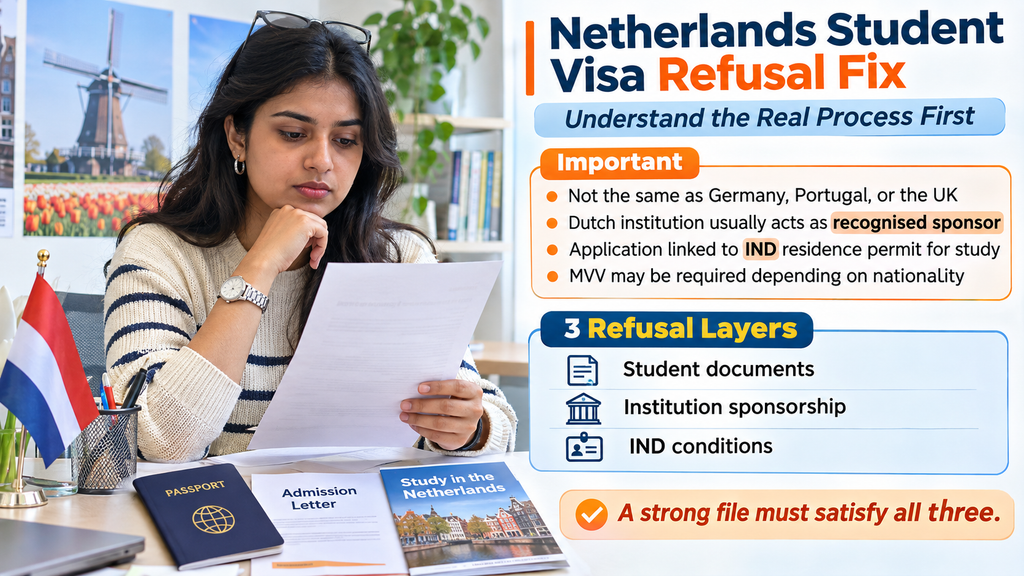
This means a refusal can arise from three different layers: the student’s own documents, the institution’s ability to sponsor, or the student’s failure to meet IND conditions. A strong file must satisfy all three.
| Layer | Common Problem | Practical Fix |
| University/admission layer | The programme is not eligible, the institution is not an IND-recognised sponsor, or admission is conditional in a way that does not satisfy filing requirements. | Verify sponsor status and admission conditions early. Do not rely only on marketing pages. |
| Applicant document layer | Funds, passport, academic history, motivation letter, insurance, or prior immigration history are incomplete or inconsistent. | Prepare the file according to the university’s IND checklist and keep a clean evidence trail. |
| IND compliance layer | The application does not meet official study, income, public order, or TB-related conditions. | Use IND official requirements as the controlling source and update documents before the sponsor files. |
Avoid Netherlands Visa Rejection 2026: Check the IND-Recognised Sponsor First
For Dutch higher education, the recognised sponsor concept is central. The IND public register allows applicants to check whether a school or organisation has been recognised by the IND as a sponsor. If the educational institution is not recognised for the study category, the student residence pathway may not work in the expected way.
This is why applicants should not choose a school only because it advertises English programmes or “easy admission.” In the Dutch system, immigration eligibility depends heavily on whether the institution can properly act as sponsor and whether the programme fits the IND study route.
What to verify before paying tuition or deposit
- Is the institution listed in the IND public register for study sponsors?
- Is the programme full-time and suitable for a residence permit for study?
- Does the admission letter clearly confirm the intake, programme, level, and conditions?
- Does the university require you to transfer living expenses to the institution or provide separate bank evidence?
- Does the university have country specific document rules for your nationality or previous education?
Netherlands IND Student Application Refused: Financial Proof Problems
Financial proof is one of the most practical refusal risks because the amount is objective and the document format is often institution specific. For 2026, the official IND study amount for higher professional education (hbo) or university is EUR 1,130.77 per month. This amount is for living costs and does not include tuition fees.
The exact submission method may vary by institution. Some universities require funds to be transferred to the institution so that the school can confirm financial means to the IND. Others may accept certain bank documents, sponsor declarations, or scholarship letters. The controlling rule is not what another student used last year; it is what your recognised sponsor and the IND require for your intake.
| Financial Requirement | 2026 Position | Common Mistake |
| Living cost norm | EUR 1,130.77 per month for hbo/university study in 2026. | Using an old study norm or confusing tuition with living costs. |
| Tuition fees | Must be covered separately from the monthly study norm. | Showing only living expenses and ignoring tuition payment requirements. |
| Scholarship | Can help if the scholarship amount and coverage period are clear. | Assuming a partial grant covers the entire IND financial requirement. |
| Family sponsor | May be possible depending on institution rules and documentation. | Submitting vague sponsor letters without traceable funds or income evidence. |
| Education loan | Depends on institution acceptance and document quality. | Assuming all universities accept loans because one institution did. |
| Fresh deposits | Not automatically fatal, but unexplained funds may raise credibility concerns. | Submitting last minute transfers with no source explanation. |
How to make financial proof stronger
- Use the official 2026 IND monthly amount and calculate the correct number of months required by your institution.
- Keep tuition, living cost proof, scholarship, and sponsor evidence clearly separated.
- If funds come from parents or relatives, show the relationship and the credible source of funds.
- Avoid edited screenshots. Use official bank letters, statements, or the university’s prescribed format.
- Check whether the university requires money to be transferred to its account before filing with the IND.
Netherlands Student Visa Common Mistakes in the Motivation Letter
A weak motivation letter does not always cause refusal by itself, but it can damage the credibility of the study purpose. The Dutch system is practical: the university checks academic fit, and the IND assesses whether the residence purpose meets legal conditions. A letter that looks generic, contradictory, or disconnected from the applicant’s background can create avoidable risk.
| Weak Approach | Stronger Approach |
| “The Netherlands is beautiful and has good universities.” | Name the programme, modules, learning outcomes, and why they fit your previous study or career direction. |
| “I want a better future in Europe.” | Explain the academic purpose and realistic career path after graduation without sounding like the study route is only an immigration strategy. |
| Unexplained study gap | Explain employment, family obligations, certifications, savings period, or career development with supporting evidence. |
| Major field change with no logic | Bridge the field change through work experience, projects, certifications, or a clear career transition plan. |
| Copy paste template | Write a specific, evidence based letter that matches the CV, admission letter, and LinkedIn profile. |
Nuffic Netherlands Degree Recognition and Academic Document Risks
Nuffic provides information and credential evaluations that compare foreign diplomas to Dutch educational levels. Universities may also use their own admission evaluation processes. Applicants should not assume that admission from an unverified or poorly understood background will automatically satisfy every academic concern.
Academic document risks include missing transcripts, unclear grading scales, untranslated documents, inconsistent names, or documents that cannot be verified. If a programme requires a specific academic level or subject background, the student must show that the previous education reasonably meets that requirement.
When academic documents become refusal risks
- The admission is conditional but the conditions are not resolved before the immigration filing.
- The name on certificates does not match the passport and no explanation is provided.
- Translations or legalisations are missing where required.
- The programme is a major academic shift and the student gives no credible explanation.
- The previous institution or qualification is difficult to verify.
Language Test Requirement Netherlands: Do Not Confuse Admission with Visa Safety
The Netherlands has many English taught programmes, but language proof still matters because the student must meet the programme’s admission conditions. IELTS, TOEFL, Cambridge English, or other accepted tests depend on the university and programme. A student should not assume that “English taught” means “no English proof needed.”
If the university grants a waiver based on previous English medium education, the waiver should be clearly documented in the admission decision. If the admission remains conditional on a language result, the immigration timeline may be affected.
MVV Refusal Netherlands Appeal, Objection, or New Application?
If the IND refuses an application, the decision letter explains the legal remedy. The IND explains that applicants can object to or appeal a decision, and the objection letter should explain which decision is being challenged and why. In some situations, the recognised sponsor or legal representative may be involved.
A new application may be more practical where the problem is easy to correct, such as missing financial evidence, an updated admission letter, or a clearer document format. An objection may be more appropriate where the applicant believes the IND misunderstood facts, ignored evidence, or applied the rules incorrectly. This decision should be made after reading the actual refusal letter, not based on social media examples.
| Situation | Likely Better Direction | Reason |
| Missing or outdated financial document | Correct and refile through the institution if possible. | The problem may be evidentiary rather than legal. |
| Institution not recognised as sponsor | Change institution or pathway. | A personal objection may not fix sponsor ineligibility. |
| IND misunderstood submitted evidence | Consider objection with supporting documents. | The issue may be factual or procedural. |
| Forgery or false statement concern | Seek qualified legal advice immediately. | This can affect future applications and credibility. |
| Programme mismatch or weak motivation | Rebuild academic narrative and supporting evidence. | Repeating the same file may repeat the same weakness. |
Post-Arrival Risks: Approval Is Not the End of Compliance
Many rejection prevention articles stop at the visa decision, but Dutch student immigration also includes post arrival obligations. A student who receives a residence permit must continue meeting the conditions of that permit.
The 50% credit rule under study progress monitoring
The IND explains that students must make enough study progress each year, which generally means obtaining at least 50% of the credits for each study year. The educational institution assesses progress. If progress is insufficient and there is no good reason, the institution must report this to the IND. This can lead to residence permit consequences.
TB test requirement where applicable
IND guidance states that after arrival in the Netherlands, some applicants must undergo a tuberculosis test unless they are exempt based on nationality or other listed conditions. The requirement is often handled through a declaration of intent and a test after arrival. Students should check whether their nationality appears on the exemption list and follow the IND and GGD procedure if the test is required.
Municipality registration, BSN, DigiD, and insurance
After arrival, students usually need municipal registration to receive a BSN. The BSN supports practical steps such as bank accounts, DigiD, work administration, and some insurance processes. Study only students generally have different health insurance rules than students who work; students should check Dutch insurance rules before starting paid employment.
Fraud, False Documents, and Future Schengen Risk
Do not submit altered bank statements, fake academic records, false employment letters, or fabricated sponsor documents. Fraud can lead to refusal, withdrawal of residence rights, future credibility damage, and potentially wider immigration consequences. The safer advice is simple: submit only verifiable, accurate, and lawful documents.
Applicant Scenarios: Which Files Are at Higher Risk?
| Applicant Type | Risk Level | Main Risk | Best Fix |
| Strong admission, clean finances, recognised sponsor | Lower | Administrative errors only. | Follow the institution checklist exactly. |
| Admission but funds are from recent family transfer | Medium | Unclear source of funds. | Add sponsor declaration, bank history, income proof, and relationship evidence. |
| Long gap after graduation | Medium | Study purpose may look unclear. | Explain work history, career logic, and why the Dutch programme is needed now. |
| Field change applicant | Medium to high | Academic progression may be questioned. | Show work experience, projects, certifications, and career bridge. |
| Prior Schengen refusal | Higher | Unresolved refusal ground. | Disclose and address the prior issue with evidence. |
| Questionable documents or inconsistent story | Very high | Credibility and fraud concerns. | Do not file until documents are corrected and verified. |
Decision Checklist Before Your Institution Files with IND
| Question | Yes/No |
| Is your educational institution listed as an IND-recognised sponsor for study? | |
| Does your admission letter show the correct programme, level, start date, and conditions? | |
| Have you calculated living costs using the 2026 IND study amount? | |
| Have you budgeted tuition separately from living cost proof? | |
| If a sponsor funds you, is the source of funds documented and credible? | |
| Do your passport, admission, CV, bank documents, and academic records use consistent names and dates? | |
| Have you explained study gaps or field changes clearly? | |
| Have you checked language proof requirements for your specific programme? | |
| Have you disclosed previous visa refusals or immigration issues honestly? | |
| Do you understand post arrival obligations such as BRP registration, TB test if applicable, insurance, and study progress? |
When Professional Review May Help
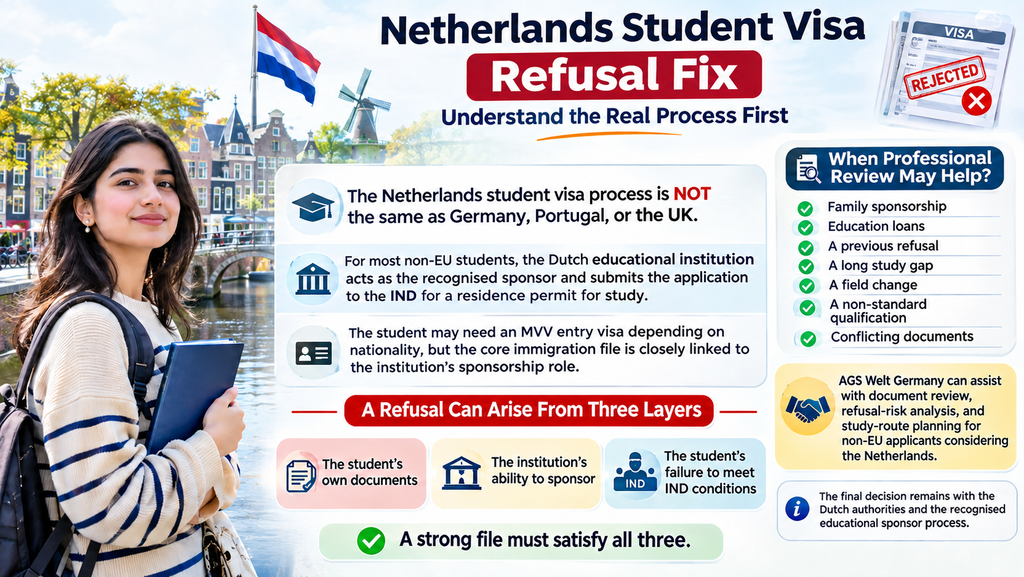
A professional review can be useful when the case involves family sponsorship, education loans, a previous refusal, a long study gap, a field change, a non-standard qualification, or conflicting documents. AGS Welt Germany can assist with document review, refusal risk analysis, and study route planning for non-EU applicants considering the Netherlands. The final decision remains with the Dutch authorities and the recognised educational sponsor process.
FAQ Section
Why do Netherlands student visas get rejected?
They are usually at risk because of insufficient funds, non-recognised sponsorship, incomplete documents, weak study purpose, inconsistent records, unmet language or admission conditions, public order issues, or post arrival non-compliance such as insufficient study progress.
Can I appeal a Netherlands student visa rejection?
Yes, if the IND refuses an application, the decision explains whether and how you can object or appeal. The best response depends on the refusal reason and whether the problem is legal, factual, or documentary.
What financial proof prevents Netherlands visa rejection?
For 2026, hbo and university students must meet the IND study amount of EUR 1,130.77 per month, excluding tuition. The exact document format depends on the university sponsor’s requirements.
Can I use my parents as financial sponsors?
Often yes, but the sponsor evidence must be credible. The university may require bank statements, relationship proof, income evidence, or funds transferred through the institution’s financial process.
Does a Dutch university admission guarantee a visa?
No. Admission is essential, but the residence application must still satisfy IND requirements, including sponsor status, funds, passport, public order, insurance, and other applicable conditions.
What happens if I fail the 50% credit rule?
Your institution assesses study progress. If you do not obtain enough credits and have no recognised good reason, the institution may have to report this to the IND, which can affect your permit.
Do I need a TB test for the Netherlands student permit?
Some applicants must take a TB test after arrival unless exempt by nationality or other listed conditions. Check the IND exemption list and follow the GGD process if required.
Can fake documents affect future Schengen visas?
Yes. False or altered documents can cause refusal, withdrawal, and serious future immigration consequences. Applicants should submit only genuine, verifiable records.
Should I reapply or object after a refusal?
Reapply may be better for missing or weak documents. Objection may be better where the IND misunderstood facts or applied rules incorrectly. Review the refusal letter carefully first.
Can AGS Welt Germany help with a Netherlands refusal?
AGS Welt Germany can review the refusal reason, identify documentary and strategy gaps, and help prepare a stronger file or reapplication strategy where appropriate, without guaranteeing approval.