
About the Author
Rawaid Hussain Siddiqui is an immigration-law specialist. He holds an LL.M. in Immigration Law, a Master’s in Diplomacy and International Relations and he is a PhD Scholar in Immigration Law.
Google Scholar: https://scholar.google.com/citations?user=lRi85DUAAAAJ&hl=en
Study in Germany tuition fees 2026 is one of the most misunderstood topics for international students. Germany can still be an affordable study destination, especially at many public universities, but “free education” does not mean a free visa process, free living costs, or no university payments at all. Students planning a Germany student visa in 2026 must understand the difference between tuition fees, semester contribution, blocked account proof, health insurance, rent, and state level tuition exceptions before choosing a university.
This article explains what is actually free, what is not free, where non-EU students may pay tuition, and how to build a realistic study budget before applying. It is written for international students, parents, and applicants comparing Germany with other study destinations.
Quick Answer: Is Germany Free to Study for International Students?
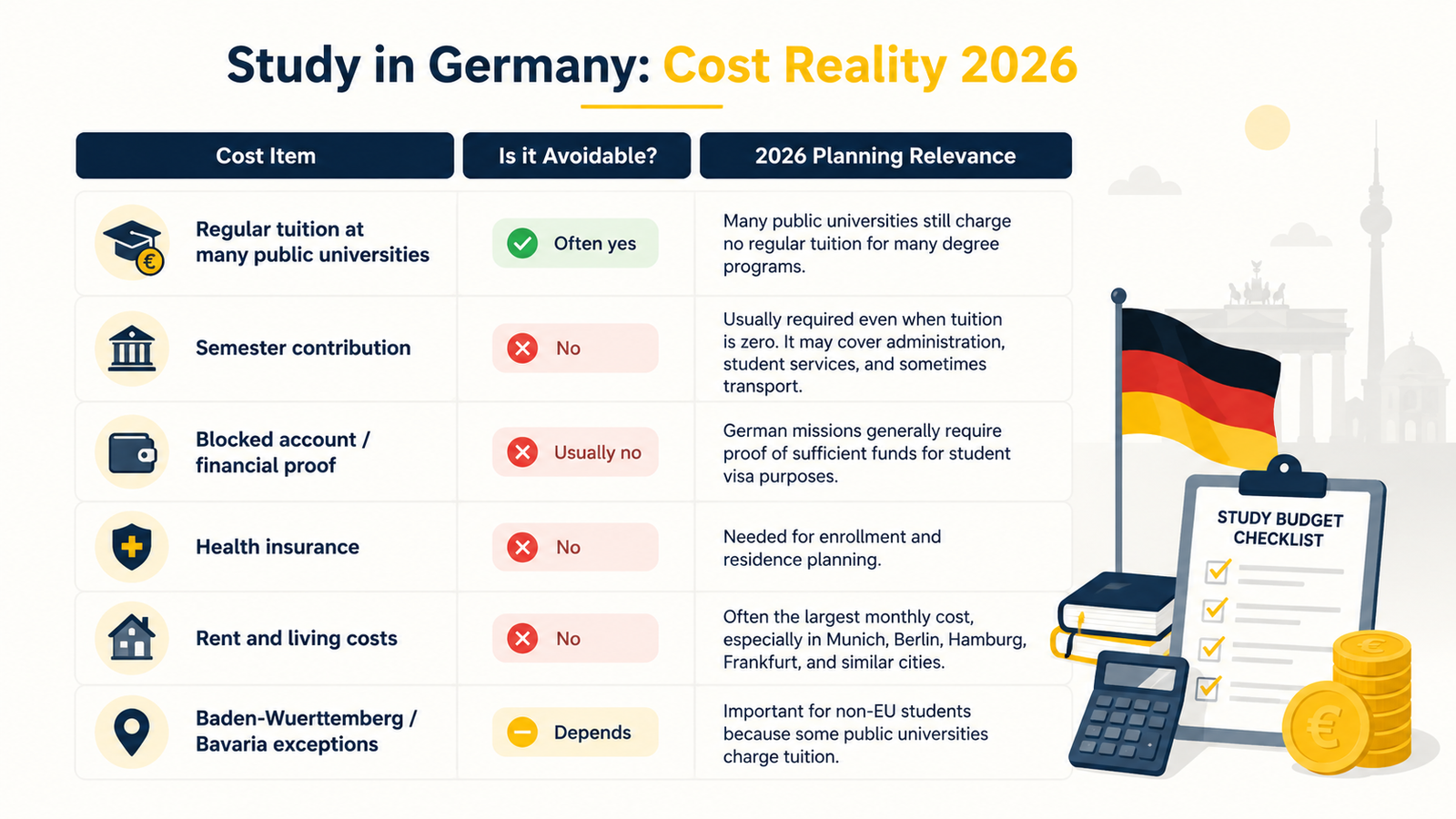
Germany is often tuition free at public universities, but it is not completely free to study in Germany. Many public universities do not charge regular tuition for Bachelor’s programs and many consecutive Master’s programs. However, students usually pay a semester contribution, must prove living funds for the visa, need health insurance, and may pay tuition in certain states, universities, private institutions, or non-consecutive Master’s programs.
| Cost item | Is it avoidable? | 2026 planning relevance |
|---|---|---|
| Regular tuition at many public universities | Often yes | Many public universities still charge no regular tuition for many degree programs. |
| Semester contribution | No | Usually required even when tuition is zero. It may cover administration, student services, and sometimes transport. |
| Blocked account / financial proof | Usually no | German missions generally require proof of sufficient funds for student visa purposes. |
| Health insurance | No | Needed for enrollment and residence planning. |
| Rent and living costs | No | Often the largest monthly cost, especially in Munich, Berlin, Hamburg, Frankfurt, and similar cities. |
| Baden-Wuerttemberg / Bavaria exceptions | Depends | Important for non-EU students because some public universities charge tuition. |
Free Tuition in Germany for International Students: What “Free” Actually Means
When people say Germany has free education, they usually mean that many public universities do not charge regular tuition fees. This is different from saying that the entire study pathway is free. Students still need to budget for enrollment related charges, visa proof of funds, health insurance, rent, food, transport, study materials, and relocation costs.
DAAD explains that most state higher education institutions do not charge tuition fees for Bachelor’s degrees and many Master’s programs, but there are important exceptions. Baden-Wuerttemberg charges many non-EU citizens EUR 1,500 per semester, and some institutions in Bavaria charge international tuition under state level rules. Students should check the exact program page, not only general statements about tuition-free study in Germany.
The Practical Difference Between Tuition, Semester Contribution, and Living Costs
| Term | Meaning | Why it matters |
|---|---|---|
| Tuition fee | A fee charged for instruction or study in a degree program. | May be zero at many public universities but can apply in specific states, private universities, or special programs. |
| Semester contribution | A mandatory payment to the university or student services each semester. | It is not the same as tuition. Students usually pay it even at tuition-free public universities. |
| Blocked account / financial proof | Evidence that the student can finance living expenses in Germany. | A visa may be refused or delayed if financial proof is weak, incomplete, or not accepted by the German mission. |
| Living costs | Rent, food, insurance, transport, study materials, phone, internet, and personal expenses. | Living costs decide whether the student can realistically survive in Germany, especially before finding part-time work. |
Germany University Costs for International Students: The Main Categories
A strong Germany study plan should separate university costs from visa and living costs. Many applicants make the mistake of asking only whether tuition is free. The better question is: “What will I need to pay before arrival, at enrollment, and every month after arrival?”
| Cost category | Typical situation | Planning note |
|---|---|---|
| Application fees | Some universities or application portals may charge fees. | Check the portal and university instructions. |
| Tuition fees | Often zero at many public universities, but not always. | Check state, university, degree level, citizenship category, and program type. |
| Semester contribution | Usually required every semester. | Budget it even when tuition is free. |
| Visa fee and appointment costs | Usually required for the visa process. | Check the German mission in your country. |
| Blocked account / financial proof | Commonly required for student visa applications. | Do not transfer funds until checking the mission's current checklist and accepted providers. |
| Health insurance | Required for students in Germany. | The type and cost can depend on age, status, and insurance category. |
| Accommodation deposit | Often required before or after arrival. | Students may need several months of rent upfront. |
| Monthly living costs | Varies by city and lifestyle. | Munich is usually much more expensive than Leipzig, Jena, Magdeburg, or Chemnitz. |
Study in Germany Tuition Fees 2026: Public Universities Are Not All the Same
The safest way to understand study in Germany tuition fees 2026 is to look at three levels: the federal state, the university, and the program. Germany’s higher education system is not a single national price list. A public university in Berlin may have a very different tuition position from a public university in Baden-Wuerttemberg or a non-EU fee-charging program at TUM in Bavaria.
States and Universities Where Tuition-Free Study Is Still Common
Many public universities in Germany remain tuition free for regular degree programs, including institutions in major student regions such as Berlin, North Rhine-Westphalia, Hesse, Lower Saxony, and several other federal states. For example, Berlin’s public universities are often attractive because they combine strong academic reputation with no regular tuition for many programs, although students still pay semester contributions and face high living costs.
This is why a student comparing Humboldt University of Berlin, TU Berlin, or Free University of Berlin should not only ask about tuition. The student must also consider housing, visa proof of funds, German mission requirements, program language, admission competitiveness, and enrollment deadlines.
Germany Public University Fees Non-EU: Key Exceptions Students Must Check
Non-EU students must be especially careful because the tuition free model is no longer uniform across every public university and every state. The two most important warning areas are Baden-Wuerttemberg and Bavaria, although other special program fees may also exist.
| Location / institution type | 2026 tuition relevance for non-EU students | Practical warning |
|---|---|---|
| Baden-Wuerttemberg public universities | Many non-EU students pay EUR 1,500 per semester. | This may apply at universities such as Heidelberg, Freiburg, Stuttgart, Tuebingen, Karlsruhe, Mannheim, and others in the state. Always check exemptions. |
| Technical University of Munich (TUM) | Non-EEA students newly enrolled in Bachelor's or Master's programs may pay program-based tuition. | TUM lists typical Bachelor's fees of EUR 2,000 or EUR 3,000 per semester and Master's fees of EUR 4,000 or EUR 6,000 per semester. |
| Other Bavarian institutions | Some institutions may introduce or apply fees under Bavaria's higher education framework. | Do not assume every Bavarian public university is free for non-EU students. Check the exact university page. |
| Private universities | Tuition is usually charged and may be substantial. | A private admission letter does not automatically make the visa case strong. Program credibility, financing, academic logic, and career plan still matter. |
| Non-consecutive Master's / executive programs | May charge tuition even in otherwise tuition-free states. | Check whether the program directly follows your prior degree and whether it is classified as consecutive. |
Baden-Wuerttemberg: The EUR 1,500 Per Semester Rule
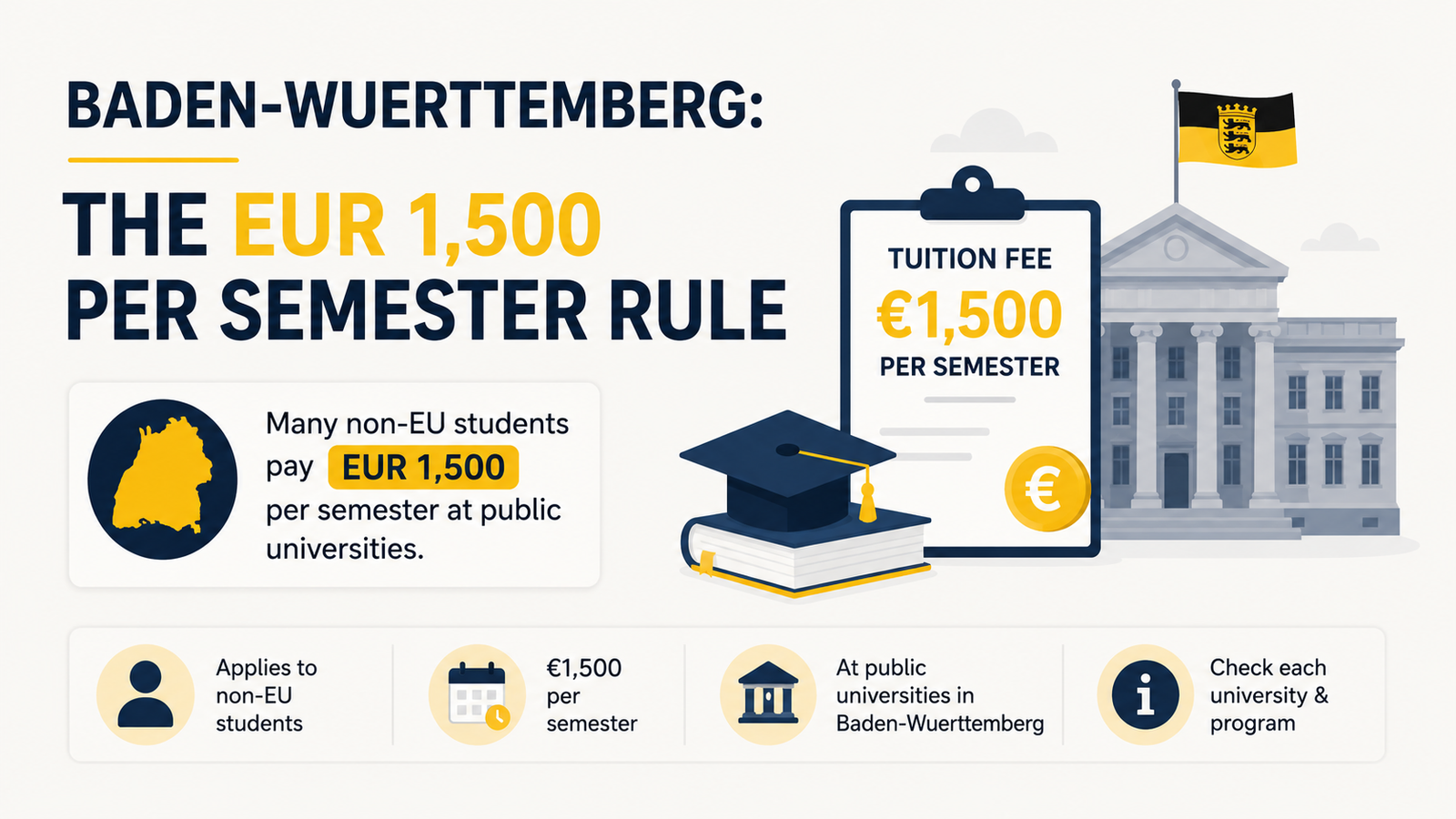
Baden-Wuerttemberg is the most famous exception to Germany’s tuition free image. Many international students from non-EU and non-EEA countries with foreign university entrance qualifications must pay EUR 1,500 per semester at public higher education institutions in the state. This fee is generally in addition to the semester contribution.
This does not mean Baden-Wuerttemberg is a bad choice. The state has respected universities and strong economic regions. But students must compare the academic value of the program with the additional tuition burden, especially if they are already required to show visa financial proof and pay higher rent in competitive cities.
Bavaria and TUM: Why “Public University” Does Not Always Mean Zero Tuition
Bavaria is important because some universities can charge tuition to non-EU or non-EEA students. TUM is the best known example. TUM states that tuition fees for non-EEA international students newly enrolled in Bachelor’s and Master’s programs apply from the winter semester 2024/25, with typical fee ranges depending on program and degree level.
A student applying to TUM should therefore check three separate items: the program tuition, the regular semester fee, and the cost of living in Munich. Munich is academically attractive, but it is also one of Germany’s most expensive student cities.
Semester Contribution Germany: The Cost Many Students Misunderstand
The semester contribution in Germany is not tuition in the ordinary sense, but it is usually mandatory. It may support student services, administration, student union functions, and sometimes a public transport ticket. The amount varies by university and semester, so applicants should check the exact figure on the university’s official enrollment or re-registration page.
A common mistake is telling parents or sponsors that the university is “free” and then forgetting semester payments. Even if the amount is far lower than tuition in many other countries, it still affects the yearly study budget.
Germany Student Visa 2026: Tuition-Free Study Still Requires Financial Proof
A tuition-free admission does not remove the Germany student visa 2026 financial requirement. German missions usually require applicants to show that they can finance their living expenses in Germany. A blocked account is one common method, but official sources also recognize other forms of financial proof depending on the mission and case.
Study in Germany and DAAD currently identify EUR 992 per month, or EUR 11,904 per year, as the student financial proof amount from 1 January 2025 onward. Because financial-proof amounts can be adjusted, students applying later in 2026 should verify the current amount on the German mission’s checklist before transferring funds.
| Financial proof point | What to check before applying |
|---|---|
| Required amount | Confirm the current monthly and yearly amount on the German mission's official checklist. |
| Accepted proof type | Check whether the mission accepts a blocked account, scholarship, parental proof, bank guarantee, or formal obligation letter. |
| Provider acceptance | If using a blocked account, use a provider accepted by the relevant German mission. |
| Timing | Open and fund the account early enough to receive official confirmation before the appointment. |
| Currency and transfer risk | Allow time for international transfers, bank delays, compliance checks, and exchange-rate differences. |
Living Costs Germany Student: Why the City Matters More Than the Tuition Headline
For many students, rent is more important than tuition. A tuition free program in Munich may cost more overall than a paid or low fee program in a cheaper city because monthly housing costs can dominate the budget. Students should compare total yearly cost, not only university tuition.
| City type | Likely cost pressure | Planning comment |
|---|---|---|
| Munich and similar high-cost cities | Very high rent and housing competition. | A strong academic offer may justify the cost, but students need realistic housing and funds. |
| Berlin | High demand and rising rents. | Tuition may be low at public universities, but housing can be difficult. |
| Frankfurt, Hamburg, Stuttgart | Often expensive depending on neighborhood and housing type. | Budget carefully and search early. |
| Leipzig, Jena, Magdeburg, Chemnitz, Passau | Often more affordable than major hubs. | May offer a more manageable student budget if the program fits the academic plan. |
| Aachen and other student cities | Often practical but still competitive. | Good option where program quality, cost, and career prospects align. |
As a planning estimate, many students should prepare for at least the official financial proof level, but actual costs can be higher in expensive cities or if private accommodation is required. Students should not rely on finding part-time work immediately after arrival to cover essential costs.
Can Student Work Make Germany Affordable in 2026?
Student work can help, but it should not be the foundation of the visa plan. Germany allows many international students to work during their studies, but work rights are limited and must not undermine the main purpose of residence, which is study.
Make it in Germany states that international students may generally work 140 full days or 280 half days per year, or up to 20 hours per week during the lecture period. Full-time work may be possible during lecture free periods, but students must also consider tax, social security, insurance, academic workload, employer availability, and university rules.
| Work topic | 2026 planning note |
|---|---|
| Annual work limit | 140 full days or 280 half days is the common rule for many international students. |
| Lecture period | Up to 20 hours per week is generally the practical limit during the lecture period. |
| Semester breaks | Full-time work may be possible within the legal framework and student-status limits. |
| Minimum wage | The statutory minimum wage is EUR 13.90 gross per hour from 1 January 2026. |
| Werkstudent roles | Students may work in university, research, service, technology, automotive, logistics, healthcare support, or business roles depending on language and skills. |
| Freelance/self-employment | Do not assume freelance work is allowed under a standard student residence permit. Check before accepting such work. |
A realistic monthly earning range can vary widely. Some students may earn a modest amount through a mini-job or campus job, while others in Werkstudent roles may earn more. However, work cannot be treated as guaranteed income before arrival, and it may not replace the financial proof required for the visa.
Public vs Private Universities Germany: The Visa Planning Difference
Private universities can be suitable in the right situation, especially where the program is reputable, accredited, career aligned, and financially realistic. But students should not choose a private university only because admission seems easier or faster.
Admission to a private university does not automatically make the visa case strong. The German mission may still look at whether the study plan is credible, whether the student can finance tuition and living costs, whether the academic progression makes sense, and whether the documentation is consistent. If tuition is high, the financial proof challenge becomes more serious.
| Question | Why it matters before choosing a private university |
|---|---|
| Is the institution recognized/accredited? | The student must avoid weak or unclear institutions that create visa credibility problems. |
| Is the program academically logical? | A sudden unrelated program choice may need a strong explanation. |
| Can the student prove tuition plus living costs? | High tuition does not replace the blocked-account or living-cost requirement. |
| Is the program language realistic? | English-taught programs may still require German for daily life, internships, or jobs. |
| Does the program support post-study goals? | A program should connect to employability, not only admission convenience. |
DAAD Scholarship Germany: Helpful, But Not a Shortcut Around Planning
DAAD scholarships and other recognized scholarships can reduce financial pressure and may support visa financial proof if the award clearly states duration and monthly amount. However, scholarships are competitive and often have specific deadlines, academic requirements, and target groups.
Students should not wait for a scholarship result without a backup financial plan. If the scholarship amount does not fully cover the official financial requirement, the German mission may require additional proof.
Route Selection Logic: Which Study Cost Path Fits Your Profile?
| Applicant situation | Possible strategy | Mistake to avoid |
|---|---|---|
| Strong academic profile, limited budget | Prioritize tuition-free public universities in more affordable cities. | Applying only to famous cities without checking rent and housing. |
| Non-EU student applying to Baden-Wuerttemberg | Budget EUR 1,500 per semester plus semester contribution and living costs. | Assuming Heidelberg or Stuttgart is tuition-free because it is public. |
| Student applying to TUM or Bavaria | Check program-level tuition, semester fee, and Munich cost of living. | Thinking "public university" automatically means zero tuition. |
| Student with private university admission | Check accreditation, total tuition, financial proof, and study-plan credibility. | Treating easier admission as a stronger visa case. |
| Student relying on part-time work | Use work as supplementary income only. | Expecting a job immediately after arrival or using future income as the main funding plan. |
| Student comparing Germany with another country | Compare total cost, post-study work, language, employability, and family goals. | Choosing only by tuition without considering residence pathway and career fit. |
Applicant Scenario Section: Realistic Examples
| Applicant Type | Possible Route / Cost Logic | Key Issue | Common Mistake |
|---|---|---|---|
| Pakistani student admitted to a public university in Berlin | Tuition may be zero, but semester contribution, blocked account, health insurance, and rent still apply. | Financial proof and housing plan. | Thinking zero tuition means low total cost. |
| Indian student considering Heidelberg University | Baden-Wuerttemberg non-EU tuition may apply. | EUR 1,500 per semester plus living costs. | Ignoring state-level tuition rules. |
| Engineering applicant considering TUM Munich | Program-level non-EEA tuition may apply, and Munich has high living costs. | Tuition plus city affordability. | Checking admission requirements but not tuition navigator. |
| Student choosing a private business school | Tuition may be significant and must be financed in addition to living costs. | Program credibility and total financing. | Assuming private admission improves visa chances automatically. |
| Student targeting Leipzig or Jena | Potentially lower living costs if the program fits academic and career goals. | Housing search and realistic monthly budget. | Choosing only by cheap rent and ignoring program quality. |
Practical Cost Checklist Before You Apply

- Check the exact program page: Do not rely only on general “Germany is free” articles.
- Confirm the federal state: Baden-Wuerttemberg and some Bavarian institutions need special attention.
- Separate tuition from semester contribution: A zero tuition program can still require semester payments.
- Calculate the blocked-account requirement: Use the current German mission checklist before transferring funds.
- Estimate real city costs: Rent and housing availability can change the entire budget.
- Check health insurance rules: Your insurance category may depend on age, enrollment, and work status.
- Do not rely on immediate part-time income: Work rights exist, but jobs are not guaranteed.
- Prepare a credible study plan: The program should connect logically with your background and career goals.
When AGS Welt Can Help
If you are comparing tuition free public universities, Baden-Wuerttemberg universities, TUM-style tuition structures, private programs, or low-cost student cities, AGS Welt can review your admission plan, financial proof, and visa readiness before you commit to a program.
AGS Welt can assist with route selection, documentation strategy, financial proof planning, study plan review, and Germany student visa preparation where professional support is appropriate. The final decision always remains with the responsible university, German mission, and immigration authority.
Conclusion: Germany Can Be Affordable, But It Is Not Automatically Free
Study in Germany tuition fees 2026 should be understood with precision. Many public universities remain tuition free for international students, but the cost reality is broader than tuition. Semester contribution, blocked account proof, health insurance, rent, city selection, state level exceptions, private university tuition, and student work limits all affect affordability.
The strongest student plan is not simply the cheapest admission offer. It is the program that is academically credible, financially realistic, visa ready, and aligned with the student’s long-term goals in Germany.
General Information Note
This article provides general information and should not be treated as personalized legal advice. Requirements can vary depending on nationality, qualification, profession, university, location, German mission, and responsible authority. Applicants should verify current rules with official sources or seek professional guidance before applying.
FAQ Section
Germany is often tuition free at public universities, but it is not completely free. Students usually pay semester contributions, living costs, health insurance, visa fees, and financial proof amounts. Some states, universities, private institutions, and special programs charge tuition.
Many non-EU students do not pay regular tuition at public universities, but there are exceptions. Baden Wuerttemberg charges many non-EU students EUR 1,500 per semester, and some Bavarian institutions, including TUM, charge program-level tuition.
The semester contribution is a mandatory university payment that may cover administration, student services, student union costs, and sometimes public transport. It is separate from tuition and usually applies even at tuition-free public universities.
Many public universities in states such as Berlin, North Rhine-Westphalia, Hesse, and Lower Saxony often charge no regular tuition for many programs. Students must still check the exact university, program, degree level, and semester contribution.
Costs depend on the city, university, and program. Even with zero tuition, students must budget for semester contribution, financial proof, health insurance, rent, food, transport, and personal expenses. The official financial-proof amount should be checked before applying.
No. A blocked account is financial proof for living expenses during the visa process. Tuition is a university fee for study. A student may need a blocked account even if the university charges no tuition.
Many international students can work 140 full days or 280 half days per year, or generally up to 20 hours per week during the lecture period. Work should be treated as supplementary income, not guaranteed visa funding.
Not always. TUM charges tuition fees for many newly enrolled non-EEA Bachelor’s and Master’s students. The exact amount depends on the program and degree level, and the semester fee is paid separately.
They can be suitable if the institution is recognized, the program is credible, and the student can finance tuition and living costs. Private admission alone does not guarantee a strong visa case.
No. Students should compare program quality, admission fit, city costs, visa readiness, language needs, employability, and long-term residence goals. A free program in an expensive city may not be the cheapest overall option.