
Table of Contents
Germany has become one of the most attractive destinations for skilled professionals looking to build an international career. With a strong economy, excellent quality of life, and increasing demand for qualified workers, the country is actively welcoming international talent.
To address labour shortages across industries such as technology, healthcare, engineering, and skilled trades, Germany has introduced several immigration pathways. Two of the most important options for non-EU professionals are the German Opportunity Card (Chancenkarte) and the EU Blue Card.
While both visas allow foreign professionals to live and work in Germany, they are designed for different types of applicants. The EU Blue Card is aimed at highly qualified professionals who already have a job offer, whereas the Opportunity Card allows skilled individuals to enter Germany even without a job offer and search for employment.
In this guide, we’ll explain the key differences between the German Opportunity Card vs EU Blue Card, including eligibility requirements, benefits, salary thresholds, and which visa may be the best option for your career plans in Germany.
What Is the EU Blue Card?
The EU Blue Card is a residence permit designed for highly skilled professionals from non-EU countries who have secured a qualified job offer in Germany. It was introduced across the European Union to attract talented workers and address skill shortages in key industries.
This visa is considered one of the most attractive immigration pathways because it provides long-term residence, professional mobility, and a fast track to permanent residency.
In Germany, the EU Blue Card is usually issued for up to four years, depending on the length of the employment contract.
Key features of the EU Blue Card
- Requires a qualified job offer from a German employer
- Applicants must hold a recognized university degree or equivalent qualification
- A minimum salary threshold must be met
- Offers a fast pathway to permanent residency
- Allows family members to join the applicant
- Provides strong career opportunities in Germany’s labour market
Because of these benefits, the EU Blue Card is often considered the best option for professionals who already have employment secured in Germany.
EU Blue Card Eligibility Requirements
To apply for the EU Blue Card in Germany, applicants must meet several criteria established by German immigration authorities.
Main requirements
Applicants must:
- Be a non-EU or non-EEA citizen
- Have a recognized university degree or equivalent qualification
- Hold a concrete job offer from a German employer
- Work in a position that matches their qualifications
- Meet the minimum salary requirement
In some professions, especially regulated occupations such as medicine or law, applicants may also need to obtain professional recognition or licensing before starting employment.
EU Blue Card Salary Requirement (2026)
One of the most important conditions for obtaining the EU Blue Card is meeting the minimum salary threshold.
For 2026, the expected salary requirement is approximately:
€50,700 per year
However, a lower salary threshold may apply to professions experiencing labour shortages.
Examples of shortage occupations
- IT specialists
- engineers
- doctors
- mathematicians
- natural scientists
For these fields, the required salary may be reduced to around €43,000–€45,000 annually, depending on policy updates and approval from German authorities.
This flexibility allows Germany to attract professionals in industries where demand is particularly high.
Benefits of the EU Blue Card
The EU Blue Card provides several advantages that make it one of the most attractive work visas in Germany.
Fast pathway to permanent residency
EU Blue Card holders can apply for permanent residence in Germany after 27 months.
If the applicant demonstrates B1-level German language proficiency, this period can be reduced to 21 months.
Family reunification
Family members, including spouses and children, can join Blue Card holders in Germany. Spouses are typically allowed to work without restrictions, making it easier for families to relocate together.
Career stability and flexibility
The EU Blue Card offers strong job security and allows professionals to change employers under certain conditions while maintaining their residence permit.
Mobility within the European Union
After living in Germany for a certain period, Blue Card holders may also have the opportunity to move and work in other EU countries, depending on national regulations.
EU Blue Card for IT Professionals Without a Degree
Germany has also introduced more flexible policies to attract experienced professionals in the technology sector.
IT specialists may still qualify for the EU Blue Card even without a university degree, provided they meet certain requirements.
Requirements for IT professionals
Applicants must demonstrate:
- At least three years of professional experience in the IT sector
- A qualified job offer in Germany
- A salary that meets the Blue Card threshold
This policy recognizes practical experience as equivalent to academic qualifications, making Germany more accessible to skilled tech professionals worldwide.
What Is the Opportunity Card (Chancenkarte)?
The German Opportunity Card, also known as the Chancenkarte, was introduced in 2024 as part of Germany’s efforts to attract international talent.
Unlike the EU Blue Card, the Opportunity Card does not require a job offer before entering Germany.
Instead, it allows qualified professionals to move to Germany and search for employment for up to one year.
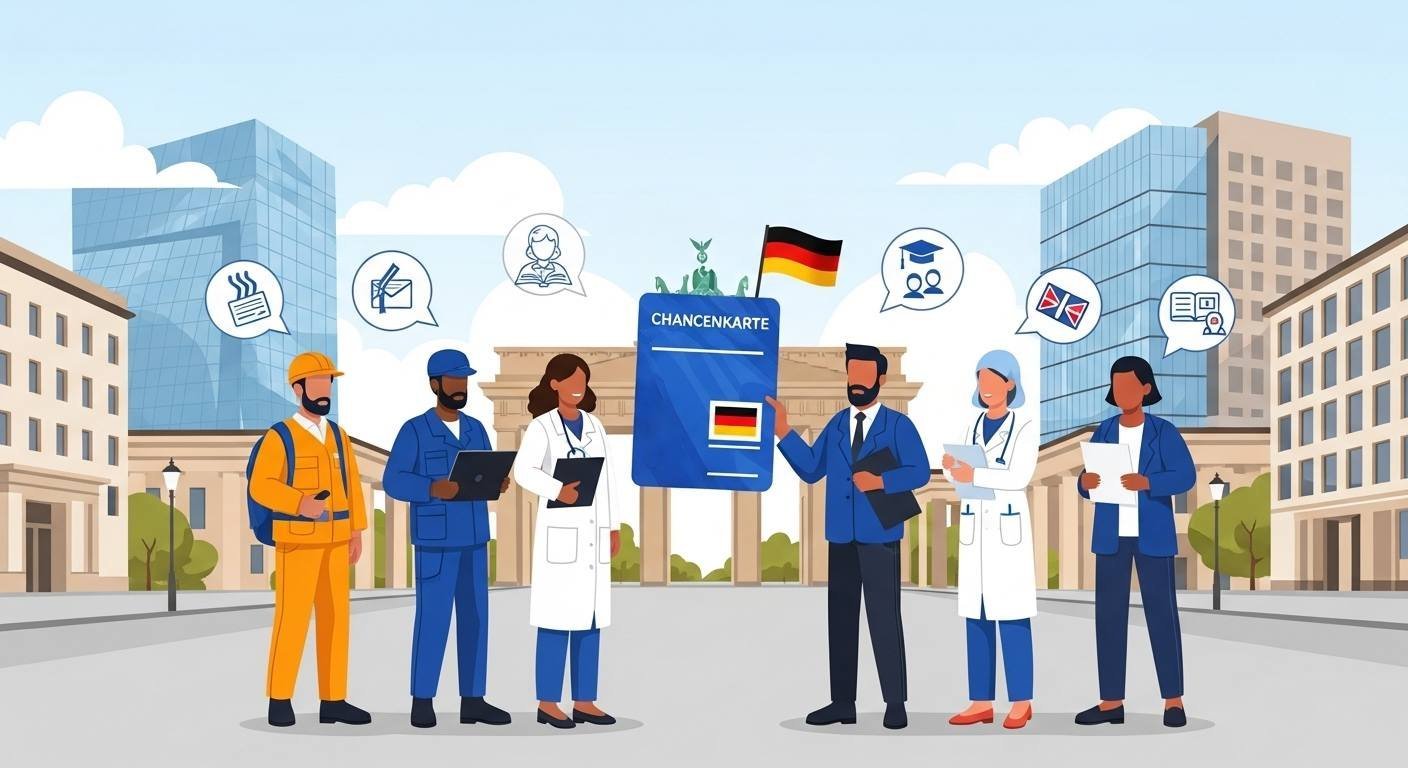
This visa is based on a points-based immigration system, which evaluates applicants based on factors such as education, work experience, age, and language skills.
The Opportunity Card provides a more flexible pathway for professionals who want to explore job opportunities in Germany but have not yet secured employment.
Opportunity Card Key Features
The Opportunity Card offers several advantages for job seekers.
Key features include
- No job offer required before entering Germany
- Stay in Germany for up to 12 months
- Ability to search for qualified employment
- Permission to work part-time up to 20 hours per week
- Possibility of transitioning to another work visa once employment is secured
This visa is particularly attractive for recent graduates, career switchers, and professionals who want to explore the German job market directly.
Opportunity Card Eligibility Requirements
To apply for the Opportunity Card, applicants must meet several basic requirements.
Main eligibility criteria
Applicants must:
- Be a non-EU citizen
- Hold a recognized academic or vocational qualification
- Demonstrate sufficient financial resources
- Meet the points system requirement
- Show language proficiency if required
Eligibility can be achieved through either the direct route or the points-based route.
Opportunity Card Points System
The Opportunity Card uses a points system similar to immigration systems used in countries like Canada.
Applicants must accumulate at least six points to qualify.
Points are awarded for
- Educational qualifications
- Professional work experience
- Age
- German or English language proficiency
- Previous stays in Germany
- Having a partner who also qualifies
This system allows Germany to evaluate candidates based on their overall potential to integrate into the labour market.
Direct Route vs Points System Route
Applicants can qualify for the Opportunity Card through two different pathways.
Direct Route
This option is available for applicants whose qualifications are fully recognized in Germany.
Requirements include:
- recognized academic or vocational qualification
- proof of financial resources
In this case, language proficiency may not be mandatory.
Points System Route
Applicants whose qualifications are not fully recognized in Germany can apply through the points system.
Requirements include:
- qualification recognized in the country of origin
- minimum six points
- language proficiency (Above-intermediate German and/or English language skills (strong, demonstrable English language skills alone are also sufficient)
Financial Requirements for the Opportunity Card
Unlike the EU Blue Card, Opportunity Card applicants must prove they can financially support themselves while searching for a job.
The most common method is through a blocked account.
Required financial proof
Applicants must show approximately:
€13,000 per year
or about €1,091 per month
This ensures that applicants can cover living expenses while job hunting in Germany.
Opportunity Card Validity and Extension
The Opportunity Card is initially valid for up to 12 months.
During this time, applicants can:
- search for employment
- participate in trial work
- work part-time
If the applicant secures a job, they can then transition to another residence permit such as:
- EU Blue Card
- Qualified Work Visa
- Skilled Worker Visa
This makes the Opportunity Card a stepping stone toward long-term residence in Germany.
German Opportunity Card vs EU Blue Card: Key Differences
Although both visas support skilled migration, they are designed for different stages of the employment process.
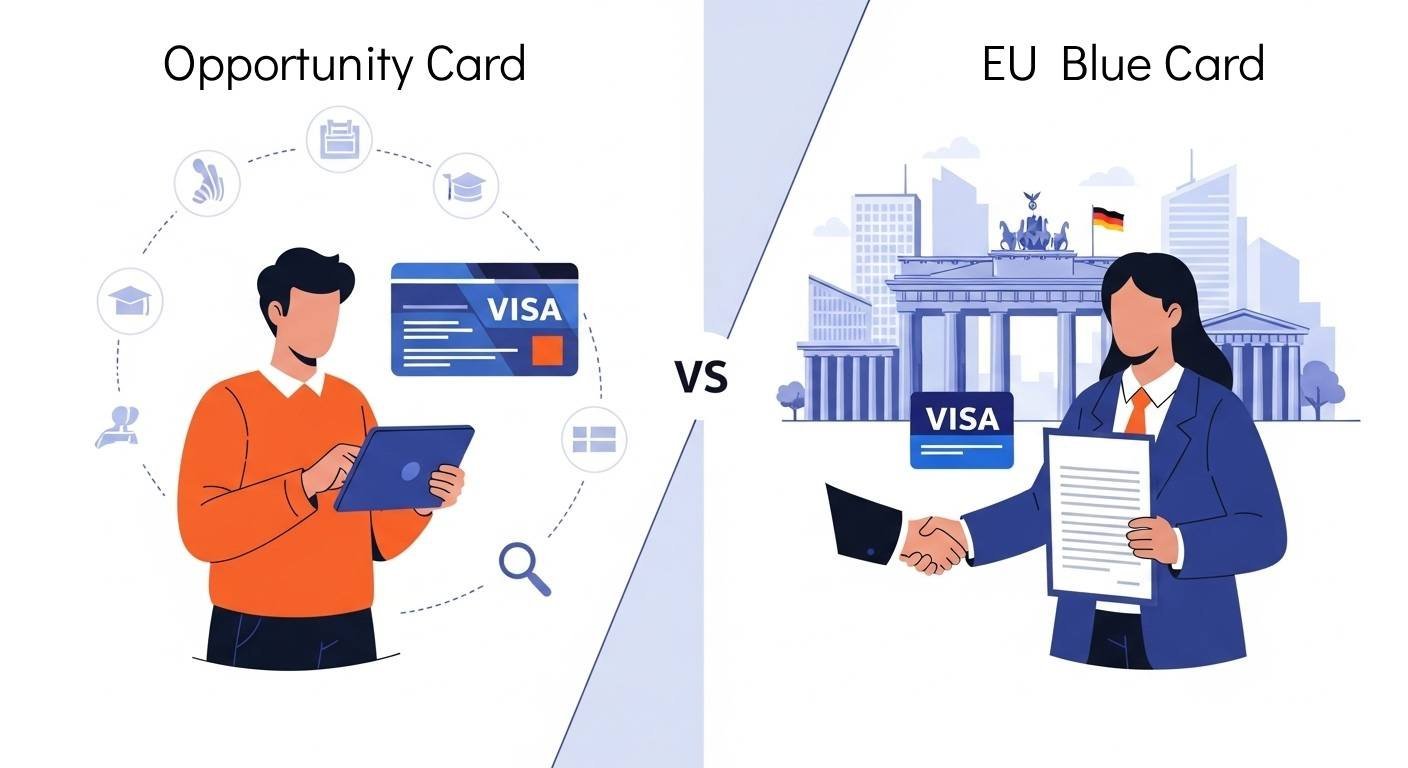
The most important difference between the German Opportunity Card vs EU Blue Card is the job offer requirement.
The EU Blue Card requires a confirmed job offer and salary threshold, while the Opportunity Card allows applicants to enter Germany and search for work first.
Comparison: Opportunity Card vs EU Blue Card
| Feature | Opportunity Card | EU Blue Card |
| Job Offer | Not required | Required |
| Salary Requirement | None | Approx €50,700 |
| Visa Duration | Up to 12 months | Up to 4 years |
| Language Requirement | Above-intermediate German and/or English language skills (strong, demonstrable English language skills alone are also sufficient) | Not mandatory |
| Financial Proof | Required | Not required |
| Permanent Residency | Clock starts only after employment | Fast-track pathway |
| Family Reunification | After securing job | Immediate |
Which German Work Visa Should You Choose?
Choosing between the German Opportunity Card vs EU Blue Card depends on your professional situation.
Choose the Opportunity Card if
- you do not yet have a job offer in Germany
- you want to explore the German labour market
- you meet the points system requirements
Choose the EU Blue Card if
- you already have a qualified job offer
- your salary meets the required threshold
- you want a faster path to permanent residency
Both options can lead to long-term career opportunities in Germany.
How to Apply for German Work Visas
The application process for both visas typically follows these steps.
Step 1: Check qualification recognition
Applicants should verify whether their degree is recognized using the ANABIN database or request a Statement of Comparability from ZAB.
Step 2: Prepare required documents
Common documents include:
- passport
- academic certificates
- CV
- employment contract (if applicable)
- language certificates
- proof of financial resources
Step 3: Submit application
Applications can often be submitted through the German Consular Services Portal or at the nearest German embassy.
Step 4: Attend visa interview
Applicants may be required to attend an interview to verify documents and eligibility.
Conclusion
Germany offers multiple pathways for international professionals who want to build a career in one of Europe’s strongest economies. Understanding the difference between the German Opportunity Card vs EU Blue Card is essential when choosing the right immigration pathway.
The EU Blue Card is ideal for professionals who already have a high-paying job offer in Germany and want a fast track to permanent residency. The Opportunity Card, on the other hand, provides flexibility for skilled workers who wish to enter Germany and search for employment before committing to a specific job.
By evaluating your qualifications, career goals, and employment situation, you can select the visa that best supports your journey to living and working in Germany. For more information or professional legal consultancy services, contact us today!
Frequently Asked Questions (FAQs)
1. What is the German Opportunity Card?
The German Opportunity Card is a points-based visa that allows skilled professionals from non-EU countries to enter Germany and search for employment for up to one year.
2. What is the EU Blue Card in Germany?
The EU Blue Card is a residence permit for highly qualified professionals who have a job offer in Germany with a minimum salary threshold.
3. What is the main difference between the German Opportunity Card and EU Blue Card?
The Opportunity Card does not require a job offer, while the EU Blue Card requires a confirmed job offer and salary requirement.
4. Can I apply for the Opportunity Card without a job offer?
Yes. The Opportunity Card allows you to move to Germany and search for employment without a job offer.
5. What salary is required for the EU Blue Card?
The salary requirement is approximately €50,700 per year, with lower thresholds for shortage occupations.
6. How long is the Opportunity Card valid?
The Opportunity Card is usually valid for up to 12 months.
7. Can Opportunity Card holders work in Germany?
Yes. Holders can work part-time up to 20 hours per week and participate in trial jobs.
8. Can I switch from Opportunity Card to EU Blue Card?
Yes. Once you secure a qualifying job offer, you can switch to the EU Blue Card.
9. Do I need German language skills for the Opportunity Card?
Applicants may need A1 German or B2 English, depending on the eligibility route.
10. Do I need language skills for the EU Blue Card?
German language skills are not mandatory but can help with integration and permanent residency.
11. Can I bring my family with the EU Blue Card?
Yes. Family reunification is allowed for spouses and children.
12. Can family members join Opportunity Card holders?
Family reunification usually becomes possible after the applicant secures employment.
13. What is the points system for the Opportunity Card?
Applicants need at least 6 points, based on education, experience, age, language skills, and connections to Germany.
14. What is a blocked account for Germany?
A blocked account is a bank account that proves you have enough funds to support yourself while living in Germany.
15. How much money is required for the Opportunity Card?
Applicants typically need around €13,000 per year to prove financial stability.
16. How long does it take to process a German work visa?
Processing times usually range from 4 to 12 weeks, depending on the embassy and application volume.
17. Can I work in Germany without a degree?
Yes. Experienced professionals, especially in IT fields, may qualify based on work experience.
18. What is ANABIN?
ANABIN is a database used to verify whether foreign academic qualifications are recognized in Germany.
19. Which visa is better for working in Germany?
It depends on your situation. If you already have a job offer, the EU Blue Card is usually the better option.
20. Is Germany good for skilled immigrants?
Yes. Germany has a strong economy and actively welcomes skilled workers to address labour shortages.