
Introduction
Lithuania allows non-EU nationals to bring family members through a temporary residence permit on the basis of family reunification. In student-related cases, this usually includes a spouse or registered partner and dependent minor children. For bachelor’s students, family reunification is generally not immediate, and the student usually needs to first obtain a residence permit and meet the relevant legal conditions before applying for family members.
By contrast, master’s and PhD students are in a more favourable position, as they and their family members can generally apply at the same time, making the process more straightforward. This means that, depending on the level of study and immigration status, international students may be able to legally bring family to Lithuania through the proper residence permit process.
Can students legally bring family to Lithuania?
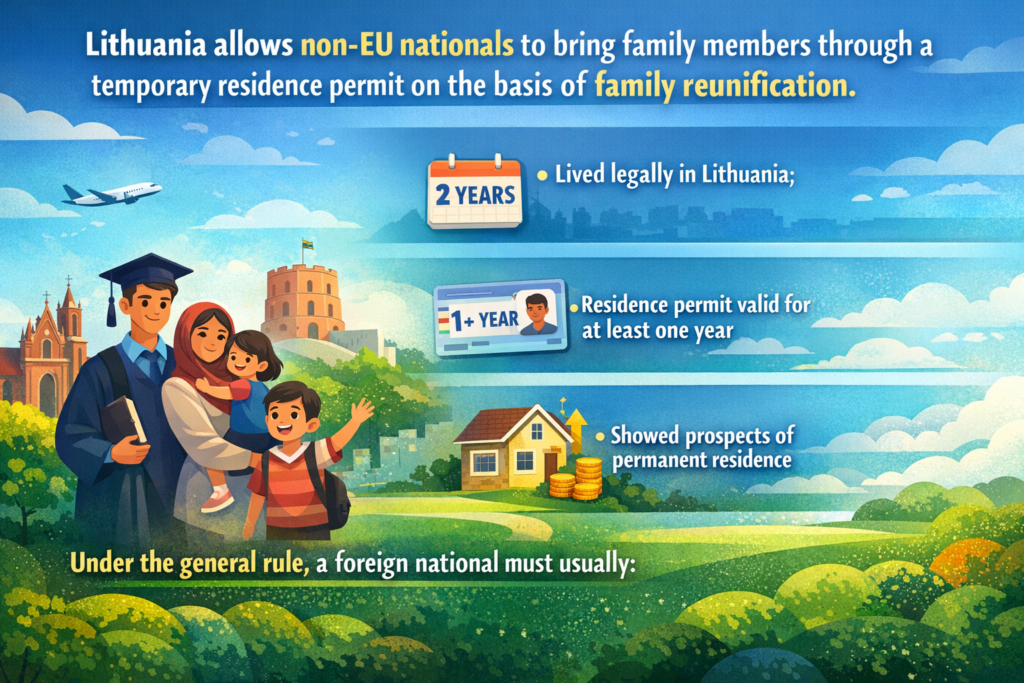
Lithuania allows non-EU nationals to bring family members through a temporary residence permit on the basis of family reunification. In most student-related cases, this means a spouse or registered partner and dependent minor children. Under the general rule, however, a foreign national with a temporary residence permit must usually have lived legally in Lithuania for at least two years, held a residence permit valid for at least one year, and shown reasonable prospects of permanent residence before bringing family members. For master and PhD student reunification is simplier, straight forward and easier. They can apply together but surely the requirements
The most important rule in 2026: study level matters
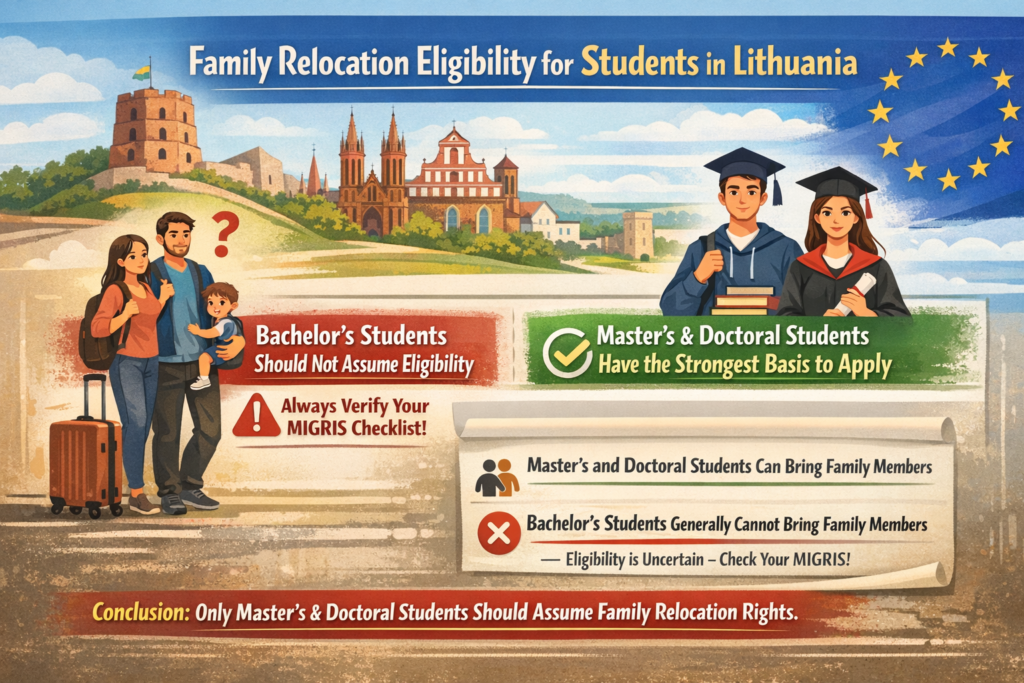
In Lithuania, family reunification rules for students depend heavily on the level of study. Bachelor’s students should not assume that their spouse or children can apply together with them immediately, because they usually need to secure their own residence status first. However, master’s and PhD students are generally allowed to apply together with their family members, which makes relocation planning much easier for them. For this reason, anyone planning to move with a spouse or children should check eligibility carefully based on the study level before starting the process, especially if they want to legally bring family to Lithuania through the correct immigration route.
Who can usually apply as family members?
For student-family cases, the most relevant categories are usually a spouse or registered partner and unmarried dependent minor children. For families asking how to legally bring family to Lithuania, the practical discussion is usually about a husband, wife, partner, or child joining the main student sponsor in Lithuania.
Financial requirements in 2026
Financial proof is one of the biggest reasons applications become weak. For a student’s own residence permit, the Migration Department says the required subsistence amount is 0.5 of the minimum monthly wage per month, and it must cover the requested permit period or at least one year. With Lithuania’s minimum monthly wage at EUR 1,153 from 1 January 2026, that works out to about EUR 576.50 per month for the student’s own study-based residence calculation.
For family reunification, the threshold is higher. The Migration Department’s residence-permit service pages state that the subsistence requirement is one minimum wage per month for an adult family member, while for a minor foreigner the amount is 0.5 minimum wage per month. Using the 2026 minimum wage, applicants should plan on roughly EUR 1,153 per adult family member per month and EUR 576.50 per minor child per month, unless MIGRIS shows a different case-specific requirement.
In practical terms, students should prepare strong financial evidence rather than relying on assumptions. That can include bank statements, an undertaking from the sponsor or supporting relative, and supporting documents such as an employment contract. If you plan to move with family, it is wise to calculate not only the legal minimum but also your real monthly living costs.
Accommodation requirements
Housing is another area where many people make mistakes. For the student’s own residence application, the current student page says the dwelling should provide at least 4 square metres per adult declaring residence there. However, the family-reunification service pages use the stricter family standard of at least 7 square metres per adult declaring residence there. For anyone planning how to legally bring family to Lithuania, the 7 square metre rule is the more relevant practical standard.
This means students planning to bring a spouse or children should not assume that ordinary dormitory accommodation will be enough. In most real cases, suitable private family accommodation is the safer option, especially if multiple adults will declare residence at the same address and the goal is to legally bring family to Lithuania without avoidable housing issues.
Health insurance requirements
keyword: Legally Bring family to lithuania
Health insurance is a mandatory part of the application. The Migration Department says insurance must cover emergency medical care and expenses connected to the foreigner’s return to the home country for health reasons, including transport and medical escort where necessary. The insurance must generally remain valid for the entire requested residence period or at least one year, unless compulsory health insurance contributions are already being paid in Lithuania.
Some public-facing sources also still mention an insurance sum of EUR 6,000 in the family-reunification context. The safer way to write this in a professional article about how to legally bring family to Lithuania is not to present that figure as the only legal test, but to say that the policy must satisfy Lithuania’s coverage requirements and applicants should follow the exact insurance instructions shown in MIGRIS for their case when planning to legally bring family to Lithuania.
Documents required for family reunification
A strong family-reunification application usually includes passports, proof of relationship, proof of lawful stay in Lithuania, evidence of sufficient funds, accommodation documents, and health insurance. For families planning how to legally bring family to Lithuania, applicants may also need conviction or non-conviction certificates from countries where they lived during the previous two years. Foreign civil-status documents may need translation into Lithuanian and legalisation or Apostille, depending on the country and document type.
The safest practical advice is to avoid relying on a generic blog checklist alone. The best approach is to generate the exact list of documents through MIGRIS, because the checklist can differ depending on whether the applicant is a spouse, child, or another family category, and whether the sponsor is a student, graduate, or another type of permit holder. This is especially important for anyone trying to legally bring family to Lithuania without delays or document-related problems.
How to apply through MIGRIS
Lithuania’s residence-permit process starts electronically through MIGRIS, the Lithuanian Migration Information System. The student residence page says the applicant must complete the request online, upload digital copies of the required documents, and then appear in person within 4 months to submit biometrics and original documents after booking the visit through MIGRIS. In practice, families should understand that the process is not purely online; the in-person stage is a key part of the application for anyone planning to legally bring family to Lithuania.
If the applicant is abroad, Lithuania also uses external service providers in certain countries. Lithuania changed the list of countries where foreigners can submit temporary residence permit or national visa applications through these providers from 22 October 2025, so families applying from abroad should always verify where they can file before making travel plans if they want to legally bring family to Lithuania without unnecessary delays.
Processing time and fees
For most temporary residence permits, the Migration Department’s current fee page lists a state fee of EUR 160 under the general procedure and EUR 320 under the urgent procedure. Personalisation of a new temporary residence permit card costs EUR 45 under the general procedure or EUR 90 urgently. Students admitted to a Lithuanian study or doctoral programme benefit from a reduced general-order processing fee of EUR 80 for the study-based permit itself, which is helpful for those planning to legally bring family to Lithuania.
The family-permit service pages show that issuance is commonly processed within 3 months under the general procedure or 45 calendar days under the urgent procedure, while changing an existing permit usually takes 2 months under the general procedure or 1 month under the urgent procedure. Families should still allow extra time for appointment availability, translations, legalisation, and document collection when preparing to legally bring family to Lithuania smoothly.
Can your spouse work in Lithuania?
Yes. Family members who receive a residence permit on the basis of family reunification can work in Lithuania without a separate work permit. Public guidance also says they may change employer without restrictions. This is one of the most important practical advantages of family reunification in Lithuania and can make relocation much more realistic financially.
Can students work while studying?
This point needs careful wording because current public guidance is not fully consistent. The Migration Department FAQ says there are no limitations or restrictions for work if you hold a temporary residence permit on the basis of studies. However, the EU Immigration Portal for Lithuania still states that students may work up to 20 hours per week, with doctoral students exempt from that limitation. Because these two public sources do not say the same thing, students should confirm the current work rule directly with the Migration Department or their university’s international office before depending on employment income in their financial planning.
How long will the family permit remain valid?
A family member’s temporary residence permit is generally linked to the sponsor’s status. Public guidance says the permit is issued for the same period as the residence permit of the person the family member is joining in Lithuania. This is an important planning point, because if the main student’s residence status expires and is not renewed or changed to another legal basis, the family’s right to stay may also be affected. For anyone planning to legally bring family to Lithuania, maintaining the sponsor’s valid residence status is essential to avoid complications for the entire family.
What happens after studies end?
Lithuania does provide a post-study route. The current student page says that, after completing studies, a graduate may apply for a temporary residence permit for 12 months to look for work, take up employment, or become self-employed. That makes post-study planning especially important for students who want to keep their family together in Lithuania after graduation and continue to legally bring family to Lithuania under a valid residence status.
Final verdict
Yes, international students can bring family to Lithuania, but the right is not universal for all students. As of 1 April 2026, the strongest current operational guidance says that master’s and doctoral students can bring family members, while general family-reunification rules remain more restrictive for others. A successful application depends on the correct legal basis, enough funds, suitable accommodation, valid health insurance, and a properly prepared MIGRIS file for those planning to legally bring family to Lithuania.
For a trustworthy article, the best professional advice is simple: treat the Migration Department service pages and your exact MIGRIS checklist as the main source of truth, especially because some official public pages still differ on student work rights and study-level eligibility. That honesty makes the article more credible, not less, particularly for anyone trying to legally bring family to Lithuania with accurate and up-to-date information.
Can bachelor’s students bring family to Lithuania?
Bachelor’s students should not assume automatic eligibility for immediate family reunification. The official exception clearly names students studying for a doctor’s degree, while other cases should be checked individually through MIGRIS or the Migration Department.
Can PhD students bring their spouse and children to Lithuania?
Yes, their family members can apply together.
Is there a Lithuania student dependent visa?
People often search for a “student dependent visa,” but the official Lithuanian route is usually handled through family reunification and temporary residence permit procedures rather than a simplified dependent-visa label.
Can a spouse work in Lithuania after family reunification?
Yes. Public Lithuania guidance says family members who receive residence permits on this basis can start working after they receive the residence permit and do not need a separate work permit for that step.
How do family members apply?
The application begins through MIGRIS, followed by a booked appointment for biometric data and original document verification either in Lithuania or via an external service provider, depending on the case.