The Portugal student visa 2026 non-EU route is becoming more attractive because many international students want a European study option that feels more affordable and flexible than the UK, Canada, Ireland, the Netherlands or other high-cost destinations. Portugal offers real advantages: public and private universities, growing English taught programmes, a safe lifestyle, Schengen area access, and a warmer, more relaxed environment than many northern European countries.
However, Portugal should not be presented as an easy shortcut to Europe. A good Portugal study plan requires more than university admission. Non-EU students must understand the visa category, proof of funds, accommodation, AIMA residence permit process, language reality, post-study options and recent immigration policy changes. This guide explains Portugal as a study destination in 2026 with a practical, accurate and student focused approach.
Quick Answer: Is Portugal an Underrated Study Destination?
Yes, Portugal can be one of Europe’s most underrated study destinations for the right student. It may be a strong option if you want a European degree, manageable living costs outside the most expensive cities, English taught Master’s or PhD options, and a pathway to experience the EU labour market after graduation. It may be a weaker choice if your long-term plan depends on immediate high salaries, no local language learning, or outdated assumptions about fast citizenship.
| Student Question | Practical Answer |
|---|---|
| Is Portugal good for international students? | Yes, especially for students who choose a credible programme and prepare funds, accommodation and residence steps carefully. |
| Is Portugal cheaper than Germany? | Not always. Tuition may be higher than many German public universities, but lifestyle and admission factors can make Portugal more practical for some students. |
| Can I study in English? | Yes, many programmes are available in English, especially at Master’s and PhD level, but availability depends on university and field. |
| Can I work while studying? | Higher-education residence permit holders may work under Portuguese rules, but work should be complementary to the study purpose and properly documented. |
| Is Portugal still a 5-year citizenship strategy? | This should not be assumed. Recent nationality-law reform has created uncertainty and longer proposed timelines. Verify current law before planning. |
Study Portugal International Students 2026: Who Should Consider It?
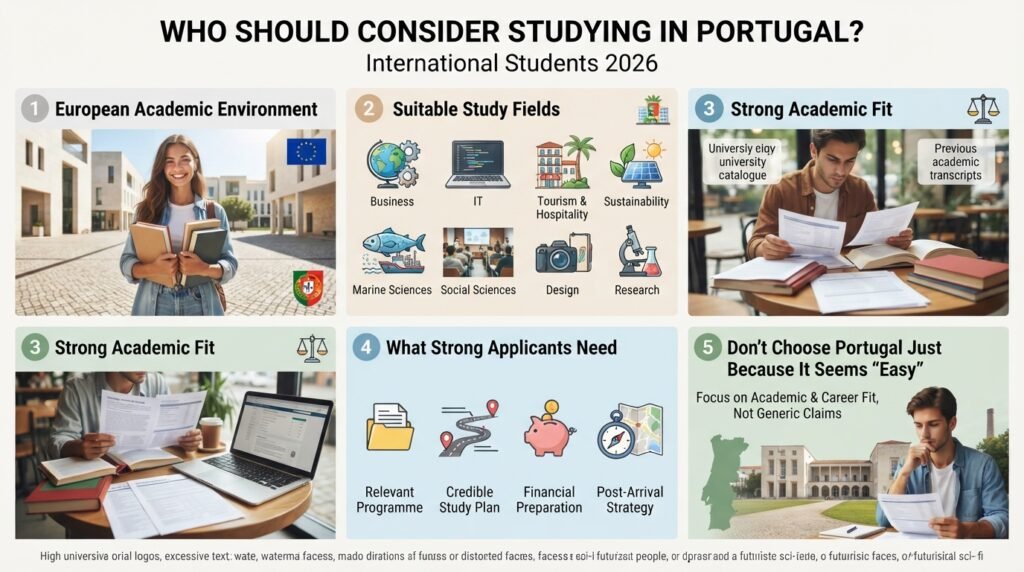
Portugal is a realistic option for students who want a European academic environment but may not want the highly competitive admission, language, or documentation requirements associated with some other EU destinations. It is particularly suitable for students considering business, management, tourism, hospitality, IT, digital fields, sustainability, marine sciences, social sciences, public policy, design, and research based postgraduate programmes.
The strongest applicants are not those who simply want to enter Europe. They are students who can explain why a specific Portuguese programme fits their academic history and career goals. A well-selected programme, a credible study plan, sufficient financial preparation and a realistic post-arrival strategy are far more important than generic claims about Portugal being “easy.”
| Student Profile | Portugal May Fit If | Main Risk |
|---|---|---|
| Master’s applicant | The programme is credible, English-taught and aligned with prior education. | Choosing a low-value programme only because admission is easy. |
| Budget-conscious student | The student can afford tuition, rent, insurance and arrival costs for at least the first year. | Underestimating Lisbon or Porto housing costs. |
| Student comparing EU options | Portugal feels more practical than Germany, France or the Netherlands based on language and admission fit. | Assuming Portugal is always easier or cheaper. |
| Post-study focused applicant | The degree connects to Portuguese employment sectors or international employers. | Expecting automatic employment or residence after graduation. |
Why Study Portugal Non EU 2026: The Real Advantages
The main reason to study in Portugal is not that it is a shortcut. The stronger reason is that Portugal can offer a balanced European study experience: recognized universities, Bologna-compatible degrees, international student communities, relatively accessible living conditions in many cities, and opportunities to build professional networks in Portugal and across the EU.
- Portugal is part of the European Higher Education Area, so degrees generally follow the Bologna structure used across Europe.
- Lisbon and Porto host many international companies, start-ups, service centres and technology employers, although competition is real.
- Several universities offer English taught programmes, especially at postgraduate level.
- Smaller cities such as Coimbra, Braga, Aveiro and Faro may offer a more manageable student lifestyle than Lisbon or Porto.
- Portugal can be attractive for students who value safety, climate, culture and gradual integration into Europe.
Portugal vs Other EU Countries Study: Where Portugal Stands
Portugal should be compared honestly with other European study destinations. Germany may be stronger for engineering, manufacturing, healthcare and high-volume industrial employment. The Netherlands and Ireland may offer more English dominant environments, but their tuition and housing costs can be significantly higher. France and Spain may have strong universities but often require more local language integration. Portugal sits in the middle: accessible, increasingly international, but not risk-free.
| Factor | Portugal | Germany | Netherlands/Ireland |
|---|---|---|---|
| Tuition | Moderate to variable; non-EU fees depend on institution. | Many public universities have low or no tuition, but costs and admission rules vary by state and programme. | Often higher, especially for non-EU students. |
| Language | English is common in universities and urban areas, but Portuguese matters for integration. | German is very important for many jobs and long-term integration. | English is easier for daily study and work, but housing and cost pressure are high. |
| Housing | Lisbon and Porto are expensive; smaller cities can be more manageable. | Severe housing pressure in many student cities. | Very high housing pressure in major cities. |
| Post-study logic | Possible if the student secures the correct residence pathway and employment fit. | Strong labour market in many technical fields. | Good prospects in some sectors, but immigration and cost barriers can be higher. |
Portugal Student Visa Requirements Overview
For non-EU students, the correct route depends on nationality, duration of study and programme type. Portuguese visa guidance distinguishes temporary stay visas from residence visas. Temporary stay visas generally cover stays of less than one year, while residence visas are used for longer stays and allow entry for the purpose of applying for a residence permit with AIMA after arrival.
This distinction is critical. A residence visa is not the final residence card. It is the entry stage. The student must still complete the residence permit process in Portugal and continue meeting the relevant conditions. The European Commission’s student guidance for Portugal also explains that non-EU students generally need a residence visa and residence permit for study.
| Requirement Area | What to Prepare |
|---|---|
| Admission | Acceptance or enrolment evidence from a recognized Portuguese institution. |
| Passport | Valid passport or travel document, with validity suitable for the visa and residence process. |
| Financial means | Proof of means of subsistence based on official Portuguese rules and the purpose/duration of stay. |
| Accommodation | Housing evidence, booking, rental arrangement, university accommodation confirmation or credible plan, depending on the consulate and case. |
| Insurance/health coverage | Travel medical insurance for the visa stage and health insurance or national-health-service coverage for residence stage where applicable. |
| Criminal record | Police clearance or criminal-record documents where required. |
| AIMA step | Residence-permit appointment or procedure after arrival, depending on the student’s visa and applicable process. |
Portugal Student Visa 2026 Non EU: Financial Proof and Cost Reality
Portugal is not “cheap Europe” anymore, especially in Lisbon and Porto. Students must budget for tuition, rent, deposit, insurance, food, transport, document legalization, translations, visa service fees and residence permit costs. The official Portuguese visa portal states that proof of sufficient means is mandatory for long-stay visa applications and that the 2026 benchmark is the minimum monthly salary of EUR 920, with percentage increases for family members.
This does not mean every student simply shows EUR 920 once. It means the financial analysis is connected to the official minimum salary benchmark, the duration and purpose of stay, and the family composition. Students should prepare clear, traceable and liquid funds rather than relying on informal sponsor letters or last minute deposits.
| Cost Category | Practical 2026 Guidance |
|---|---|
| Tuition | Check the official university page. Non-EU fees can be higher than EU/local fees and vary widely by programme. |
| Living costs | Plan more for Lisbon and Porto; consider Coimbra, Braga, Aveiro or other cities if budget is tight. |
| Proof of funds | Use official means-of-subsistence logic. Keep funds liquid, documented and consistent with sponsor evidence. |
| Accommodation | Do not wait until the last moment. Housing proof is often one of the practical weaknesses in student files. |
| Arrival buffer | Keep funds for deposits, first month rent, local transport, phone, NIF-related steps and emergency expenses. |
English-Taught Study in Lisbon and Porto: Useful, But Not Enough Alone
English taught programmes are one reason Portugal is becoming more visible. Lisbon and Porto universities, polytechnics and private institutions may offer English medium programmes in business, management, international relations, technology, tourism, design and other fields. However, students should not choose a programme only because it is in English. The academic logic must be credible.
- Confirm that the institution is recognized and that the degree is legitimate for your academic and career goals.
- Check whether the programme is fully in English or only partly in English.
- Review tuition, refund policies, internship options, campus location and student support services.
- Prepare an explanation of why Portugal and that specific programme make sense for your background.
- Begin Portuguese language learning early if you plan to work or stay after graduation.
Can Non-EU Students Work in Portugal?
Work rights must be explained carefully. Higher education students may be able to work in Portugal, but employment should remain compatible with the purpose of the residence permit. Students should not treat part-time work as a replacement for financial proof or assume that they can fund the entire first year through immediate employment.
The EU Immigration Portal states that secondary education students, unpaid trainees and volunteers are not allowed to work with their residence permit. For higher education students, work may be possible, but practical compliance matters: tax number, social security, employment contract, student status, and any applicable AIMA notification or evidence requirements should be handled correctly.
| Work Scenario | Safe Planning Approach |
|---|---|
| Part-time work during studies | Possible for many higher-education students, but should remain secondary to study and properly documented. |
| Freelance or self-employment | May require additional tax and social-security steps. Do not begin without understanding compliance. |
| Depending on work income | Risky. Visa-stage financial proof should be strong before arrival. |
| English-only employment | Possible in some international sectors, but Portuguese improves options significantly. |
Post-Study Options: Job Search, Work Residence and Long-Term Planning
Students should separate three different ideas: studying in Portugal, staying after graduation, and becoming a long-term resident or citizen. These are related but not identical. After graduation, a student may need to move into a suitable temporary residence pathway for work, highly qualified activity, entrepreneurship or job search, depending on the law and AIMA rules in force at the time.
Portugal also changed its job-seeker visa framework in 2025. The Portuguese visa portal announced that the previous job-seeker visa no longer exists as previously defined and that consular offices and providers would no longer accept those applications from October 23, 2025. This makes it even more important not to rely on old blog articles or generic “Portugal job seeker visa” claims when planning 2026 options.
Important Warning: Do Not Market Portugal as a Guaranteed 5-Year Citizenship Route

A major problem in older Portugal content is the repeated claim that students can simply study, stay five years and apply for citizenship. That is no longer a safe statement. Portugal’s nationality law environment has been changing. Public reporting and reform proposals have described a move toward longer naturalization periods, including 10 years for many applicants and 7 years for certain groups, although students must verify the current law and implementation status through official legal sources before making decisions.
For ethical student counselling, Portugal should be presented as a study and residence planning option, not as a guaranteed citizenship shortcut. Students should decide based on programme quality, affordability, legal eligibility, employability, and realistic integration capacity.
Common Mistakes Non-EU Students Make When Choosing Portugal
- Selecting a programme only because admission is easy, without checking academic credibility or career fit.
- Using outdated articles that still describe Portugal as a simple 5-year passport route.
- Budgeting for tuition but not budgeting for rent deposits, insurance, translations, visa service fees and arrival costs.
- Assuming English is enough for long-term employment and integration.
- Confusing the residence visa with the final residence permit.
- Waiting until after arrival to understand AIMA documentation and appointment requirements.
- Using weak sponsor evidence or unexplained funds that create credibility issues.
- Ignoring country specific consular requirements, including VFS, BLS or TLS documentation differences.
Decision Checklist: Is Portugal Right for You?
| Question | If Yes | If No |
|---|---|---|
| Do you have a real academic reason for Portugal? | Proceed to programme and visa-readiness review. | Compare Germany, Italy, Spain, France or other destinations first. |
| Can you fund at least the first year safely? | Your financial profile may be workable. | Delay application until funds are stable and explainable. |
| Is your programme recognized and relevant? | Prepare a strong study plan. | Avoid weak programmes that can damage visa credibility. |
| Can you learn Portuguese gradually? | Your long-term integration chances improve. | Portugal may still work for study, but post-study plans may be limited. |
| Are you comfortable with administrative uncertainty? | Build buffer time for AIMA and housing. | Consider destinations with clearer processing predictability. |
How AGS Welt Germany Can Help
AGS Welt Germany can support non-EU students with Portugal study route assessment, programme fit review, visa document planning, financial proof organization, personal statement guidance, and application-readiness review. This support is most useful when a student is comparing Portugal with Germany or another EU destination and needs a realistic decision before investing in admission, housing or visa preparation.
For Portugal student visa consultation service, apply Portugal student visa 2026 planning, or AGS Welt Portugal study visa help, students may book Portugal visa preparation support through AGS Welt Germany. The goal is not to force Portugal as the answer. The goal is to determine whether Portugal is actually the right route for the student’s academic, financial and immigration profile.
Final Recommendation
Portugal is a strong study destination for some non-EU students in 2026, but only when the choice is based on realistic planning. The best Portugal cases are built on a credible programme, clear funds, strong accommodation planning, awareness of AIMA procedures, and an honest understanding of language and post study realities. Portugal may be underrated, but it should not be oversold.
FAQ: Portugal Student Visa 2026 for Non-EU Students
Yes, Portugal can be a good option if the programme is credible, affordable and aligned with your career goals. It is strongest for students who want European education, a safe lifestyle and gradual EU integration.
Costs vary by university, city and programme. Students should budget for tuition, rent, insurance, food, transport, visa fees, residence steps and arrival costs. Lisbon and Porto are usually more expensive.
It is manageable for prepared applicants, but it is not automatic. Admission, financial proof, accommodation, insurance, study logic and complete documents all matter.
Many higher-education students may work under Portuguese rules, but work should be compatible with the study purpose. It should not replace strong financial proof for the visa stage.
English may be enough for many programmes, especially at postgraduate level. Portuguese is still important for daily life, local jobs, administration and long-term integration.
It depends. Portugal may suit students seeking a warmer, smaller and more flexible destination. Germany may be stronger for certain technical fields, low-tuition public universities and larger labour-market depth.
Possibly in the long term, but students should not rely on outdated 5-year citizenship claims. Nationality rules have been changing, so current law must be verified before planning.
Students from CPLP countries may have specific facilitation or documentation considerations, but they should still verify current consular and AIMA requirements for their nationality and situation.