For many international students, the real immigration question begins after graduation: can you stay and work in Germany, or must you leave as soon as your student residence permit ends? The Germany post study work visa after graduation is commonly used to describe Germany’s 18 month residence permit for graduates who completed studies in Germany and want time to find qualified employment.
This article explains what the 18 month job search permit does, who can use it, what documents are usually required, how work rights operate during the search period, and how graduates can move from temporary job search status to a skilled worker permit, EU Blue Card, self-employment permit, or long-term settlement pathway. It is written for non-EU graduates planning their next step after a German university degree.
Quick Answer: Can I Stay and Work in Germany After Graduation?
Yes. Non-EU graduates who successfully complete a degree in Germany may generally apply for a residence permit for up to 18 months to look for qualified employment. During this period, graduates are usually allowed to take up any type of job to support themselves. The permit is not renewable for the same job search purpose, so the 18 months should be used strategically.
| Question | Practical Answer |
|---|---|
| How long can I stay after graduation? | Up to 18 months, if you meet the requirements and apply in time. |
| Can I work during the 18 months? | Yes, the post-study job-search permit generally allows any gainful employment. |
| Do I need a job offer before applying? | No, the purpose is to search for qualified employment after completing studies. |
| Can I stay permanently with this permit? | No. You must switch to another residence title, such as skilled employment, EU Blue Card, self-employment, further study, or another lawful basis. |
| Should I wait until the student permit expires? | No. Start preparing before expiry and apply through the local Ausländerbehörde on time. |
What Is the Germany 18 Month Job Search Visa?
The phrase “Germany 18 month job search visa” is widely used online, but the more accurate term is a residence permit to seek qualified employment after completing studies in Germany. It is usually handled inside Germany by the local Ausländerbehörde, not by applying for a new student visa from abroad.
This distinction matters. A visa is normally used for entry into Germany. A residence permit is the document that allows you to stay in Germany for a specific purpose after arrival. Graduates who already live in Germany on a student residence permit usually apply for a change or extension of residence purpose after completing their degree.
The permit is designed as a bridge. It gives graduates time to find a suitable professional role, but it is not the final work residence title. Once you obtain a qualifying job offer, you should move to the correct long-term residence title before the 18 month window ends.
Germany Graduate Work Visa Requirements
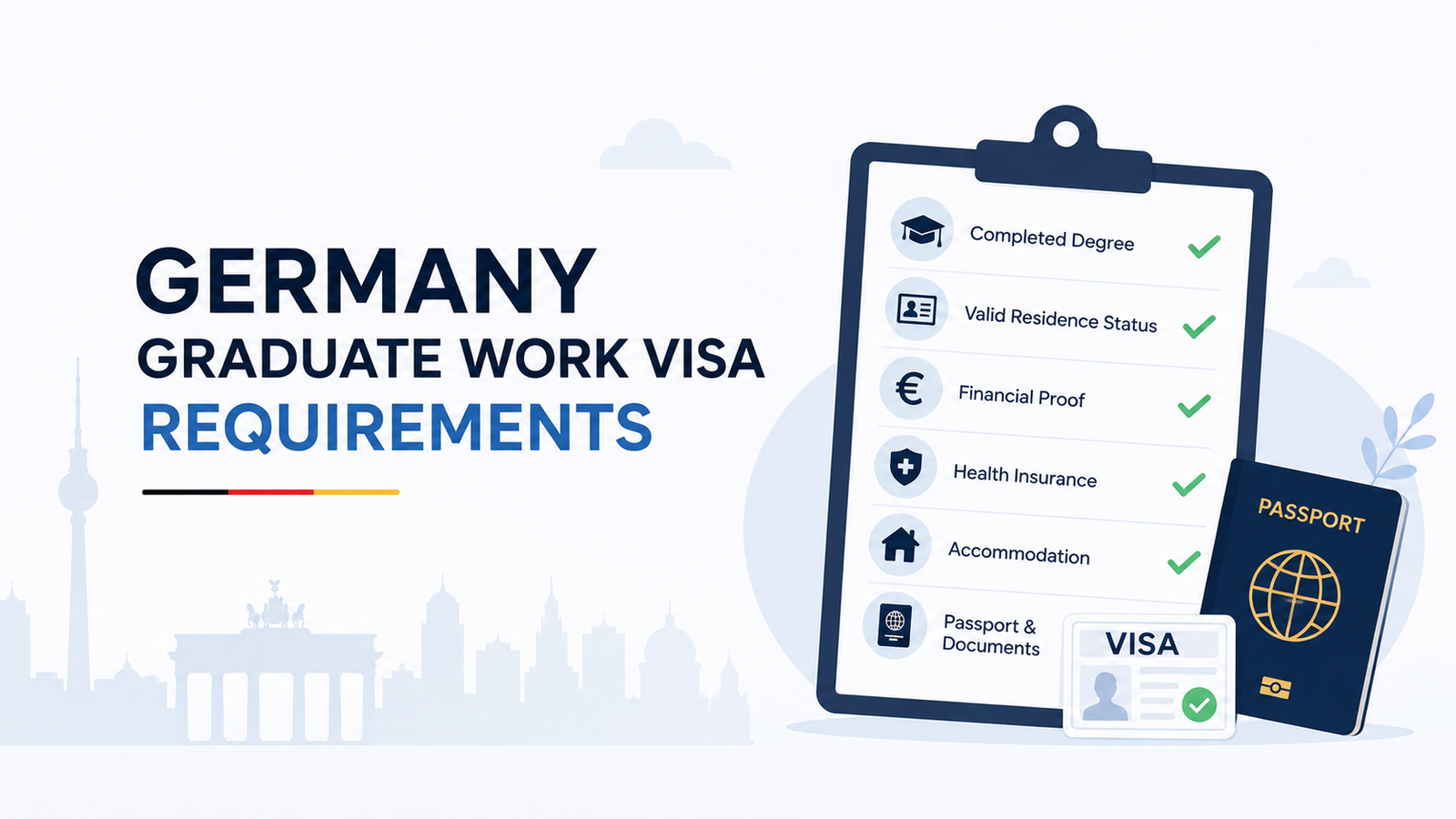
The exact document checklist can vary by city and local immigration office, but the core requirements are usually consistent. You must show that you completed your studies in Germany, can support yourself, have health insurance, and applied while you still have lawful residence.
| Requirement | What It Usually Means | Common Risk |
|---|---|---|
| Completed German degree | Degree certificate, final transcript, or official university confirmation that all requirements were completed. | Waiting for the diploma ceremony when a formal completion confirmation may already be available. |
| Valid residence status | You normally apply while your student residence permit is still valid. | Applying late after expiry may create avoidable legal-status problems. |
| Secured livelihood | Savings, employment income, blocked account, sponsor support, or other acceptable proof depending on the authority. | Assuming one city's financial-proof practice applies everywhere. |
| Health insurance | Statutory or adequate private health insurance valid in Germany. | Relying on travel insurance or incomplete coverage. |
| Address registration | Current Anmeldung/Meldebescheinigung and housing details. | Not updating address registration before the appointment. |
| Passport and biometric data | Valid passport, biometric photo, application form, and fee. | Submitting a passport that expires too soon. |
When Does the 18 Month Period Start?
Students often assume the 18 months starts when the physical residence permit card is printed. That is not a safe assumption. The period is connected to completion of studies and the authority’s decision on the new residence purpose. Local authorities may rely on your official university confirmation, final transcript, or degree completion date.
For planning, do not wait for the graduation ceremony if your university can issue written proof that you have completed all requirements. Ask your university’s examination office or international office which document the local Ausländerbehörde usually accepts.
Practical timing rule
Begin preparing as soon as you know when your final exam result or completion confirmation will be available. Appointment shortages are common in many cities, and waiting until the last few weeks of your student permit can create unnecessary stress.
Stay in Germany After Degree 2026: What You Can and Cannot Do
The 18 month permit gives graduates far more flexibility than the normal student work rules. However, that flexibility should not be misunderstood. It helps you survive financially and search for work; it does not remove the need to qualify for a proper long-term residence title later.
| During the 18-Month Job Search Period | After You Find a Long-Term Pathway |
|---|---|
| You may generally work in any type of job to support yourself. | You must switch to the residence title that matches your long-term activity. |
| The job does not necessarily need to match your degree during the search phase. | For EU Blue Card, the job must match your qualification and salary rules. |
| Self-employment may be possible during the search period in some local guidance. | Long-term freelancing or business residence requires the proper self-employment/freelance permit. |
| The permit is temporary and not renewable for further job search. | You need skilled employment, Blue Card, self-employment, further study, research, or another legal basis. |
Can You Work Any Job During the 18 Month Period?
Yes, the post-study job search residence permit generally allows graduates to take up any type of job during the 18 month search period. This is important because many graduates need income while applying for qualified positions. A temporary retail, hospitality, delivery, support, tutoring, or administrative job may help cover living expenses.
However, that temporary job is not always enough for a long-term work residence title. The long-term transition depends on the next permit category. A skilled worker residence permit, EU Blue Card, or self-employment permit will have its own requirements.
Do not confuse income support with immigration strategy
A job that pays rent during the search phase may be useful, but your residence future usually depends on securing qualified employment, building a viable business case, starting further study, or qualifying under another lawful route.
Aufenthaltserlaubnis zur Arbeitssuche Germany: Reapplication and Extension Limits
The post study job search permit is usually issued for up to 18 months and is not extendable beyond that for the same job search purpose. If the 18 months ends and you have not moved into another valid residence title, you may need to leave Germany or identify another lawful basis for residence.
This is why graduates should not treat the first six months casually. Job applications, CV adaptation, German style interviews, networking, LinkedIn/XING optimization, and employer education about residence titles should begin early.
Can You Switch from Student Permit to EU Blue Card Germany Graduate?
Yes. If you secure a qualifying job offer, you may be able to switch from student or post study job-search status to the EU Blue Card from within Germany. The EU Blue Card is attractive because it offers strong work rights, employer mobility rules after an initial period, family advantages, and a faster potential settlement pathway.
| EU Blue Card Requirement | 2026 Planning Point |
|---|---|
| Specific job offer | The employment contract or concrete offer must generally be for at least six months. |
| Qualification match | The job must correspond to your academic qualification. Regulated professions need licensing or it must be in prospect. |
| Standard salary threshold | EUR 50,700 gross annual salary in 2026. |
| Lower threshold | EUR 45,934.20 in 2026 for shortage occupations and new entrants to the labour market, subject to applicable conditions and BA approval where required. |
| Recent graduate advantage | If your last degree was obtained less than three years ago, you may qualify under the lower threshold as a new entrant if the other conditions are met. |
Skilled Worker Permit vs EU Blue Card After Graduation
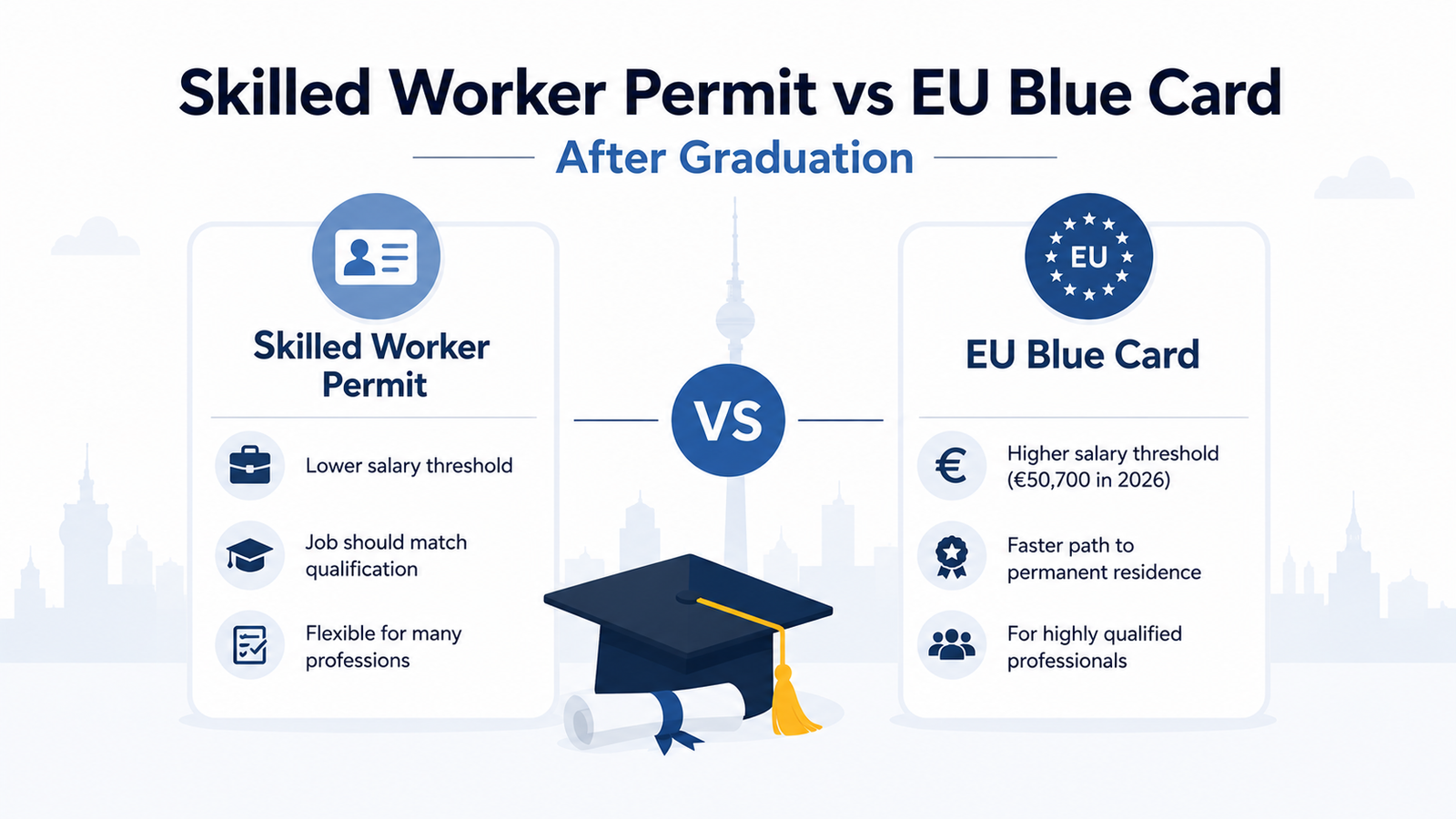
Not every graduate needs or qualifies for an EU Blue Card. Some graduates may use a skilled worker residence permit instead. The best route depends on salary, job match, profession, qualification, employer documentation, and whether the occupation is regulated.
| Route | Best For | Key Issue |
|---|---|---|
| EU Blue Card | Graduates with a degree-matching job offer meeting salary thresholds. | Salary threshold and qualification match are central. |
| Skilled worker residence permit | Graduates with qualified employment that may not meet Blue Card salary levels. | Authorities assess job, qualification, salary sufficiency, and work conditions. |
| Self-employment/Freelance residence permit | Graduates building a business or freelance career. | Needs a separate business/freelance residence strategy, not just the job-search permit. |
| Further study or doctorate | Graduates moving to a Master's, PhD, or research route. | Must fit the new academic or research purpose and documentation. |
| Opportunity Card | Usually less advantageous for graduates already eligible for the 18-month post-study route. | Opportunity Card job-search rules are more limited than the graduate job-search permit. |
Can You Start a Business or Freelance After Graduation?
This is an area where students receive oversimplified advice. Some local guidance, including Berlin’s comparison with the Opportunity Card, states that the post study job search permit can allow gainful employment including self-employment. However, that does not mean a graduate can automatically remain long-term as a freelancer or company founder without changing to the correct residence title.
If your long-term plan is self-employment, freelancing, or a start-up, treat the 18 month period as preparation time. You may need a business plan, client contracts, financing evidence, tax registration, professional qualifications, and proof that the activity can support your livelihood. For a long-term self-employment residence permit, the authority assesses the business venture under separate rules.
Practical founder warning
Do not wait until month 17 to ask whether your start-up qualifies. Build documentation early, speak with a start-up advisory service, and verify the local Ausländerbehörde’s expectations for self-employment or freelance residence.
Fiktionsbescheinigung: Can You Work While Waiting for the Card?
If you apply before your current residence permit expires, the Ausländerbehörde may issue a confirmation or Fiktionsbescheinigung while your application is pending. This can protect lawful residence during processing, but you must read the wording carefully.
Do not assume every temporary document has the same work authorization. Before starting or continuing employment, check whether the document states that employment or gainful activity is permitted. Employers may also ask to see the temporary document before allowing you to begin work.
Documents to Prepare Before Your Ausländerbehörde Appointment
| Document | Why It Matters |
|---|---|
| Application form or online application confirmation | Shows you have formally applied for the new residence purpose. |
| Valid passport | Required for identity and residence documentation. |
| Current student residence permit | Shows your current lawful status. |
| Proof of graduation | Degree certificate, final transcript, or university confirmation of successful completion. |
| Health insurance proof | Foreign travel insurance is usually not enough for residence purposes. |
| Proof of livelihood | Savings, income, sponsor evidence, blocked account, or other accepted proof. |
| Anmeldung/Meldebescheinigung | Confirms your registered address in Germany. |
| Rental agreement or housing proof | May be requested by the local authority. |
| Biometric photo | Needed for the residence permit card or application file. |
| Fee payment method | Fees vary by authority and document format. |
Common Mistakes Graduates Make After Completing Studies
- Waiting for the diploma ceremony instead of asking for an official completion confirmation.
- Assuming the 18 month permit is automatic and requires no application.
- Letting the student residence permit expire before filing the next application.
- Taking any job and assuming it automatically qualifies for a long-term work permit.
- Ignoring EU Blue Card salary thresholds until after signing a contract.
- Not checking whether the job actually matches the degree for Blue Card purposes.
- Planning a start-up without preparing a separate self-employment residence strategy.
- Assuming a Fiktionsbescheinigung always allows the same work rights without reading the document.
- Failing to keep health insurance continuous after graduation.
- Not planning permanent residence requirements such as pension contributions and German language early enough.
Germany Niederlassungserlaubnis After Work: How Graduates Should Think Long-Term
Graduates should not only ask whether they can stay for 18 months. They should also ask how the next title affects permanent residence. Germany offers facilitated settlement routes for certain groups, including EU Blue Card holders and people who completed higher education or vocational training in Germany and later hold a skilled worker residence title.
| Long-Term Route | Settlement Planning Point |
|---|---|
| EU Blue Card | Settlement may be possible after 27 months of qualified employment and pension contributions, or 21 months with B1 German, if other requirements are met. |
| Skilled worker title after German studies | Graduates of German higher education may qualify after two years on an employment residence title as a skilled worker, with 24 months of pension contributions and other requirements. |
| Self-employment | A self-employed person may have a separate settlement route after three years if the business is sustainable and livelihood is secured. |
| General long-term residence | Other routes may require longer residence, income stability, language, housing, integration knowledge, and pension contribution history. |
Applicant Scenarios: Which Route Fits After Graduation?
| Graduate Profile | Possible Route | Key Issue | Mistake to Avoid |
|---|---|---|---|
| Master's graduate with a software job offer | EU Blue Card or skilled worker permit | Salary threshold and job-degree match | Accepting a low salary without checking Blue Card rules. |
| Business graduate with internship converting to job | Skilled worker permit or Blue Card if salary qualifies | Concrete contract and sufficient income | Assuming internship status is enough for long-term residence. |
| Graduate still searching for career role | 18-month job-search residence permit | Proof of livelihood and timely filing | Waiting until the student permit expires. |
| Graduate launching a start-up | Job-search permit first, then self-employment permit if viable | Business plan, clients, financing, tax setup | Assuming any side business guarantees residence. |
| Graduate planning a PhD | Study/research residence title or employment/research route | Funding, university admission, work structure | Using the wrong permit for the actual activity. |
When AGS Welt Germany Can Help
If you are close to graduation, AGS Welt Germany can help you review your post study route before you lose time. A structured review can identify whether your next step should be the 18 month job-search permit, EU Blue Card, skilled worker residence permit, self-employment route, further study, or another lawful pathway.
This support is especially useful if you have a job offer with uncertain salary eligibility, a delayed Ausländerbehörde appointment, a start-up plan, family members in Germany, or confusion about which residence title fits your long-term goal.
General Information Disclaimer
This article provides general information and should not be treated as personalized legal advice. Requirements can vary depending on nationality, city, residence history, degree, job offer, salary, profession, family situation, and the responsible Ausländerbehörde. Applicants should verify current rules with official sources or seek professional guidance before applying.
FAQs Section
Yes. Non-EU graduates of German universities may generally apply for an 18-month residence permit to look for qualified employment, if they meet the requirements and apply in time.
The post-study job-search residence permit is usually valid for up to 18 months and is not renewable for the same job-search purpose.
Most graduates apply inside Germany for a residence permit to seek qualified employment after completing studies. It is commonly called a post-study work visa, but it is usually a residence permit extension.
Yes. If you obtain a qualifying job offer, you may apply to switch to a skilled worker residence permit or EU Blue Card without leaving Germany.
It is a residence permit allowing graduates of German institutions to remain in Germany for up to 18 months to seek qualified employment.
Generally yes. The 18-month post-study job-search permit allows graduates to take up any gainful employment during the search period, but long-term residence requires another qualifying title.
Some local guidance allows self-employment during the post-study job-search permit, but long-term freelancing or business activity requires a separate residence strategy and approval under the correct route.
Yes, if you have a qualifying job offer, the job matches your qualification, and the salary meets the applicable 2026 EU Blue Card threshold.
You generally need another lawful residence basis, such as employment, further study, research, self-employment, or another eligible route. Otherwise, you may have to leave Germany.
Yes. Continuous adequate health insurance is normally required for residence permits in Germany, including the 18-month post-study job-search permit.